
Showing posts with label Essay. Show all posts
Showing posts with label Essay. Show all posts
Thursday, April 19, 2018
Postscript
As an addendum to my recent cri de coeur, I offer this chart:
Note that this chart is inflation-adjusted. I took it from this article, which is well worth reading.

Friday, March 23, 2018
Essay: What Trump Voters Got Right
I am not a Donald Trump enthusiast. I do, however, think it's useful to assess Trumpism in an analytical, detached fashion (blame this guy), as opposed to the hyper-partisan mode of . . . well . . . everyone else. Trumpism is not an inexplicable force of nature. Further, while there are bad people among Trump voters, they are not universally bad, nor does it follow that they are all wrong about everything.
I think Trump voters are reacting--at least some of them, some of the time--to a genuine problem. I don't think they've chosen a good solution, but that doesn't mean that the problem isn't there. Specifically:
I think Trump voters are reacting--at least some of them, some of the time--to a genuine problem. I don't think they've chosen a good solution, but that doesn't mean that the problem isn't there. Specifically:
- The system is in need of radical (in the sense of Latin radix, "root") reform.
- The system is designed to make radical reform impossible.
- The project been legally mandated since 1990.
- The MBTA already owns the right-of-way, which runs alongside the commuter rail tracks.
- It's supported by virtually everybody.
- It doesn't require any tunnels or complex engineering.
- It's even genuinely useful.
The line is 4.7 miles long. In the 9,944 days since December 31, 1990, the amount of track that has been laid along that 4.7 miles is zero feet, zero inches. If I could snap my fingers and have the line completed overnight, the average rate of construction would have been just about thirty inches per day.
Of course, the line won't be completed overnight. After the MBTA fired its original contractor, it took them 23 months just to name a replacement. Naturally, no work whatsoever happened in the interim.
Consider that from 1863 to 1869 this country built a railroad from Omaha to Sacramento using black powder, mules, and human muscles. Obviously things were a lot different there and then, and there was both enormous waste and grave injustice involved . . . but still. In six years, the Pacific Railroad laid 1,868 miles of track. In the six years since the so-called "ground-breaking" of the Green Line extension, we've paid a lot of money for virtually nothing.
Multiply that by all the things that the federal and state governments do, and you get the kind of institutional sclerosis that lets the nationalist populist authoritarians take over.
By the way, I think my prognostications here were pretty accurate. Just saying.
Sunday, May 21, 2017
Book Review/Essay: You Say to Brick
You Say to Brick: The Life of Louis Kahn
Wendy Lesser
Biography, architecture
In some ways I am the wrong reader for this book. I knew that going in. Louis Kahn was a modernist, and I'm not a fan of modernism in any artistic form. For that matter, I didn't know much about Kahn other than his name; the only Kahn building I've been in is the Kimbell Art Museum, and I can't say that the building itself particularly struck me one way or another.
But then I thought: knowledge is what you're supposed to get out of a book, not what you're supposed to bring into it.
By that measure, You Say to Brick was a partial success. I learned a good deal about Louis Kahn himself, his family, and his architectural practice--none of it especially deep, but all of it informative. I learned some about what Kahn himself thought he was doing. I did not learn to love Kahn's buildings. I also did not learn to love Wendy Lesser's writing, which is itself an example of some of the failings of modernism.


How about these? They're both educational institutions. One is described in You Say to Brick as Kahn's crowning achievement. The other comes from a Travel and Leisure article entitled "America's Ugliest College Campuses".

 If you're not certain, You Say to Brick will offer no clarity. It offers nothing more than bare assertions about the wonderfulness of Kahn's designs. To be fair, a good deal of Lesser's enthusiasm goes towards the interiors, rather than the exteriors. However, that leads me to . . .
Wendy Lesser
Biography, architecture
In some ways I am the wrong reader for this book. I knew that going in. Louis Kahn was a modernist, and I'm not a fan of modernism in any artistic form. For that matter, I didn't know much about Kahn other than his name; the only Kahn building I've been in is the Kimbell Art Museum, and I can't say that the building itself particularly struck me one way or another.
But then I thought: knowledge is what you're supposed to get out of a book, not what you're supposed to bring into it.
By that measure, You Say to Brick was a partial success. I learned a good deal about Louis Kahn himself, his family, and his architectural practice--none of it especially deep, but all of it informative. I learned some about what Kahn himself thought he was doing. I did not learn to love Kahn's buildings. I also did not learn to love Wendy Lesser's writing, which is itself an example of some of the failings of modernism.
The Buildings
One of these buildings was acclaimed as a Kahn masterpiece, "the most consequential building constructed in the United States". The other is the #11 Google image result of a search for "ugliest building ever". Can you tell which is which?
How about these? They're both educational institutions. One is described in You Say to Brick as Kahn's crowning achievement. The other comes from a Travel and Leisure article entitled "America's Ugliest College Campuses".


The Writing
The body of the book, to be honest, is fine. It's a straight biography, a bit light on analysis, but perfectly clear. There are, however, two major things that I found objectionable.
- Between major sections of the book, Lesser puts descriptions of a number of Kahn interiors, which she writes in the second person present. "You" enter here, "you" see this, "you" react this way. This is pointless, stupid, and irritating. In the first place, it's not true; it's just Wendy Lesser's way of experiencing the building, not mine. In the second place, it's a condescending way of dictating an aesthetic experience. In the third place, it's unverifiable. In the fourth place, it's hard to read. The use of the second-person present adds nothing, conveys nothing, explains nothing.
- Kahn had scars on his face. Lessing mentions this right up front, and alludes to it occasionally in the text, but doesn't explain what caused it until the very last page. (He was burned when he was three years old.) For the love of God, what purpose is served by this cutesy trick? This isn't Citizen Kane; we're not waiting with bated breath for this sudden flash of illumination that changes everything that has gone before. The scars don't seem to have figured heavily in Kahn's life; they didn't stop him having children by three different women in parallel, for example. There is literally no earthly reason to save this information to the end except to try to impress the reader with how clever your technique is. Once again: it adds nothing, conveys nothing, explains nothing.
I'm harping on these venial sins because they're an example of what's wrong with modernism. In Wendy Lesser's mind, apparently, it's no longer enough to write a book that's clear and informative and readable. Equally, it's no longer acceptable to design buildings that mere commoners will enjoy looking at, or write "classical music" that sounds like classical music, or paint pictures that look like anything whatsoever. Doing any of those things lets ordinary people criticize the substance of what you've done. If you draw a portrait of Benjamin Franklin and it ends up looking like Bozo the Clown, some pedant is sure to kvetch. Who wants that? The modernist idiom turns the tables: it lets you criticize anyone who fails to understand your brilliance, on the basis that they're obviously bourgeois, middle-brow, anti-intellectual, old-fashioned, counterrevolutionary, not transgressive, timid, etc.
Very well. I give you, then, my own architectural design. I warn you in advance that it is not merely transcendantly brilliant, but radical, daring, and visionary. It will challenge you. It vastly outstrips the outmoded and petty concepts of Le Corbusier, Kahn, and van der Rohe, to say nothing of such populist parvenus as Pei, Libeskind, and Gehry. It is nothing less than post-post-postmodern, ironic, witty, reverential, breathtaking, and--in the most overworked adjective of the last architectural century--iconic. If you disagree, you clearly have no artistic taste whatsoever.

Prove me wrong.
Very well. I give you, then, my own architectural design. I warn you in advance that it is not merely transcendantly brilliant, but radical, daring, and visionary. It will challenge you. It vastly outstrips the outmoded and petty concepts of Le Corbusier, Kahn, and van der Rohe, to say nothing of such populist parvenus as Pei, Libeskind, and Gehry. It is nothing less than post-post-postmodern, ironic, witty, reverential, breathtaking, and--in the most overworked adjective of the last architectural century--iconic. If you disagree, you clearly have no artistic taste whatsoever.

Prove me wrong.
Wednesday, November 9, 2016
Uncharted Waters
WARNING: politics ahoy.
I am not a historian, but I do read a good many history books. What follows is my best attempt at analyzing what's going on in the wake of Donald Trump's election. I'm specifically trying to be factual rather than polemical, but obviously my prejudices will color my conclusions.
So now what? Well, whatever else it may be, Trumpism is manifestly:
The United States has never before had a mass nationalist-populist-authoritarian political movement--at least, not one with this kind of power. Andrew Jackson came close, but Jackson in the 1820s was at least in harmony with his own political party. Huey Long took some steps in that direction before he was assassinated. The 19th-century "Know-Nothings" were profoundly nativist, and (briefly) had significant political power, but they didn't have the other characteristics.
So, as the title says: we're in uncharted waters.
However: other nations have had, and continue to have, nationalist-populist-authoritarian political parties. Historical comparisons are unavoidably fraught with emotion, but there are plenty of current examples. Consider Hugo Chavez in Venezuela, Recep Tayyip Erdogan in Turkey, and (no avoiding this one) Vladimir Putin in Russia. To find out what's in store for the U.S., we can look at these. I draw these conclusions:
I am not a historian, but I do read a good many history books. What follows is my best attempt at analyzing what's going on in the wake of Donald Trump's election. I'm specifically trying to be factual rather than polemical, but obviously my prejudices will color my conclusions.
So now what? Well, whatever else it may be, Trumpism is manifestly:
- Nationalist, in that it embraces an "America First" ideology;
- Populist, in that it stokes up and harnesses anger directed at elites; and
- Authoritarian, in that an admiration for "strength" seems to be a core belief both for Trump and for his followers.
The United States has never before had a mass nationalist-populist-authoritarian political movement--at least, not one with this kind of power. Andrew Jackson came close, but Jackson in the 1820s was at least in harmony with his own political party. Huey Long took some steps in that direction before he was assassinated. The 19th-century "Know-Nothings" were profoundly nativist, and (briefly) had significant political power, but they didn't have the other characteristics.
So, as the title says: we're in uncharted waters.
However: other nations have had, and continue to have, nationalist-populist-authoritarian political parties. Historical comparisons are unavoidably fraught with emotion, but there are plenty of current examples. Consider Hugo Chavez in Venezuela, Recep Tayyip Erdogan in Turkey, and (no avoiding this one) Vladimir Putin in Russia. To find out what's in store for the U.S., we can look at these. I draw these conclusions:
- These regimes tend to become repressive over time. The weaker the nation's civil and political institutions, the faster the repressiveness comes. If anyone has an example of a nationalist-populist-authoritarian regime which has not tended toward repression, please leave me a comment.
- A core constituency develops whose members will never under any circumstances turn on the leader. It doesn't matter how far the leader goes or in what direction. As long as they feel that the Strong Man stays strong, his adherents will follow him.
- When I say "the leader," I mean "the leader." It's not a group or an explicit ideology that animates the movement. It's hero-worship of a particular man. (I can't come up with a single female example off the top of my head.)
- The leader usually surrounds himself with loyalists. They may be competent or incompetent; that's neither here nor there to the boss. They are never strong enough to stand up to the autocrat in their own right, but they often use their position to build up their own power bases.
- Once in power, the regime takes steps to remain in power. Opposition politicians, bureaucrats, judges, and so forth are removed or neutralized. Non-core or borderline supporters are forced to choose: join the movement, or be purged. The vast majority of them join.
The third bullet is another interesting point. Trump is seventy years old. Strong-man leaders don't have a great record of transferring their authority to anyone else (Nicolas Maduro and Dmitriy Medvedev are cases in point). We're probably still too early in the process for him to pull off a family dynasty a la North Korea or Syria. Prognosis: unknown.
Finally, the U.S. has generally had strong civil institutions. It may be that they will check the repressive tendencies of the neo-Republican/Trumpist movement, or at least slow it down--through sheer inertia, if nothing else. Barring a major policy blunder, however, I think we are likely to see our politics dominated by mobs of insecure and angry white people for some time to come.
Saturday, September 24, 2016
Book Review/Essay: Behind That Curtain
Behind That Curtain
Earl Derr Biggers
Mystery
This was my first exposure to Charlie Chan. I'd never read any of the books, nor seen any of the movies. I came in with no strong personal opinion, but with the knowledge that the character is often regarded as a racist caricature.
That view isn't wrong, but it isn't complete either. Charlie Chan is a comic character, but then many fictional detectives are comic characters. Think of Lt. Columbo, or the early Lord Peter Wimsey, or--most especially--of Hercule Poirot. Like Poirot, Chan says and does things that are funny, or he says and does them in funny ways. He's full of minor malapropisms. Behind That Curtain came out in 1928; so did Christie's masterpiece The Murder of Roger Ackroyd. Here are some quotes from each book.
In similar fashion, Chan has a collection of eccentricities and fussy little habits. He often emits little bits of faux-Chinese wisdom. He addresses others with exaggerated humility (in one case, indeed, it's obviously sarcastic). All this is typical of a comic-detective character, like Columbo with his car and his raincoat and his "There's just one more thing . . ." shtick.
So Chan is funny; but he's not being made fun of. The characters in the book don't condescend to Chan. On the contrary, they refer to him as a genius, as a great detective--indeed, as a respectable peer for Sir Frederic Bruce, former head of Scotland Yard. The exception is the one character who's depicted negatively: an American policeman. Needless to say, it's Chan and not Inspector Flannery who solves the case.
Nonetheless, there's an element of racism. Poirot is foreign; Chan is alien. Poirot is eccentric because he's from another country. Chan is different because he is "a Chinese". This is the kind of book that takes it for granted that you can say "The Chinese are . . . " (as well as "The Americans are . . .") and have it generally applicable: "The Chinese are a nocturnal people." Americans "smile", but Chinese "grin". However admirable he may be, Charlie Chan is other in a way that Hercule Poirot is not.
This wasn't an uncommon attitude in the 1920s, even among so-called progressives. The idea that race was a real and immutable thing, rather than a gauzy psycho-social fiction, was mainstream. Liberals tended to argue, not that other races were like Europeans, but that they were different yet equivalent. Not just white Americans, but black Americans, gave voice to this in the U.S.--the classic book When Harlem Was in Vogue has some startling examples.
In the end, I personally was able to read Behind That Curtain through mental corrective lenses. I found that I could give Earl Derr Biggers credit for trying to portray a Chinese detective in a positive way--certainly in contrast to a lot of contemporary literature--and de-escalate the bits that grate against a 21st-century sensibility. I wouldn't blame anyone who felt otherwise, though.
As a book qua book, it's readable. The writing is at a young adult level: simple sentences, not too much description, no mood, strongly one- or zero-dimensional characters. The story moves along at a good clip. There are a few too many characters, and the final resolution depends a bit too much on coincidence, but it's not without cleverness. Although Earl Derr Biggers was no Agatha Christie, I've read substantially worse.
Earl Derr Biggers
Mystery
This was my first exposure to Charlie Chan. I'd never read any of the books, nor seen any of the movies. I came in with no strong personal opinion, but with the knowledge that the character is often regarded as a racist caricature.
That view isn't wrong, but it isn't complete either. Charlie Chan is a comic character, but then many fictional detectives are comic characters. Think of Lt. Columbo, or the early Lord Peter Wimsey, or--most especially--of Hercule Poirot. Like Poirot, Chan says and does things that are funny, or he says and does them in funny ways. He's full of minor malapropisms. Behind That Curtain came out in 1928; so did Christie's masterpiece The Murder of Roger Ackroyd. Here are some quotes from each book.
| Chan | Poirot |
|---|---|
| A four-horse chariot could not have dragged me in an opposite direction. | The good dog, he does not leave the scent, remember! |
| I am torn with grief to disagree. | I demand of you a thousand pardons, monsieur. |
| This last story illuminates darkness. | The affair marches, does it not? |
| Your words have obscure sound. | The word exact, you are zealous for it. |
In similar fashion, Chan has a collection of eccentricities and fussy little habits. He often emits little bits of faux-Chinese wisdom. He addresses others with exaggerated humility (in one case, indeed, it's obviously sarcastic). All this is typical of a comic-detective character, like Columbo with his car and his raincoat and his "There's just one more thing . . ." shtick.
So Chan is funny; but he's not being made fun of. The characters in the book don't condescend to Chan. On the contrary, they refer to him as a genius, as a great detective--indeed, as a respectable peer for Sir Frederic Bruce, former head of Scotland Yard. The exception is the one character who's depicted negatively: an American policeman. Needless to say, it's Chan and not Inspector Flannery who solves the case.
Nonetheless, there's an element of racism. Poirot is foreign; Chan is alien. Poirot is eccentric because he's from another country. Chan is different because he is "a Chinese". This is the kind of book that takes it for granted that you can say "The Chinese are . . . " (as well as "The Americans are . . .") and have it generally applicable: "The Chinese are a nocturnal people." Americans "smile", but Chinese "grin". However admirable he may be, Charlie Chan is other in a way that Hercule Poirot is not.
This wasn't an uncommon attitude in the 1920s, even among so-called progressives. The idea that race was a real and immutable thing, rather than a gauzy psycho-social fiction, was mainstream. Liberals tended to argue, not that other races were like Europeans, but that they were different yet equivalent. Not just white Americans, but black Americans, gave voice to this in the U.S.--the classic book When Harlem Was in Vogue has some startling examples.
In the end, I personally was able to read Behind That Curtain through mental corrective lenses. I found that I could give Earl Derr Biggers credit for trying to portray a Chinese detective in a positive way--certainly in contrast to a lot of contemporary literature--and de-escalate the bits that grate against a 21st-century sensibility. I wouldn't blame anyone who felt otherwise, though.
As a book qua book, it's readable. The writing is at a young adult level: simple sentences, not too much description, no mood, strongly one- or zero-dimensional characters. The story moves along at a good clip. There are a few too many characters, and the final resolution depends a bit too much on coincidence, but it's not without cleverness. Although Earl Derr Biggers was no Agatha Christie, I've read substantially worse.
Friday, June 24, 2016
The Spirit of '16
[WARNING: politics (Irish, though)]
2016 is the 100-year anniversary of the Easter Rising. If that doesn't ring many bells with you, the short version is that it's roughly the Irish equivalent of Lexington and Concord plus July 4, 1776. Not surprisingly, Ireland is in all-out commemorative mode.
I've just come back from there. I didn't discuss Irish politics, much less sing Irish political songs. It's not my business to visit another country and tell them how to run it, or how to understand its past. Now that I'm back, though, I have some thoughts.
There's a standard narrative of the 1916 Rising. The rebels are heroic visionaries, and their actions--however destructive in the short term--are ultimately justified by History. The corollary is that there was no better way to achieve this righteous outcome.
It's always comforting to believe this sort of thing. We Americans have a similar standard narrative. Here's one difference, though: the American Revolution was a revolution of ideas*. We didn't invoke a mystical moral right of nationhood based on territory or ethnicity or identity. We invoked, rather, an idea--the idea that monarchy is wrong in principle. We didn't just reject what Britain was doing; we rejected the philosophical basis for doing it.
Reading the Proclamation of the Irish Republic, I see an assertion of an ethnic identity. I see a rejection of all things English/British. I see a lot of (justified) anger at centuries of British misrule and colonialism and exploitation**.
That wasn't the majority position at the time, either. From what I've read, the most popular Irish political parties in 1916 weren't separatists at all; they were advocates for Home Rule (now known as devolution). In other words, there plenty of people were willing to believe that they could be both British and Irish.
They may have been wrong. The government response to the Easter Rising convinced many of them that they were.

Still, as an American, I'm comfortable with the notion of a hyphenated identity. And as a reader of history, I don't buy the dictum that "war is the continuation of politics by other means." Political violence is failure. That's true in 1776, 1916, 1861, 1914, 1939 ... Sometimes, perhaps, the failure is inevitable; but inevitable failure is failure nonetheless.
*Yes, I am vastly oversimplifying here. I don't mean to imply that every Minuteman was a political philosopher, or that the public at large was motivated entirely by an abstract desire for a more just society. In every war, individuals fight for a wide variety of reasons. There is also a collective purpose at work, though, and it makes a difference.
**British practice and policy in Ireland were infinitely more destructive than anything that happened in the American colonies. Religious persecution, prejudice, social stratification, administrative incompetence, broken treaties ... you could cogently argue that Britain had already forfeited any moral right to exercise authority over Ireland. By contrast, Americans in 1775 were already the free-est, least-taxed people on earth.
2016 is the 100-year anniversary of the Easter Rising. If that doesn't ring many bells with you, the short version is that it's roughly the Irish equivalent of Lexington and Concord plus July 4, 1776. Not surprisingly, Ireland is in all-out commemorative mode.
I've just come back from there. I didn't discuss Irish politics, much less sing Irish political songs. It's not my business to visit another country and tell them how to run it, or how to understand its past. Now that I'm back, though, I have some thoughts.
There's a standard narrative of the 1916 Rising. The rebels are heroic visionaries, and their actions--however destructive in the short term--are ultimately justified by History. The corollary is that there was no better way to achieve this righteous outcome.
It's always comforting to believe this sort of thing. We Americans have a similar standard narrative. Here's one difference, though: the American Revolution was a revolution of ideas*. We didn't invoke a mystical moral right of nationhood based on territory or ethnicity or identity. We invoked, rather, an idea--the idea that monarchy is wrong in principle. We didn't just reject what Britain was doing; we rejected the philosophical basis for doing it.
Reading the Proclamation of the Irish Republic, I see an assertion of an ethnic identity. I see a rejection of all things English/British. I see a lot of (justified) anger at centuries of British misrule and colonialism and exploitation**.
We declare the right of the people of Ireland to the ownership of Ireland and to the unfettered control of Irish destinies, to be sovereign and indefeasible. The long usurpation of that right by a foreign people and government has not extinguished the right, nor can it ever be extinguished except by the destruction of the Irish people. In every generation the Irish people have asserted their right to national freedom and sovereignty; six times during the past three hundred years they have asserted it in arms.What I don't see is any assertion of principle. And that bothers me. In the century since 1916, we have seen too much cruelty based on metaphysical ethnic nationalism. Isn't this at least veering towards the principle of Volksgeminschaft? Irish = Not-British = Good, which in turn means that British = Evil, which in turn justifies anything.
That wasn't the majority position at the time, either. From what I've read, the most popular Irish political parties in 1916 weren't separatists at all; they were advocates for Home Rule (now known as devolution). In other words, there plenty of people were willing to believe that they could be both British and Irish.
They may have been wrong. The government response to the Easter Rising convinced many of them that they were.
Kilmainham Gaol, Dublin
Still, as an American, I'm comfortable with the notion of a hyphenated identity. And as a reader of history, I don't buy the dictum that "war is the continuation of politics by other means." Political violence is failure. That's true in 1776, 1916, 1861, 1914, 1939 ... Sometimes, perhaps, the failure is inevitable; but inevitable failure is failure nonetheless.
*Yes, I am vastly oversimplifying here. I don't mean to imply that every Minuteman was a political philosopher, or that the public at large was motivated entirely by an abstract desire for a more just society. In every war, individuals fight for a wide variety of reasons. There is also a collective purpose at work, though, and it makes a difference.
**British practice and policy in Ireland were infinitely more destructive than anything that happened in the American colonies. Religious persecution, prejudice, social stratification, administrative incompetence, broken treaties ... you could cogently argue that Britain had already forfeited any moral right to exercise authority over Ireland. By contrast, Americans in 1775 were already the free-est, least-taxed people on earth.
Monday, December 21, 2015
Spoiler-Free Notes on The Force Awakens
Yes, I saw the movie on its opening weekend. (Mainly because I don't want to have to leave the room while all my friends discuss it.) I may have some much more detailed spoiler-heavy analysis later. Here, however, are my first thoughts.
- It was, overall, pretty OK. (John Scalzi, as often happens, has a good analogy.) I went in with absolutely neutral expectations. I was not surprised either pleasantly or unpleasantly. I am not sorry to have seen it. I would not spend money to see it again.
- I specifically had no expectation of seeing anything that would have the kind of impact that the original had. It's not just that I'm REDACTED years older. When Star Wars came out in 1977, literally nobody had ever seen anything like it. What we think of as the SFX Blockbuster Movie Genre did not exist. Science fiction on the screen was still a niche, and not a respectable one either. The number of SF movies that were both critical and popular successes was one (the overrated 2001: A Space Odyssey).
- As a movie, it was vastly better than The Phantom Menace, which is the only one of the prequels I've seen. It was better than Return of the Jedi, which again is not the highest bar--I'm looking at you, Ewoks. I have a much more critical opinion of The Empire Strikes Back than most people seem to; I'd put this one not too far below it, or even on a level.
- As an exercise in nostalgia and fan-service, it was great! Look, sound, feel, and music all said Star Wars. If you want all your boxes checked off, The Force Awakens will check them. The cost of this, however, is that it's profoundly unimaginative and unoriginal--I'd even call it "derivative", verging on "rehash". To be clear, I'm not talking about the return of the original characters; I'm talking about the plot. There were some twists, but I'd guessed most of them (with, I admit, partial accuracy) weeks ago.
- The biggest script weakness is that there's nobody whose desires actually drive the story forward, which means that there's no real conflict--only characters running away and/or reacting to stuff. Compare to the original, where Luke is the protagonist, and the film revolves around his goals:
- When we meet him, he wants to get the hell off of Tattooine. But there is a conflict, because he also feels responsible to his aunt and uncle, and anyway it all seems impossible.
- After his family is killed, he wants to be a Jedi like his father and deliver R2-D2. But there is a conflict, because the Empire is hunting R2-D2 and, by extension, him.
- Once he gets to the Death Star, he wants to rescue the princess. But there is a conflict, because duh.
- In the climax, he wants to destroy the Death Star. But there is a conflict, because lasers and Tie fighters and the attack run and Darth Vader all disagree. (Notice, also, that the conflict between Vader's wants and Luke's wants gets more and more direct through the film.)
- The plot holes are moderately enormous. While watching the movie I could ignore them, and they didn't reduce my enjoyment substantially, which is the minimum that I ask.
Thursday, December 10, 2015
Book Review/Essay: The Fellowship
The Fellowship: The Literary Lives of the Inklings: J.R.R. Tolkien, C. S. Lewis, Owen Barfield, Charles Williams
Philip and Carol Zaleski
Literature, biography
The Fellowship is a readable, detailed, and sympathetic biography by a pair of Smith College professors. It's nice to see the Inklings get some scholarly attention, even if it's only a fraction of the attention that's been given to contemporaries such as the Bloomsbury Group. It's not, perhaps, for the casual reader; if your interest starts and ends with Middle-Earth and Narnia, you might want to work your way up to this one.
Inevitably, the coverage of the Inklings is uneven. Lewis and Tolkien get roughly equal time, with Lewis emerging as the driving force of the group. Williams and Barfield share a second tier. The remainder of the group, aside from Lewis's brother Warnie, gets only token attention.
To be honest, that's fine by me. I've read some Charles Williams, but in general I find him obscure and unengaging. I have read nothing by Barfield, and based on this account I'm unlikely to do so; each of us would consider the other as spouting tendentious gibberish. No doubt both men were genuinely deep and original thinkers, but they wrote for an audience of which I'm not a member.
If anything, that points out the genius of Lewis and Tolkien. Both of them were first-rate intellectuals (critical snobbery aside), and far more deeply versed in theology, literature, and philosophy than I will ever be. They put that depth into their writings; and yet both men--especially Tolkien--can be read for pure, unadulterated pleasure.
This, I think, is one of the two major divides between JRRT and the vast legions of schlock artists who've followed in his footsteps. You might not see the genuine depth of The Lord of the Rings, but you can still feel it. The sense of mingled loss and consolation, for example, that pervades the book isn't an accident; it's fundamental to Tolkien's Christian, Catholic, and Boethian philosophy.
The other (and related) major divide is that all the Inklings were fascinated by myths: how they work, why they work, and what they're good for. Commercial fantasy writers focus on the mere trappings of myth (swords, magic spells, divine power, etc.) without having the least idea of why. The result is a kind of literary placebo, which dulls the imagination rather than stimulating it. It is to the genuine stuff what Nabisco's "Chips Ahoy!" is to home-made chocolate cookies.
Confession: I've read my fair share of this writing. I hope never to do so again. Life's too short to spend it killing your own brain cells.
Humphrey Carpenter's J. R. R. Tolkien: A Biography is a good starting point for the curious. Lewis has had a good many studies of his life and work, but they've mostly taken a rather academic slant.
Philip and Carol Zaleski
Literature, biography
The Fellowship is a readable, detailed, and sympathetic biography by a pair of Smith College professors. It's nice to see the Inklings get some scholarly attention, even if it's only a fraction of the attention that's been given to contemporaries such as the Bloomsbury Group. It's not, perhaps, for the casual reader; if your interest starts and ends with Middle-Earth and Narnia, you might want to work your way up to this one.
Inevitably, the coverage of the Inklings is uneven. Lewis and Tolkien get roughly equal time, with Lewis emerging as the driving force of the group. Williams and Barfield share a second tier. The remainder of the group, aside from Lewis's brother Warnie, gets only token attention.
To be honest, that's fine by me. I've read some Charles Williams, but in general I find him obscure and unengaging. I have read nothing by Barfield, and based on this account I'm unlikely to do so; each of us would consider the other as spouting tendentious gibberish. No doubt both men were genuinely deep and original thinkers, but they wrote for an audience of which I'm not a member.
If anything, that points out the genius of Lewis and Tolkien. Both of them were first-rate intellectuals (critical snobbery aside), and far more deeply versed in theology, literature, and philosophy than I will ever be. They put that depth into their writings; and yet both men--especially Tolkien--can be read for pure, unadulterated pleasure.
This, I think, is one of the two major divides between JRRT and the vast legions of schlock artists who've followed in his footsteps. You might not see the genuine depth of The Lord of the Rings, but you can still feel it. The sense of mingled loss and consolation, for example, that pervades the book isn't an accident; it's fundamental to Tolkien's Christian, Catholic, and Boethian philosophy.
The other (and related) major divide is that all the Inklings were fascinated by myths: how they work, why they work, and what they're good for. Commercial fantasy writers focus on the mere trappings of myth (swords, magic spells, divine power, etc.) without having the least idea of why. The result is a kind of literary placebo, which dulls the imagination rather than stimulating it. It is to the genuine stuff what Nabisco's "Chips Ahoy!" is to home-made chocolate cookies.
Confession: I've read my fair share of this writing. I hope never to do so again. Life's too short to spend it killing your own brain cells.
Humphrey Carpenter's J. R. R. Tolkien: A Biography is a good starting point for the curious. Lewis has had a good many studies of his life and work, but they've mostly taken a rather academic slant.
Saturday, June 13, 2015
Book Review/Essay: Rendez-vous With Art and the Rationalist Temperament
Rendez-vous With Art
Philippe de Montebello, Martin Gayford
Art
A couple of men who really, really love Art go to museums and talk about what they see. Much dialogue ensues.
For me, Rendez-vous With Art is as much a sociological investigation as an artistic one. Now, I'm not a total philistine. I sometimes visit art museums voluntarily. I myself have committed acts of art, and even been paid for them. There are painters I admire greatly (Vermeer, Hopper) and painters I despise (Jackson Pollock, Roy Lichtenstein).
But I do not--I probably cannot--feel about art the way de Montebello and Gayford feel about Art.
I've never stood before a painting and felt ravished. I've never had the feeling that "this must be the best painting ever".
Perhaps this is another divide between the Romantic and the Enlightenment temperaments. For example, at one point, Philippe de Montebello says:
I would be willing to bet a moderate amount of money that the answer to the last question is no, by the way. Many studies have shown that people, including wine experts, can't tell the difference in blind testing between cheap wines and expensive ones--but when you tell them a wine is more expensive (even if it's not!) they enjoy it more.
Here's another example. De Montebello looks at this Assyrian relief (which, by the way, I agree is marvelous):

His reaction:
Perhaps these kinds of reactions are why I--like other engineers of my acquaintance--often prefer illustration to art. The distinction is artificial, and relatively recent, but I think it's a useful one. (I've done both.) Art, as it's currently understood, is an interior and subjective experience, and as such it's exceedingly vulnerable to group-think and critical faddism. Illustration is intended to give a clear, evocative picture. The ideal illustration is one that can be enjoyed by anyone, and will get a fairly consistent response across most viewers.
N. C. Wyeth, for example, was an illustrator, particularly beloved for his adventure book paintings. His wonderful pirate illustrations literally created the iconic "pirate look":

This is a terrific illustration. It's all surface--what you see is what it is--but what a wonderful surface it is!
His son Andrew Wyeth was an artist. His most famous painting is Christina's World:

Christina's World is intended as art. It leaves everything to the imagination of the viewer. We're free to project ourselves into the picture and react individually.
Nowadays illustration is considered rather coarse and lowbrow; "fine" art gets all the respect. Perhaps I'm limited by my Enlightenment-oriented, engineering-trained mind, but I can't help thinking that this attitude sells the illustrators short. To show a thing clearly, and show it in a way that it's not only beautiful but becomes more real than the reality, is no small matter.
Philippe de Montebello, Martin Gayford
Art
A couple of men who really, really love Art go to museums and talk about what they see. Much dialogue ensues.
For me, Rendez-vous With Art is as much a sociological investigation as an artistic one. Now, I'm not a total philistine. I sometimes visit art museums voluntarily. I myself have committed acts of art, and even been paid for them. There are painters I admire greatly (Vermeer, Hopper) and painters I despise (Jackson Pollock, Roy Lichtenstein).
But I do not--I probably cannot--feel about art the way de Montebello and Gayford feel about Art.
I've never stood before a painting and felt ravished. I've never had the feeling that "this must be the best painting ever".
Perhaps this is another divide between the Romantic and the Enlightenment temperaments. For example, at one point, Philippe de Montebello says:
There are may things to enjoy and ravish the eye in the works of Caravaggio's finest followers, but the image that will remain engraved in your memory, the picture that has shaken you, changed you, and that you will not forget, will be by Caravaggio.To which I immediately think: really? Have double-blind studies been done? If so, who was the control group, and what was the level of statistical significance achieved? And ... are you certain that that would be your reaction if you didn't know which picture was a genuine Caravaggio?
I would be willing to bet a moderate amount of money that the answer to the last question is no, by the way. Many studies have shown that people, including wine experts, can't tell the difference in blind testing between cheap wines and expensive ones--but when you tell them a wine is more expensive (even if it's not!) they enjoy it more.
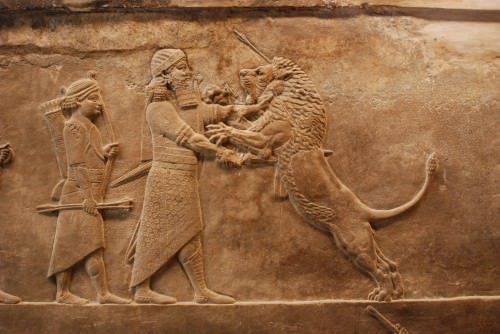
Here's another example. De Montebello looks at this Assyrian relief (which, by the way, I agree is marvelous):
(Image hosted at the Ancient History Encyclopedia)
His reaction:
The king is impassive, invincible ... The king has to be represented in a hieratic, predetermined and specific way ...My reaction: drawing people in lifelike action poses is hard (I know by personal experience). I bet it's a lot harder when you're working stone with early-Iron-Age tools. Maybe the king looks stiff because the artist had hit the limits of his skill.
Perhaps these kinds of reactions are why I--like other engineers of my acquaintance--often prefer illustration to art. The distinction is artificial, and relatively recent, but I think it's a useful one. (I've done both.) Art, as it's currently understood, is an interior and subjective experience, and as such it's exceedingly vulnerable to group-think and critical faddism. Illustration is intended to give a clear, evocative picture. The ideal illustration is one that can be enjoyed by anyone, and will get a fairly consistent response across most viewers.
N. C. Wyeth, for example, was an illustrator, particularly beloved for his adventure book paintings. His wonderful pirate illustrations literally created the iconic "pirate look":

This is a terrific illustration. It's all surface--what you see is what it is--but what a wonderful surface it is!
His son Andrew Wyeth was an artist. His most famous painting is Christina's World:

(Image hosted by the Museum of Modern Art)
Christina's World is intended as art. It leaves everything to the imagination of the viewer. We're free to project ourselves into the picture and react individually.
Nowadays illustration is considered rather coarse and lowbrow; "fine" art gets all the respect. Perhaps I'm limited by my Enlightenment-oriented, engineering-trained mind, but I can't help thinking that this attitude sells the illustrators short. To show a thing clearly, and show it in a way that it's not only beautiful but becomes more real than the reality, is no small matter.
Monday, June 8, 2015
The Meaning of Life, Part II
In re: one of my recent reviews, my faithful correspondent Sean asked:
Conventional evolution--the "Darwinian Synthesis"--notes that the gene, rather than the individual, is the unit of selection. That is, evolution operates by killing off some genes and replicating others. The organism is simply the vehicle.
However, biologists have long argued about the evolution of certain traits that don't seem to favor the reproductive success--and, hence, the genes--of the individuals who have them. The classic conundrum is altruism. If you jump into a raging river to save a drowning person, you are much more likely to die than if you watch dispassionately from the shore. Yet altruism is a human universal, and has been observed in other species as well. Why have not those genes been eliminated?
One simple answer is group selection. The naive version goes like this: Yes, your genes will perish. But your tribe is stronger because you are willing to do this. Your tribe will cooperate more, save each others' lives, and therefore outcompete other, less-altruistic tribes. This model imagines natural selection operating at the levels of groups: better-adapted groups thrive, worse-adapted groups don't.
This is intuitive. The problem is that the math doesn't seem to support it. The benefit to the group has to be implausibly huge, and the risk tiny, for these genes to survive. The reason is that you're directly competing with people within your group, and compared to them, you, Mr. Altruist, are a total loser. As in, you are dead, rendering your further reproductive success highly doubtful
A somewhat different explanation, which came to prominence in the 1960s and 1970s, is called kin selection, or inclusive selection. Kin selection says, basically, that altruism is disguised selfishness. Your genes are willing to risk themselves to the extent that the victim in the river may have some of those same genes. Thus, most people are very altruistic towards their children; somewhat altruistic towards near relatives; slightly altruistic to distant relatives; and very little altruistic towards complete strangers.
Kin selection is now the orthodoxy among biologists. It has some math to back it up, and some examples that fit the observed data. Edward Wilson himself was originally a prominent supporter.
More recently he's broken with the Church, and has been appropriately vilified therefor. His current argument is that there is a more subtle form of group selection that does meet the mathematical tests, while the math behind kin selection is flawed.
Boiling it down, my understanding of his position is that, just as you can model an individual as a carrier of heteregeneous genes, you can model a group the same way. The unit of selection is still the gene--but if you're talking about a gene that's dispersed through the group, it may make sense to talk about the group collectively "having" some genetic trait.
In a social species, for example, a gene that promotes a feeling of social cohesion may be an individual reproductive advantage; individuals that have it will cooperate to outcompete individuals who don't. At the point where the "cooperation" gene is dispersed through the group, you can sensibly model natural selection at higher levels than the individual.
Obviously, you should not rely on a dilettante engineer for your biology homework. I don't know enough about the subject to have an opinion one way or the other, although it does seem to me that both Wilson and his opponents--especially Richard Dawkins--are behaving somewhat childishly. Here is what seems to me to be an in-depth "middle-ground" position, if you're curious.
For those of us not in the know, what are the models of group evolution you mention?The answer turned out to be too long for a reply, so here it is. DISCLAIMER: I am a complete amateur in this area, so take this synopsis for what it's worth.
Conventional evolution--the "Darwinian Synthesis"--notes that the gene, rather than the individual, is the unit of selection. That is, evolution operates by killing off some genes and replicating others. The organism is simply the vehicle.
However, biologists have long argued about the evolution of certain traits that don't seem to favor the reproductive success--and, hence, the genes--of the individuals who have them. The classic conundrum is altruism. If you jump into a raging river to save a drowning person, you are much more likely to die than if you watch dispassionately from the shore. Yet altruism is a human universal, and has been observed in other species as well. Why have not those genes been eliminated?
One simple answer is group selection. The naive version goes like this: Yes, your genes will perish. But your tribe is stronger because you are willing to do this. Your tribe will cooperate more, save each others' lives, and therefore outcompete other, less-altruistic tribes. This model imagines natural selection operating at the levels of groups: better-adapted groups thrive, worse-adapted groups don't.
This is intuitive. The problem is that the math doesn't seem to support it. The benefit to the group has to be implausibly huge, and the risk tiny, for these genes to survive. The reason is that you're directly competing with people within your group, and compared to them, you, Mr. Altruist, are a total loser. As in, you are dead, rendering your further reproductive success highly doubtful
A somewhat different explanation, which came to prominence in the 1960s and 1970s, is called kin selection, or inclusive selection. Kin selection says, basically, that altruism is disguised selfishness. Your genes are willing to risk themselves to the extent that the victim in the river may have some of those same genes. Thus, most people are very altruistic towards their children; somewhat altruistic towards near relatives; slightly altruistic to distant relatives; and very little altruistic towards complete strangers.
Kin selection is now the orthodoxy among biologists. It has some math to back it up, and some examples that fit the observed data. Edward Wilson himself was originally a prominent supporter.
More recently he's broken with the Church, and has been appropriately vilified therefor. His current argument is that there is a more subtle form of group selection that does meet the mathematical tests, while the math behind kin selection is flawed.
Boiling it down, my understanding of his position is that, just as you can model an individual as a carrier of heteregeneous genes, you can model a group the same way. The unit of selection is still the gene--but if you're talking about a gene that's dispersed through the group, it may make sense to talk about the group collectively "having" some genetic trait.
In a social species, for example, a gene that promotes a feeling of social cohesion may be an individual reproductive advantage; individuals that have it will cooperate to outcompete individuals who don't. At the point where the "cooperation" gene is dispersed through the group, you can sensibly model natural selection at higher levels than the individual.
Obviously, you should not rely on a dilettante engineer for your biology homework. I don't know enough about the subject to have an opinion one way or the other, although it does seem to me that both Wilson and his opponents--especially Richard Dawkins--are behaving somewhat childishly. Here is what seems to me to be an in-depth "middle-ground" position, if you're curious.
Sunday, April 12, 2015
Book Review/Essay: Valediction and the Spenser Canon
WARNING: Contains some modest spoilers. Also, this is more essay and less review than is customary in this space.
Valediction
Robert B. Parker
Mystery
I started thinking about Robert B. Parker after a close friend of mine reread The Godwulf Manuscript.
Parker wrote no less than forty novels featuring his iconic private eye, Spenser. The first eleven, written between 1973 and 1984, are all at least good; the best among them--I'd pick Promised Land, Looking for Rachel Wallace, and Early Autumn--are among the best novels of any sort I've ever read. They're morally complex; they're ambitious; they have both lovely descriptive writing and super-taut dialogue. Valediction is the last of these "classic Spenser" novels.
The rest range from OK to lousy.
We're not talking gradual decline here. It's a sharp, clean break, and the breaking point is the twelfth novel, A Catskill Eagle. Put plainly, it's awful. Parker's marriage broke down about this point, and A Catskill Eagle is a revenge-therapy wet dream. Spenser's long-time girlfriend Susan Silverman leaves him; her new lover turns out to be not a mere bad guy, but a megalomaniac militarist would-be dictator. So Spenser gets to kill him and kill off most of the private army he's building in the wild, remote, unexplored hills of Connecticut (whose nickname is not "The wild, remote, unexplored hills state"), and Susan comes back, and admits that he was right and she was wrong and she made a terrible mistake and never again and ... just take my word for it, it's embarrassingly bad.
From that point onward, Parker stopped taking risks with his novels. Increasingly, they read like drafts or outlines of books, not finished books.
One way to see this is simply by comparing the language. Here's the opening of The Widening Gyre (1983):
That's symptomatic of the changes in the novels. Chapters get shorter. Descriptions disappear. Everything except dialogue and action is pared away.
And, in this paring away, Parker loses the things that make his early novels so brilliant. It's not just language. He loses the depth, the complexity, and the humanity that the language was there to support.
Classic Spenser has two interlinked stories. The "outer" story is the crime/mystery plot. The "inner" story is something that affects Spenser himself, personally.
After A Catskill Eagle, the "inner" story vanishes. Spenser is generally secure, to the point where he starts getting smug. When he and Susan come into conflict, he is always right, and she is always wrong, and she always ends up admitting it. (This happens all the time in real-world relationships, I'm sure.) The early Spenser uses violence sparingly, and there are always consequences; in Mortal Stakes, for instance, he spends a good three pages in the final chapter trying to work out his own conflicted feelings after shooting two thugs. The later books almost always end in a gunfight, which Spenser treats as routine. Even Spenser's relationships with the secondary characters--Hawk, Lieutenant Quirk, and others--become sketchy: the early books have tension and conflict there, where the later books have everyone acting like members of the same Secret Boys' Club.
Well, so be it. I've never written anything as good as the first eleven Spenser books, and I'm in no position to criticize a working author for writing books that will sell, and in any case I think any author has a right to be judged on his best work instead of his worst. I think of the later volumes as the story of a deutero-Spenser, another character who has somehow taken up the identity of the originals. Some of them are tolerable enough for me to have reread. But the original Spenser is incomparable.
As for Valediction itself, it's not the best of the classics, but it's good. It has the inner story (Susan takes a job in San Francisco) interlinked with the outer one (a possessive client hires Spenser to find his girlfriend). It's got a very good, very tight character portrait of a man trying to function when he feels like he's got no reason to function. It's got a good take on love and romance.
And it's got an arresting last sentence, which to my mind is indeed a valediction of sorts: the last sentence of the original Spenser:
Valediction
Robert B. Parker
Mystery
I started thinking about Robert B. Parker after a close friend of mine reread The Godwulf Manuscript.
Parker wrote no less than forty novels featuring his iconic private eye, Spenser. The first eleven, written between 1973 and 1984, are all at least good; the best among them--I'd pick Promised Land, Looking for Rachel Wallace, and Early Autumn--are among the best novels of any sort I've ever read. They're morally complex; they're ambitious; they have both lovely descriptive writing and super-taut dialogue. Valediction is the last of these "classic Spenser" novels.
The rest range from OK to lousy.
We're not talking gradual decline here. It's a sharp, clean break, and the breaking point is the twelfth novel, A Catskill Eagle. Put plainly, it's awful. Parker's marriage broke down about this point, and A Catskill Eagle is a revenge-therapy wet dream. Spenser's long-time girlfriend Susan Silverman leaves him; her new lover turns out to be not a mere bad guy, but a megalomaniac militarist would-be dictator. So Spenser gets to kill him and kill off most of the private army he's building in the wild, remote, unexplored hills of Connecticut (whose nickname is not "The wild, remote, unexplored hills state"), and Susan comes back, and admits that he was right and she was wrong and she made a terrible mistake and never again and ... just take my word for it, it's embarrassingly bad.
From that point onward, Parker stopped taking risks with his novels. Increasingly, they read like drafts or outlines of books, not finished books.
One way to see this is simply by comparing the language. Here's the opening of The Widening Gyre (1983):
I was nursing a bottle of Murphy's Irish Whiskey, drinking it from the neck of the bottle sparingly, and looking down from the window of my office at Berkeley Street where it crosses Boylston.
It was dark and there wasn't much traffic down there. Across the street there were people working late in the ad agency, but the office where the brunette art director worked was dark. The silence in my office was linear and dwindling, like an art-perspective exercise. The building was pretty much empty for the night and the occasional faraway drone and jolt of the elevator only added energy to the silence.By contrast, Now and Then (2007) opens with a seven-page chapter which is almost 100% dialogue. No mood, no scene-setting. It's pretty good dialogue, but the older books had dialogue that was just as good, plus they had the other stuff.
That's symptomatic of the changes in the novels. Chapters get shorter. Descriptions disappear. Everything except dialogue and action is pared away.
And, in this paring away, Parker loses the things that make his early novels so brilliant. It's not just language. He loses the depth, the complexity, and the humanity that the language was there to support.
Classic Spenser has two interlinked stories. The "outer" story is the crime/mystery plot. The "inner" story is something that affects Spenser himself, personally.
- In Mortal Stakes, Spenser investigates a real-estate developer's missing wife, but ends up having to confront questions of his own relationship with Susan, and the larger question of what marriage and commitment really entail.
- In Looking for Rachel Wallace Spenser is hired as a bodyguard for a prominent lesbian author, and fails--and so he has to think about what it means to be masculine, and what it means to be a good man.
- In Early Autumn, Spenser ends up informally adopting the neglected son of squabbling, divorced parents--not because he wants to, but because all the alternatives are worse--and has to figure out what that means for himself, for the boy, and for Susan.
After A Catskill Eagle, the "inner" story vanishes. Spenser is generally secure, to the point where he starts getting smug. When he and Susan come into conflict, he is always right, and she is always wrong, and she always ends up admitting it. (This happens all the time in real-world relationships, I'm sure.) The early Spenser uses violence sparingly, and there are always consequences; in Mortal Stakes, for instance, he spends a good three pages in the final chapter trying to work out his own conflicted feelings after shooting two thugs. The later books almost always end in a gunfight, which Spenser treats as routine. Even Spenser's relationships with the secondary characters--Hawk, Lieutenant Quirk, and others--become sketchy: the early books have tension and conflict there, where the later books have everyone acting like members of the same Secret Boys' Club.
Well, so be it. I've never written anything as good as the first eleven Spenser books, and I'm in no position to criticize a working author for writing books that will sell, and in any case I think any author has a right to be judged on his best work instead of his worst. I think of the later volumes as the story of a deutero-Spenser, another character who has somehow taken up the identity of the originals. Some of them are tolerable enough for me to have reread. But the original Spenser is incomparable.
As for Valediction itself, it's not the best of the classics, but it's good. It has the inner story (Susan takes a job in San Francisco) interlinked with the outer one (a possessive client hires Spenser to find his girlfriend). It's got a very good, very tight character portrait of a man trying to function when he feels like he's got no reason to function. It's got a good take on love and romance.
And it's got an arresting last sentence, which to my mind is indeed a valediction of sorts: the last sentence of the original Spenser:
And the two of us sat alone and far, and laughed carefully together at the verge of different oceans.
Saturday, April 4, 2015
Book Review: Coined
Coined: The Rich Life of Money and How Its History Has Shaped Us
Kabir Sehgal
Economics, history
Kabir Sehgal commits an absolutely unpardonable sin in this book: he conflates Star Wars and Star Trek.
[Pause for gasps of outrage.]
That's a joke, son, but it's only a sort-of joke. Coined is fast-paced and wide-ranging, but there are too many places where Kabir Sehgal skips stuff, or makes arguments that are at best poorly phrased, or just plain makes little blunders. It's a mile wide and an inch deep (and if you think it's hypocritical for me to complain about that, you're right, but I'm doing it anyway).
To put it another way, I could have written this book myself, given enough time and the right Wikipedia articles.
Actually, that's not true. I would not have done what Kabir Sehgal does, which is to accept the conventional assertion that gold and silver represent a mythical something called "hard money".
Digression
The idea that gold has intrinsic value is, prima facie, stupid. Here are some of the many things you can't do with gold:
In reality, whether you should take the offer depends not on the market price of coconuts, but on your beliefs about the future.
End of Digression
Coined is an easy read, impressive in breadth, and suitable for someone who's never really thought about the subject. For deep reading, however, I'd recommend instead any of the following:
Kabir Sehgal
Economics, history
Kabir Sehgal commits an absolutely unpardonable sin in this book: he conflates Star Wars and Star Trek.
[Pause for gasps of outrage.]
That's a joke, son, but it's only a sort-of joke. Coined is fast-paced and wide-ranging, but there are too many places where Kabir Sehgal skips stuff, or makes arguments that are at best poorly phrased, or just plain makes little blunders. It's a mile wide and an inch deep (and if you think it's hypocritical for me to complain about that, you're right, but I'm doing it anyway).
To put it another way, I could have written this book myself, given enough time and the right Wikipedia articles.
Actually, that's not true. I would not have done what Kabir Sehgal does, which is to accept the conventional assertion that gold and silver represent a mythical something called "hard money".
Digression
The idea that gold has intrinsic value is, prima facie, stupid. Here are some of the many things you can't do with gold:
- Eat it
- Drink it
- Shelter from the rain under it
- Cure your influenza by injecting it
- Enjoy carnal pleasures with it (if I'm wrong about this, please do not tell me)
In reality, whether you should take the offer depends not on the market price of coconuts, but on your beliefs about the future.
- If you believe we're likely to be rescued soon, sure, take the coin. You can sell it when we get to shore.
- If you believe we may never be rescued, and that you may need all the coconuts you can get, you'd be an idiot to accept this offer. Coconuts have actual utility; gold doesn't.
End of Digression
Coined is an easy read, impressive in breadth, and suitable for someone who's never really thought about the subject. For deep reading, however, I'd recommend instead any of the following:
- Money: The Unauthorized Biography, by Felix Martin (who explicitly rejects the "money as commodity" view)
- The Ascent of Money, by Niall Ferguson (who would disagree with Felix Martin on many points)
- The Pulitzer-winning Lords of Finance, by Liaquat Ahamed (which is narrower in focus, but exceedingly enlightening)
Sunday, March 15, 2015
Thoughts on the Passing of a Giant
R.I.P. Sir Terry Pratchett.
Terry Pratchett was a genre writer. He entertained people. He could never win the Booker Prize, or the Pulitzer, or the Nobel, or much in the way of critical notice. All he ever did was write seventy or so books, become the second-most-popular author in the UK (after J. K. Rowling), be widely beloved by fans and admired by fellow scribblers, and leave a corpus of work that will surely be read--voluntarily! by non-academics!! for pleasure!!!--in a hundred years' time.
Genre writing is never intellectually respectable. It's popular. It's easily comprehensible. Perhaps worst of all, it's not modern; it's premodern, and in many cases antimodern. Fantasy, especially, is a throwback form of storytelling, tracing its ancestry straight back to the Iliad and Beowulf and the Morte d'Arthur. Modernism means a lot of different things to a lot of different people, but one of those things is an explicit rejection of the "outmoded," the "traditional," and the "bourgeois." In the visual arts, that meant rejecting realism for abstraction. In writing, it went the opposite way: the hero's struggle was rejected in favor of what Michael Chabon has aptly dubbed "the contemporary, quotidian, plotless, moment-of-truth revelatory story".
Even the language is loaded. The adjective "modern" has connotations that are all positive. Its antonyms are words like "premodern", "antique", or just plain "old"--all negatively charged.
So we get a literary canon in which boring, ordinary people do boring, ordinary things, in a boring, ordinary setting, as a result of which nothing much happens. Books that violate those genre conventions are defined as Not Literature, don't win prizes, and don't enter the cultural conversation. Admit to liking this stuff, and you're instantly a plebeian--a mere escapist entertainment-seeker. Cultivate a lofty sneer, on the other hand, and you may be admitted to the club.
Maybe I'm too dumb to understand real literature. Maybe I'm too short on empathy. Maybe--OK, undoubtedly--my tastes are fundamentally adolescent. But I don't like it when the books that readers actually like are reflexively marginalized.
It matters, because reading matters--in a way that virtually nothing else does. And yet, as a friend of mine recently noted, the habit of reading is neither inevitable nor particularly natural. I don't think it's coincidence that a quarter of Americans don't read any books, or that pleasure reading peaks at age 13-16 and declines steadily thereafter. (Similarly, I don't think it's a coincidence that the years which saw the canonization of John Cage and Philip Glass and other "modern" composers saw the accelerating decline in the popularity of classical music, or that fewer and fewer people are looking at art nowadays.)
To their credit, a few people within the literary Establishment recognized just how good Sir Terry Pratchett was. On their behalf, and mine, and my friends', therefore, I say: fare thee well, good sir knight; your quest was a noble one, and it outlives you. And if there are any naysayers out there who want to show me the error of my ways, I'll be in the library, reading stories about heroes.
P.S. If you want to try Pratchett but aren't sure where to start, Guards! Guards! is a good place; it begins a wonderful sequence that continues with Men at Arms and Feet of Clay.
Terry Pratchett was a genre writer. He entertained people. He could never win the Booker Prize, or the Pulitzer, or the Nobel, or much in the way of critical notice. All he ever did was write seventy or so books, become the second-most-popular author in the UK (after J. K. Rowling), be widely beloved by fans and admired by fellow scribblers, and leave a corpus of work that will surely be read--voluntarily! by non-academics!! for pleasure!!!--in a hundred years' time.
Genre writing is never intellectually respectable. It's popular. It's easily comprehensible. Perhaps worst of all, it's not modern; it's premodern, and in many cases antimodern. Fantasy, especially, is a throwback form of storytelling, tracing its ancestry straight back to the Iliad and Beowulf and the Morte d'Arthur. Modernism means a lot of different things to a lot of different people, but one of those things is an explicit rejection of the "outmoded," the "traditional," and the "bourgeois." In the visual arts, that meant rejecting realism for abstraction. In writing, it went the opposite way: the hero's struggle was rejected in favor of what Michael Chabon has aptly dubbed "the contemporary, quotidian, plotless, moment-of-truth revelatory story".
Even the language is loaded. The adjective "modern" has connotations that are all positive. Its antonyms are words like "premodern", "antique", or just plain "old"--all negatively charged.
So we get a literary canon in which boring, ordinary people do boring, ordinary things, in a boring, ordinary setting, as a result of which nothing much happens. Books that violate those genre conventions are defined as Not Literature, don't win prizes, and don't enter the cultural conversation. Admit to liking this stuff, and you're instantly a plebeian--a mere escapist entertainment-seeker. Cultivate a lofty sneer, on the other hand, and you may be admitted to the club.
Maybe I'm too dumb to understand real literature. Maybe I'm too short on empathy. Maybe--OK, undoubtedly--my tastes are fundamentally adolescent. But I don't like it when the books that readers actually like are reflexively marginalized.
It matters, because reading matters--in a way that virtually nothing else does. And yet, as a friend of mine recently noted, the habit of reading is neither inevitable nor particularly natural. I don't think it's coincidence that a quarter of Americans don't read any books, or that pleasure reading peaks at age 13-16 and declines steadily thereafter. (Similarly, I don't think it's a coincidence that the years which saw the canonization of John Cage and Philip Glass and other "modern" composers saw the accelerating decline in the popularity of classical music, or that fewer and fewer people are looking at art nowadays.)
To their credit, a few people within the literary Establishment recognized just how good Sir Terry Pratchett was. On their behalf, and mine, and my friends', therefore, I say: fare thee well, good sir knight; your quest was a noble one, and it outlives you. And if there are any naysayers out there who want to show me the error of my ways, I'll be in the library, reading stories about heroes.
P.S. If you want to try Pratchett but aren't sure where to start, Guards! Guards! is a good place; it begins a wonderful sequence that continues with Men at Arms and Feet of Clay.
Saturday, February 28, 2015
Things I Learned from Commander Spock
R.I.P. Leonard Nimoy.
It's tempting and poetic to say that I learned the following lessons from watching Star Trek. In fact, I learned these things in many different ways, some of them much less enjoyable than watching Star Trek. But Leonard Nimoy's Spock was one of them.
It's good to be smart.
Some people will not like you if you're different. That's their problem, not yours.
You may not be able to control what you feel, but you can control what you do.
Fake friends like you if you're who they want you to be. Real friends like you for who you are.
The proper response to the Unknown is neither to fear it, nor to bow in awe before it, but to try to understand it.
And, of course, this.
Sunday, January 18, 2015
States' Wrongs
When I lived in Texas, I occasionally had to listen to people espousing one of the Big Lies of U.S. History. Namely, “The Civil War
wasn’t about slavery, it was about States’ Rights!” The South, says the narrative, was defending its rights against the oppression of Washington. (Stop me if this sounds familiar.)
It’s certainly true that, during the 1850s, several states witnessed an unprecedented level of federal interference in their internal affairs—thitherto considered sacrosanct. There were mass protests and even riots against government law enforcement. In at least one case, the U.S. army marched in and enforced, at gunpoint, a flagrant violation of state law in favor of federal power (at the then-enormous cost of $40,000). In another case, a woman killed her own daughter rather than submit to the armed U.S. Marshals who stormed her house amidst gunfire. In yet other cases, the locals broke into courtrooms or forcibly liberated prisoners rather than see their laws violated.
The states whose right were thus trampled on were, of course, all in the North
The laws in question were “personal liberty” laws, meant to exclude slavery. The expansion of Federal muscle was in enforcing the Fugitive Slave Law.
Southerners, far from being oppressed by the jackbooted thugs of Washington, cheered them on. Similarly, while Southern states frequently invoked their right to “nullify” federal laws that weren’t to their taste, they were outraged when Northern states tried to do the same thing.
And when war did break out--when seven southern states seceded rather than obey the results of a perfectly legal election, before Lincoln even took office--what was the intolerable, radical straw that broke the camel's back? What tyrannical principle was it that was so deeply embedded in the Republican platform that preemptive secession was the only way to defend Southern liberty?
It was this: that slavery should be left alone, but prevented from expanding.
Funny kid of oppression, that.
It’s certainly true that, during the 1850s, several states witnessed an unprecedented level of federal interference in their internal affairs—thitherto considered sacrosanct. There were mass protests and even riots against government law enforcement. In at least one case, the U.S. army marched in and enforced, at gunpoint, a flagrant violation of state law in favor of federal power (at the then-enormous cost of $40,000). In another case, a woman killed her own daughter rather than submit to the armed U.S. Marshals who stormed her house amidst gunfire. In yet other cases, the locals broke into courtrooms or forcibly liberated prisoners rather than see their laws violated.
The states whose right were thus trampled on were, of course, all in the North
The laws in question were “personal liberty” laws, meant to exclude slavery. The expansion of Federal muscle was in enforcing the Fugitive Slave Law.
Southerners, far from being oppressed by the jackbooted thugs of Washington, cheered them on. Similarly, while Southern states frequently invoked their right to “nullify” federal laws that weren’t to their taste, they were outraged when Northern states tried to do the same thing.
And when war did break out--when seven southern states seceded rather than obey the results of a perfectly legal election, before Lincoln even took office--what was the intolerable, radical straw that broke the camel's back? What tyrannical principle was it that was so deeply embedded in the Republican platform that preemptive secession was the only way to defend Southern liberty?
It was this: that slavery should be left alone, but prevented from expanding.
Funny kid of oppression, that.
Subscribe to:
Posts (Atom)