Saturday, April 4, 2015

Book Review: Coined

Coined: The Rich Life of Money and How Its History Has Shaped Us
Kabir Sehgal
Economics, history

 Kabir Sehgal commits an absolutely unpardonable sin in this book: he conflates Star Wars and Star Trek.

[Pause for gasps of outrage.]


That's a joke, son, but it's only a sort-of joke. Coined is fast-paced and wide-ranging, but there are too many places where Kabir Sehgal skips stuff, or makes arguments that are at best poorly phrased, or just plain makes little blunders. It's a mile wide and an inch deep (and if you think it's hypocritical for me to complain about that, you're right, but I'm doing it anyway).

To put it another way, I could have written this book myself, given enough time and the right Wikipedia articles.

Actually, that's not true. I would not have done what Kabir Sehgal does, which is to accept the conventional assertion that gold and silver represent a mythical something called "hard money".

Digression

The idea that gold has intrinsic value is, prima facie, stupid. Here are some of the many things you can't do with gold:
  • Eat it
  • Drink it
  • Shelter from the rain under it
  • Cure your influenza by injecting it
  • Enjoy carnal pleasures with it (if I'm wrong about this, please do not tell me)
Imagine that you and I are on a desert island. My side has a pirate treasure chest. Your side has coconuts. I offer you a gold coin in exchange for a coconut. If gold has intrinsic value, this is a good trade. Given the relative value of gold and coconuts, you should always accept.

In reality, whether you should take the offer depends not on the market price of coconuts, but on your beliefs about the future.
  1. If you believe we're likely to be rescued soon, sure, take the coin. You can sell it when we get to shore.
  2. If you believe we may never be rescued, and that you may need all the coconuts you can get, you'd be an idiot to accept this offer. Coconuts have actual utility; gold doesn't.
The value of my gold coin, in other words, depends on whether you believe that, at some future point, you can trade it to someone else. If you don't believe this, my dubloons have zero value. In which regard they are no different from green pieces of paper with pictures of Benjamin Franklin on them. If people believe in their future exchangeability, they're money. If people disbelieve, they're not.
 
End of Digression 

Coined is an easy read, impressive in breadth, and suitable for someone who's never really thought about the subject. For deep reading, however, I'd recommend instead any of the following:

Thursday, April 2, 2015

Book Review: Eye of the Beholder

Eye of the Beholder: Johannes Vermeer, Antoni van Leeuwenhoek, and the Reinvention of Seeing
Laura J. Snyder
Art, optics

Johannes Vermeer was a master of Dutch genre painting. Antoni van Leeuwenhoek was a pioneering microscopist, the first to observe single-celled organisms. I'd known a fair amount about each of these men individually--though more about Leeuwenhoek--before I picked up Eye of the Beholder.


I had not registered that they lived in the same city (Delft) at the same time (they were baptized a week apart) in houses that were a minute's walk from each other, and had a number of mutual friends. Given the relatively small size of the city, and the two men's similar social standing, it's hard to imagine that they weren't at least acquaintances. It turns out that Leeuwenhoek was even appointed to execute Vermeer's will.

That's the first of many connections that Laura Snyder talks about, but it's hardly the most interesting part of this extraordinary and thought-provoking book. Snyder's thesis is that both men were working at the edge of a new way of seeing, using both the emerging science of optics and the new thinking of the early Enlightenment.

Take Vermeer first. He was far from the only painter of Dutch interiors, but he was perhaps the sharpest observer. He and his fellows differed from the Italian school of painting in that the Italian Old Masters tended to produce what I might call interpreted paintings--art that was meant to tell or illustrate a story (often religious or mythological), or to produce a moral lesson, or serve as an allegory. To fully understand these paintings, you sort of have to follow the artist's thoughts.

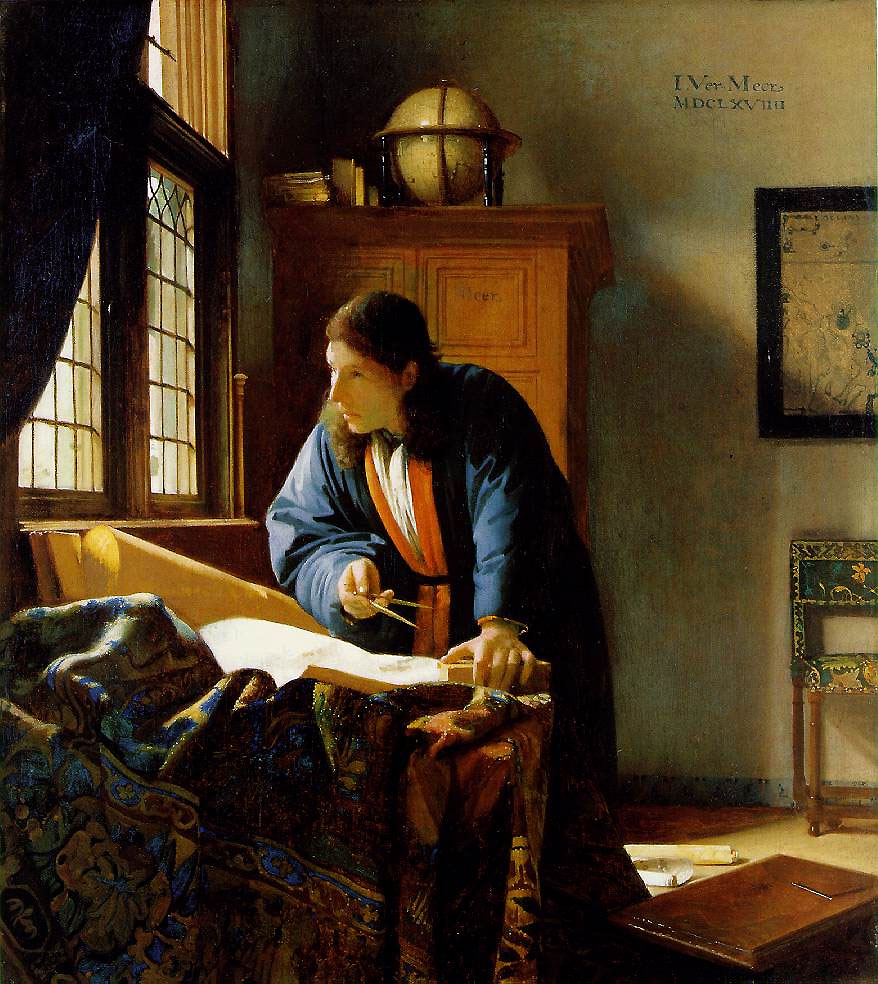
By contrast, consider Vermeer's The Geographer--the model for which, quite a few scholars think, may have been Leeuwenhoek himself:
Who is this man? Has he just been struck by a thought? He's deeply engaged in something, but in what? Vermeer doesn't tell us. He just gives us the moment, accompanied by a near-photographic level of detail. The painting isn't interpreted, but observed.*

The distinction becomes critical when we think about the then-brand-new science of microbiology. Even today, science struggles against narrative. We humans have an instinct to see, not what's there, but what we expect. In the Middle Ages and Renaissance, that was considered a feature rather than a bug. In the Scholastic tradition, to generalize wildly, phenomena were observed in order to confirm what the observer already knew (meaning, in this case, the medieval understanding of Aristotle). Galileo saw mountains on the moon; other viewers saw them as clouds, or reflections; still others--so Galileo complained--refused to look through his telescope at all.

Leeuwenhoek is called the Father of Microbiology not only because he built good microscopes, and not only because he was exceptionally skilled and diligent in using them, but because he too observed. He saw what was there, and he didn't see what wasn't there.

The above is only the briefest, barest synopsis of the ideas in this dense yet fascinating book. Some of them are speculative: Snyder subscribes to the somewhat-controversial idea that Vermeer made use of lenses, mirrors, and the camera obscura. Others are perhaps more strongly presented than the evidence warrants. These, however, are nits to pick. Overall, Eye of the Beholder is that rare and excellent book that does the thing it describes: it takes something familiar, and gives us a whole new way to look at it.

*And part of that observation prefigures the Impressionists. Examine the shadows in The Geographer above, and you'll see a whole range of tones. That's Vermeer working with how the eye perceives shade and light, which is not at all the way a camera does.

Sunday, March 29, 2015

Book Review: Would You Baptize an Extraterrestrial?

Would You Baptize an Extraterrestrial? and Other Questions from the Astronomers' In-Box at the Vatican Observatory
Guy Consolmagno and Paul Mueller
Science, theology

DISCLAIMER: I've heard Brother Guy Consolmagno speak several times, and spoken with him very briefly.

In some ways I'm the wrong reader for this book. None of the science, and not much of the philosophy, is new to me. Even the specifically Catholic aspects of the dialogue are not entirely unfamiliar. Would You Baptize an Extraterrestrial? is genially written and unsophisticated, but I didn't find it terribly challenging.

In essence, WYBaE? is an extended riff on what Steven Jay Gould termed "Non-overlapping magisteria." Science explains some things. Religion explains some things. They don't explain the same things, but that doesn't invalidate either domain.

It's a familiar refrain, but it's not an entirely satisfying one. Both science and religion make some claims to universality. That is, most scientists would agree with the statement "Nothing is exempt from scientific inquiry," while theologists have historically been very clear that "Nothing is irrelevant to the Divine purpose."*

But some universalities are more universal than others.

The difference becomes clear in WYBaE? in the chapter "What Was the Star of Bethlehem?" The authors first discuss a variety of plausible astronomical hypotheses. When they turn to the religious side, they aver that the story of the Star doesn't have to be taken literally to be religiously meaningful. The Bible operates in many modes, including story-telling. Sometimes a good story is the best way to communicate a truth.

Fair enough. But they do not--they cannot--entertain some hypotheses that the scientist would consider equally plausible. Is it not possible that the episode of the Star, as written in Matthew, is no more nor less than a propaganda piece? That, in other words, it was either (a) a folk tale (or what we'd now call an urban legend) that eventually got written down, or (b) a conscious attempt to "sex up" the story? 

Such things manifestly do occur. I certainly don't assert that they did occur in this case. As a matter of science, however, I'm free to suppose that they might have occurred. Brother Guy and Father Paul, for all their erudition, are prohibited ex cathedra from even considering these explanations. So they don't.

Still, the book is a quick yet searching overview of the interface between science and faith. I'd recommend it as an introduction for non-scientists who are interested in Catholic teaching on the subject. I wouldn't recommend it to religious fundamentalists, however, because the authors flatly state that the Bible is not meant to be taken literally; if that doesn't square with your beliefs, nothing in this book will sway you.

*The relative prestige of the two has certainly flipped over time, though. 18th-century scientists were anxious to assert that science didn't undermine religion; 21st-century "creation scientists" are no less eager to pretend that Biblical literalism is compatible with science.

Saturday, March 28, 2015

Book Review: Monstrous Regiment

Monstrous Regiment
Terry Pratchett
Fantasy (reread)

I wanted to reread something in honor of the late Sir Terry Pratchett. I picked Monstrous Regiment because, of all of his Discworld books, it's the one I've reread least. There's a reason for that: I remember thinking previously that it was a long way from being his best work.


When I reread it, I discovered that it's still a long way from being his best work. Gad, I'm perceptive! Or consistent, at least.

It's not that it isn't fun to read. Virtually any Pratchett—at least prior to Unseen Academicals, in which his illness was starting to show—is a pleasurable reading experience. This one has the usual quota of clever sentences, insight, running gags, and so forth. If that's what you want in your Pratchett, don't worry.

But Pratchett at the top of his game is something better than that: he's a top-notch teller of stories. And this isn't one. It's filled with incidents, which follow one another in sequence, but that's not the same thing.

Take the nominal protagonist. Polly Oliver is smart and observant and sympathetic, but she never actually does much. She doesn't make any hard choices on her own, or think about what she's doing, or put herself in special danger. She goes along in a group, and does what the group does.

The antagonist, on the other hand, is ... what? I'm not sure. The situation, maybe? Pratchett himself seems unsure. There's a nasty character, Corporal Stroppi, who starts out making Polly's life difficult, but he runs off around a quarter of the way through the book; he reappears near the end, briefly, and is quickly disposed of. There's an enemy officer who makes even less impression. I suppose you could say that the antagonist is "society," but "society" doesn't actually throw many obstacles in Polly's way either, because on page 1 she's already pretty well gotten a successful angle on the situation.

As a result, while Polly starts with a goal, any progress she makes towards it is purely accidental. She even achieves it ... by asking the right person at the right time. Oh, and there's a near-literal deus ex machina as well, which solves the "society-as-antagonist" problem with no effort on anyone's part.

Finally, as my friend Allen pointed out: in a book about war and soldiering, it's pretty lame when your nominal soldier-y heroes never have to actually do the one thing that soldiering is all about: killing and/or being killed. It's like they're in Disney's Warland theme park.

Late in the book, Polly reflects that it's odd
... finding out it's not about you.You think you're the hero of the story, and it turns out your part of someone else's story ... Alice will be the one they remember. We just had to get her here.
Couldn't have put it better myself. 

Sunday, March 22, 2015

Book Review: The Signal and the Noise

The Signal and the Noise: Why So Many Predictions Fail--But Some Don't
Nate Silver
Statistics, cognitive psychology

The Signal and the Noise is a user's manual about how to make better decisions with imperfect information. As is often the case, the people who would benefit most from the book are the ones who are least likely to read it, or to believe it if they do.


It turns out that foxes make better predictions than hedgehogs, that thinking in terms of probability is really important, that people who refuse to apply mathematics often talk hooey, that self-proclaimed "experts" often aren't, and that it pays never to be too certain of your initial assumptions. This book, in fact, confirmed all of my prejudices.

Therefore, it's obviously wonderful.

Put that way, it sounds stupid. And yet this is one of Nate Silver's (and others') key findings: we all think that way. The difference is that truly rational people know that they're not rational--and factor that into their thinking. Put another way, one of the most important sources of human error is to look at the data with an eye towards confirming your own biases: in real-world data, there's usually enough noise clouding the signal that a determined eye can pick out a false pattern from it.

The book doesn't put great mathematical demands on the reader, although in fact basic probability and statistics don't require much beyond high-school algebra. There are a good many charts and graphs, which are clear and easily understandable. The book is written in straightforward, entertaining, clear, and fluent prose. It perhaps loses a little steam towards the end, where Silver chooses to multiply examples rather than honing his conclusions. Aside from that nitpick, I'd recommend The Signal and the Noise to anyone who wants to be a better thinker, which I assume includes anyone who's read this far.

Pairs well with Daniel Kahneman's Thinking Fast and Slow or Dubner and Leavitt's Freakonomics.

Book Review: The Stones of London

The Stones of London: A History in Twelve Buildings
Leo Hollis
Architecture, history

"A good building must do two things; firstly it must shelter us, secondly it must speak to us." - attributed to John Ruskin


Every building encodes many messages: what its builders thought was important, what their economic concerns were, what the city around them was like, who they wanted to impress, what social problems were most pressing ... Different people and different ages have had different answers, but they've all had the same questions. And the answers have to be embodied in a way that navigates the constraints of time, physical location, materials, and (of course) money. 
 
John Nash's All Souls Church, Langham Place, London 


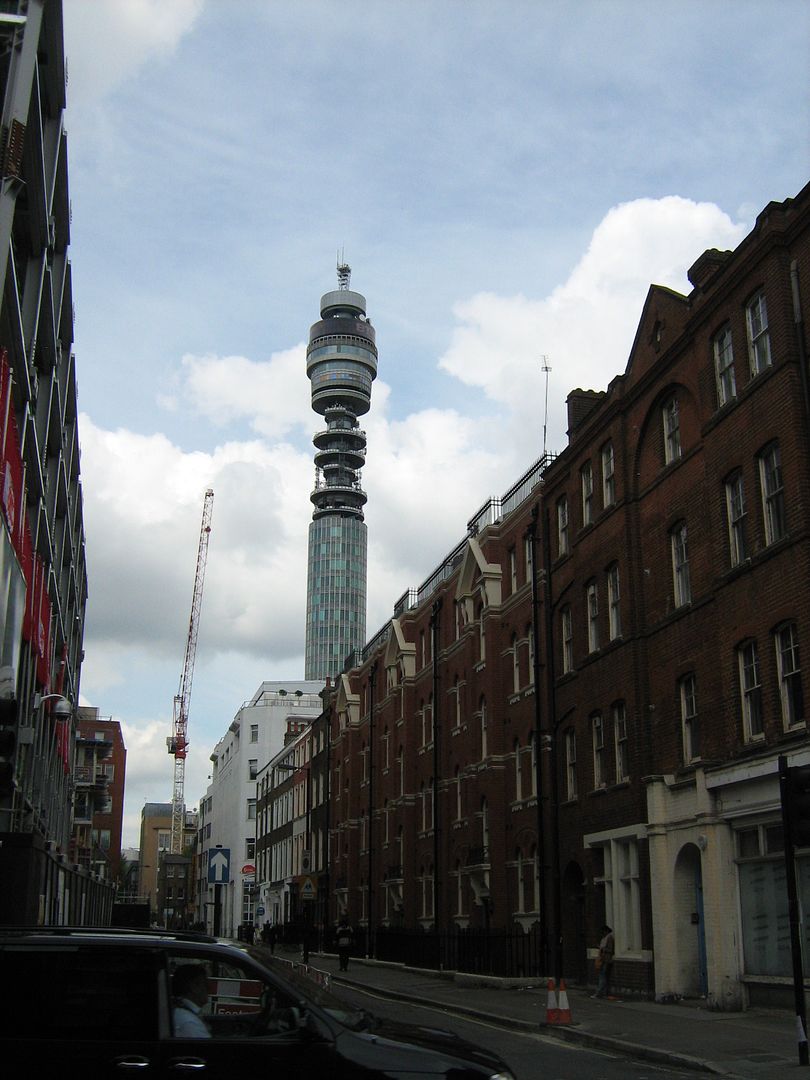
BT Tower, London

Stones of London takes twelve buildings—ranging from the world-famous to the quotidian—and uses them to snapshot how these questions have been addressed over history, within the same city-space. It would be an especially enlightening book for anyone planning a trip to London: rather than presenting a "horizontal" survey of the city in space, it's a "vertical" explanation of the city in time. It's a very enjoyable read in general, although it will make more sense if you have some level of interest in or knowledge of the city. My only minor criticism is that I wouldn't have minded a higher level of architectural/engineering detail (which was my reaction to Hollis's previous book as well).

If this stuff interests you, and if you do visit London, visit Sir John Soane's house--be sure to take the guided tour.

Friday, March 20, 2015

Book Review: The Green Road Into the Trees

The Green Road Into the Trees: An Exploration of England
Hugh Thomson
Travel, archaeology

The United Kingdom, like the United States, is essentially an urban and suburban nation. And, also like the United States, there's some kind of deep-seated voice that whispers, irrationally but compellingly: "but the small-town/village is the real America/England."

But one big difference is that the UK has managed its dense population centers much differently. Fly over Britain and you'll see a pattern: cities and towns cluster densely around a center, radiate outward, and then, at a certain point, just ... stop. Here, we get sprawl without end. There, the countryside—the actual, working, non-Disneyfied rural landscape—is within easy reach even of the big cities.


Standing stones in Avebury

That tension, I think, is at the heart of The Green Road Into the Trees. Hugh Thomson traces the path of the ancient Icknield Way across southern England—never far from the madding crowd, yet curiously insulated from it. There's some nice descriptive writing, but the book ultimately isn't about the landscape; it's about the relationship that the English have with the landscape. In some cases that takes the form of correcting old shibboleths: Thomson, in walking this Bronze-age path, does a nice job bringing that ultimately unknowable time into his present picture.


Cotswold Way 

So Thomson divides his book among Bronze- and Iron-Age land use, his own personal reactions, and a series of encounters with people who are on, in, or of the English countryside—farmers, festival-goers, Travelers, pub owners, conservationists, would-be Druids, archaeologists, and just ordinary folks. It's an odd but appealing journey, without any overt direction or focus or message. American readers, at least, will be struck by the extraordinary persistence of English rural mores; many (though not all!) of the people Thomson meets would sound perfectly at home in an Agatha Christie novel.


Chalk path

Rather like The Wind in the Willows (a book Thomson references many times) some of the best passages are not about anything except the experience of being there. For anyone who has walked or biked the English countryside, The Green Road Into the Trees is an exceedingly evocative book. And yet ... even more than his archaeological musings, Thomson's conversations with the locals—something that we Yanks can't carry off in quite the same way—makes me think that there are a lot of layers beneath that beautiful surface.