The Best American Science and Nature Writing (2018)
Sam Kean (editor)
Science
I had read a number of these pieces before, particularly in The Atlantic. Is there no great but little-known writing out there that this series could promote? The book opens with some editorial political rants, which I largely agree with but which could have been dropped. (That said, the piece on Scott Pruitt's dysfunctional EPA is predictably infuriating.)
The articles themselves are, not shockingly, good. I can't say that any of them stood out particularly, although Ross Anderson's "Welcome to Pleistocene Park" is jaw-dropping in its scope.
Showing posts with label Science. Show all posts
Showing posts with label Science. Show all posts
Friday, May 24, 2019

Tuesday, November 13, 2018
Book Review: The Poison Squad
The Poison Squad: One Chemist's Single-Minded Crusade for Food Safety at the Turn of the Twentieth Century
Deborah Blum
Biography, science, politics
In 2010, Deborah Blum published an excellent book entitled The Poisoner's Handbook. The Poison Squad is in many ways a sequel, or para-quel. Unfortunately, the comparison doesn't work in the current book's favor. In The Poison Squad, Blum slips over the line from writer to cheerleader.
The book is centered strongly on Dr. Harvey Wiley, "Father of the FDA". That in itself is a good choice; Wiley was a remarkable character, and provides a unifying thread. However, Blum makes a dreadful choice in her presentation of facts: a reader of The Poison Squad could be pardoned for concluding that everything that Dr. Wiley said, did, or proposed was absolutely righteous, because it was Dr. Wiley saying, doing, or proposing it.
This is nonsense. However well-intentioned Wiley was, and however nefarious his adversaries--and some were pretty nefarious!--he was not a prophet. The eponymous Poison Squad studies were far better than the previous standard, which consisted of nothing; but they would be laughed out of court today, due to tiny sample sizes and a lack of rigor. To use the existence of those studies to support their conclusions is absurd--but Blum does it, over and over. In no case does she even refer even glancingly to the actual, you know, currently-accepted facts. No: Dr. Wiley was always right, and his foes were always wrong (and not just wrong, but EEEVIL).
Blum likes horror stories. She flings around the fact that formaldehyde was used as a food additive like a mad card sharp pulling aces out of her sleeves, apparently because the phrase "formaldehyde in food!!!!" is a scary phrase. She doesn't mention that formaldehyde occurs naturally in some foods, much less give us meaningful facts by which we could compare quantities or make reasoned judgments. She kicks up Wiley-quotin' storm on the terror that is sodium benzoate, but does she include anything like Science Magazine's commentary on the stuff? I'll give you one guess. (Hint: Science uses the terms "idiotic", "stupid", and "Your reasoning is faulty and your science is wrong".)
At several points Blum's text reads like the "arguments" of today's anti-vaccine zealots. That is not a compliment.
Blum really shows her colors in a rather bad afterword. Here she tries to connect Saint Harvey Wiley to global warming, the Trump Administration, the heartbreak of psoriasis, etc. (Okay, I made that last one up.) This is not only off-putting; it shouldn't be necessary. If Blum had written her book better, she could have--should have--trusted her readers to make the connections for themselves. Instead, the addendum just looks like more frothing and propaganda.
A pretty good book covering some related topics (among many others) is Doris Kearns Goodwin's The Bully Pulpit.
Deborah Blum
Biography, science, politics
In 2010, Deborah Blum published an excellent book entitled The Poisoner's Handbook. The Poison Squad is in many ways a sequel, or para-quel. Unfortunately, the comparison doesn't work in the current book's favor. In The Poison Squad, Blum slips over the line from writer to cheerleader.
The book is centered strongly on Dr. Harvey Wiley, "Father of the FDA". That in itself is a good choice; Wiley was a remarkable character, and provides a unifying thread. However, Blum makes a dreadful choice in her presentation of facts: a reader of The Poison Squad could be pardoned for concluding that everything that Dr. Wiley said, did, or proposed was absolutely righteous, because it was Dr. Wiley saying, doing, or proposing it.
This is nonsense. However well-intentioned Wiley was, and however nefarious his adversaries--and some were pretty nefarious!--he was not a prophet. The eponymous Poison Squad studies were far better than the previous standard, which consisted of nothing; but they would be laughed out of court today, due to tiny sample sizes and a lack of rigor. To use the existence of those studies to support their conclusions is absurd--but Blum does it, over and over. In no case does she even refer even glancingly to the actual, you know, currently-accepted facts. No: Dr. Wiley was always right, and his foes were always wrong (and not just wrong, but EEEVIL).
Blum likes horror stories. She flings around the fact that formaldehyde was used as a food additive like a mad card sharp pulling aces out of her sleeves, apparently because the phrase "formaldehyde in food!!!!" is a scary phrase. She doesn't mention that formaldehyde occurs naturally in some foods, much less give us meaningful facts by which we could compare quantities or make reasoned judgments. She kicks up Wiley-quotin' storm on the terror that is sodium benzoate, but does she include anything like Science Magazine's commentary on the stuff? I'll give you one guess. (Hint: Science uses the terms "idiotic", "stupid", and "Your reasoning is faulty and your science is wrong".)
At several points Blum's text reads like the "arguments" of today's anti-vaccine zealots. That is not a compliment.
Blum really shows her colors in a rather bad afterword. Here she tries to connect Saint Harvey Wiley to global warming, the Trump Administration, the heartbreak of psoriasis, etc. (Okay, I made that last one up.) This is not only off-putting; it shouldn't be necessary. If Blum had written her book better, she could have--should have--trusted her readers to make the connections for themselves. Instead, the addendum just looks like more frothing and propaganda.
A pretty good book covering some related topics (among many others) is Doris Kearns Goodwin's The Bully Pulpit.
Saturday, September 29, 2018
Book Review: When Einstein Walked With Gödel
When Einstein Walked With Gödel: Excursions to the Edge of Thought
Jim Holt
Science, mathematics, philosophy
I really like Jim Holt's 2012 book Why Does the World Exist? It's both a meaty intellectual challenge and a playful, engaging read. When Einstein Walked With Gödel is equally engaging, but less meaty. The difference is simply that Why Does the World Exist is a focused collection that deeply explores a single topic, while When Einstein Walked With Gödel is a diffuse collection that shallowly explores many topics.
This isn't a diss. Jim Holt is a very good writer, and his essays are not unreminiscent of Carl Sagan in both their discursiveness and their humanity. He's especially good at weaving together biography and abstract ideas. These collected essays cover twenty years of writing, though; inevitably there is some overlap. The individual pieces are excellent, but too short to give more than an overview of their subjects. The thing as a whole is brilliant, but fragmented--kaleidoscopic isn't too strong a term.
And it's nobody's fault but my own that my brain insists on setting the book's title to the tune of "When Irish Eyes Are Smiling."
Jim Holt
Science, mathematics, philosophy
I really like Jim Holt's 2012 book Why Does the World Exist? It's both a meaty intellectual challenge and a playful, engaging read. When Einstein Walked With Gödel is equally engaging, but less meaty. The difference is simply that Why Does the World Exist is a focused collection that deeply explores a single topic, while When Einstein Walked With Gödel is a diffuse collection that shallowly explores many topics.
This isn't a diss. Jim Holt is a very good writer, and his essays are not unreminiscent of Carl Sagan in both their discursiveness and their humanity. He's especially good at weaving together biography and abstract ideas. These collected essays cover twenty years of writing, though; inevitably there is some overlap. The individual pieces are excellent, but too short to give more than an overview of their subjects. The thing as a whole is brilliant, but fragmented--kaleidoscopic isn't too strong a term.
And it's nobody's fault but my own that my brain insists on setting the book's title to the tune of "When Irish Eyes Are Smiling."
Thursday, September 27, 2018
Book Review: The Rise and Fall of the Dinosaurs
The Rise and Fall of the Dinosaurs: A New History of a Lost World
Steve Brusatte
Natural history, paleontology
As a wee shaver, one of my oft-reread books was All About Dinosaurs, by Roy Chapman Andrews. Andrews was a character--he may have been one of the inspirations for Indiana Jones--and his books are a mixture of derring-do, science, and personal history. The Rise and Fall of the Dinosaurs is as close as I've ever come to an adult equivalent. Like Andrews, Steve Brusatte is obviously having an enormous amount of fun.
The book is at once a good overall introduction to the natural history of dinosaurs, a charming and discursive autobiography, and an up-to-date survey of modern scientific thinking. Brusatte knows a lot of colorful characters (and he seems to like them all, which is nice). If they never quite get rescued from starvation by the last-minute arrival of their camel caravan in the Gobi Desert, there are still a lot of exotic locales and bone-finding adventures. Oh, and the information itself is really interesting.
The writing is good, too. Brusatte uses a conversational, intimate tone, reminiscent of Ed Yong (that's a good thing). He doesn't dumb anything down, but he does make everything perfectly accessible. For instance, I was particularly and professionally interested in the ways that computers, statistics, and basic machine-learning techniques, are being used now in paleontology; in this, as in general, Brusatte strikes a good balance between too much and not enough information for the general reader.
I wouldn't have minded if The Rise and Fall of the Dinosaurs had been 50% longer, but that's hardly a complaint. Hopefully there will be a sequel.
For a biography of Andrews, see Dragon Hunter by Charles Gellenkamp. Though not exclusively dinosaur-related, Douglas Preston's Dinosaurs in the Attic tells the story of the American Museum of Natural History and provides a good recounting of the Bone Wars.
Steve Brusatte
Natural history, paleontology
As a wee shaver, one of my oft-reread books was All About Dinosaurs, by Roy Chapman Andrews. Andrews was a character--he may have been one of the inspirations for Indiana Jones--and his books are a mixture of derring-do, science, and personal history. The Rise and Fall of the Dinosaurs is as close as I've ever come to an adult equivalent. Like Andrews, Steve Brusatte is obviously having an enormous amount of fun.
The book is at once a good overall introduction to the natural history of dinosaurs, a charming and discursive autobiography, and an up-to-date survey of modern scientific thinking. Brusatte knows a lot of colorful characters (and he seems to like them all, which is nice). If they never quite get rescued from starvation by the last-minute arrival of their camel caravan in the Gobi Desert, there are still a lot of exotic locales and bone-finding adventures. Oh, and the information itself is really interesting.
The writing is good, too. Brusatte uses a conversational, intimate tone, reminiscent of Ed Yong (that's a good thing). He doesn't dumb anything down, but he does make everything perfectly accessible. For instance, I was particularly and professionally interested in the ways that computers, statistics, and basic machine-learning techniques, are being used now in paleontology; in this, as in general, Brusatte strikes a good balance between too much and not enough information for the general reader.
I wouldn't have minded if The Rise and Fall of the Dinosaurs had been 50% longer, but that's hardly a complaint. Hopefully there will be a sequel.
For a biography of Andrews, see Dragon Hunter by Charles Gellenkamp. Though not exclusively dinosaur-related, Douglas Preston's Dinosaurs in the Attic tells the story of the American Museum of Natural History and provides a good recounting of the Bone Wars.
Wednesday, September 12, 2018
Book Review: The Age of Genius
The Age of Genius: The Seventeenth Century and the Birth of the Modern Mind
A. C. Grayling
History, philosophy, science
The first hint that The Age of Genius might have problems comes on page xiv, in the Author's Note.
Needless to say, I skipped nothing. I can't say that I'm much the wiser thereby, though. Military history is a demanding discipline, and A. C. Grayling doesn't show much mastery of it. He has moments of clarity, but overall he never makes sense of the Thirty Years War (which would be hard to do for anyone).
Nor, more critically, does he really tie it into the rest of the book. His warning is all too true: the first 100 pages of The Age of Genius are not only disjoint in themselves, but they fail to tie into the argument of the book. That argument--that the 17th century represents a watershed moment in human intellectual history--is a defensible one; but Grayling doesn't really make it. Too much of the book consists of a series of examples, like the "Before" and "After" shots in a magazine ad, where what's needed is some illustration of how Before became After.
Furthermore, the examples themselves are sometimes dubious. For example:
Actually, to call it a thesis is to give too much credit. The book is full of inconsequential side quests. What does it matter whether Descartes was a Rosicrucian or a Jesuit spying on the Rosicrucians? Why spend so much ink contrasting Hobbes and Locke when both of them clearly belong on the "modern" side of the philosophical divide? Grayling proposes at one point to set up a contrast between the world-view of an educated man in 1600 and one in 1700, and then fails to do so (or, if he does it, it's awfully well-hidden). In any case, the fact that a change occurred is hardly in doubt; the attempt to box it into one arbitrary calendrical period doesn't seem to add much value.
The book ends well. The last chapter is a robust defense of reason, the Enlightenment, liberal thought, and education. It's a pity that the rest of The Age of Genius doesn't really lead there.
A. C. Grayling
History, philosophy, science
The first hint that The Age of Genius might have problems comes on page xiv, in the Author's Note.
The section on the Thirty Years' War might be of less interest to some readers than the rest of the book . . . [they] may skim that section and pass on to the rest. It might be enough for them to have the bare report as here given . . .It is never a good sign when, before your book even starts, you have to tell your readers that they can skip over the first third of it.
Needless to say, I skipped nothing. I can't say that I'm much the wiser thereby, though. Military history is a demanding discipline, and A. C. Grayling doesn't show much mastery of it. He has moments of clarity, but overall he never makes sense of the Thirty Years War (which would be hard to do for anyone).
Nor, more critically, does he really tie it into the rest of the book. His warning is all too true: the first 100 pages of The Age of Genius are not only disjoint in themselves, but they fail to tie into the argument of the book. That argument--that the 17th century represents a watershed moment in human intellectual history--is a defensible one; but Grayling doesn't really make it. Too much of the book consists of a series of examples, like the "Before" and "After" shots in a magazine ad, where what's needed is some illustration of how Before became After.
Furthermore, the examples themselves are sometimes dubious. For example:
In 1606 Macbeth was stages for the first time. Shakespeare was able to rely on the beliefs of his audience . . . to portray the killing of a king as subversive of nature's order, to the extent that horses ate each other and owls fell upon falcons in mid-air and killed them. In 1649, a single generation later, a king was publicly killed, executed in Whitehall in London before a great crowd . . . The idea of the sacred nature of kingship as premised in Macbeth had been rejected . . .Leaving aside the fact that killing off the occasional king was hardly uncommon in previous centuries, Shakespeare's audience was not stupid. We can accept for the sake of entertainment the proposition that vampires walk among us, or that the Nazis won World War II. I have no doubt that seventeenth-century people were just as capable of accepting certain things in fiction, as fiction. By Grayling's logic, Goethe's Faust--written in the heart of the Enlightenment--shows that 19th-century Europeans generally believed in the literal truth of the deal-with-the-devil narrative, which (if it were true) would falsify The Age of Genius's main thesis.
Actually, to call it a thesis is to give too much credit. The book is full of inconsequential side quests. What does it matter whether Descartes was a Rosicrucian or a Jesuit spying on the Rosicrucians? Why spend so much ink contrasting Hobbes and Locke when both of them clearly belong on the "modern" side of the philosophical divide? Grayling proposes at one point to set up a contrast between the world-view of an educated man in 1600 and one in 1700, and then fails to do so (or, if he does it, it's awfully well-hidden). In any case, the fact that a change occurred is hardly in doubt; the attempt to box it into one arbitrary calendrical period doesn't seem to add much value.
The book ends well. The last chapter is a robust defense of reason, the Enlightenment, liberal thought, and education. It's a pity that the rest of The Age of Genius doesn't really lead there.
Sunday, September 9, 2018
Book Review: Energy
Energy: A Human History
Richard Rhodes
Science, engineering, history
Maybe I'm just the wrong reader; I know a lot of this story already. Or maybe my expectations were too high, based on Rhodes's prize-winning The Making of the Atomic Bomb. For whatever reason, Energy was a bit of a let-down.
I can't really point to anything wrong with it. It's more that, for most of its length, it doesn't do anything unusually right. Rhodes treats a series of energy sources (steam, petrochemicals, nuclear, etc.) in a lucid pop-sci fashion, giving a capsule history of the development of each. It's fine. It's just not very innovative.
The book only really gets interesting, in fact, when Rhodes gets around to nuclear power. This is where he stops reporting and starts analyzing. He's decidedly a Wizard, not a Prophet. He pays little or no attention to arguments that humanity needs to reduce its energy footprint--indeed, he takes it for granted that no such thing will occur. (I think he's probably right.) Without being polemical or myopic about it, Rhodes is pretty clearly on the side of more nuclear power. He makes a strong case, too. Coal kills a lot of people.
If you're looking for a good topic overview with no need for a technical background, Energy is for you. If you're looking for thoughtful argument, the last third of Energy is arguably for you. If you're looking for something groundbreaking, you might have to look elsewhere.
The Grid only partially overlaps Energy, but it's a very intriguing book. Coal, by Barbara Freese (and also subtitled "A Human History"), is a decent biography-of-a-substance book that covers related territory. For the emergence of steam as the first non-muscle-based power source, I liked Christopher McGowan's The Rainhill Trials (among others).
Richard Rhodes
Science, engineering, history
Maybe I'm just the wrong reader; I know a lot of this story already. Or maybe my expectations were too high, based on Rhodes's prize-winning The Making of the Atomic Bomb. For whatever reason, Energy was a bit of a let-down.
I can't really point to anything wrong with it. It's more that, for most of its length, it doesn't do anything unusually right. Rhodes treats a series of energy sources (steam, petrochemicals, nuclear, etc.) in a lucid pop-sci fashion, giving a capsule history of the development of each. It's fine. It's just not very innovative.
The book only really gets interesting, in fact, when Rhodes gets around to nuclear power. This is where he stops reporting and starts analyzing. He's decidedly a Wizard, not a Prophet. He pays little or no attention to arguments that humanity needs to reduce its energy footprint--indeed, he takes it for granted that no such thing will occur. (I think he's probably right.) Without being polemical or myopic about it, Rhodes is pretty clearly on the side of more nuclear power. He makes a strong case, too. Coal kills a lot of people.
If you're looking for a good topic overview with no need for a technical background, Energy is for you. If you're looking for thoughtful argument, the last third of Energy is arguably for you. If you're looking for something groundbreaking, you might have to look elsewhere.
The Grid only partially overlaps Energy, but it's a very intriguing book. Coal, by Barbara Freese (and also subtitled "A Human History"), is a decent biography-of-a-substance book that covers related territory. For the emergence of steam as the first non-muscle-based power source, I liked Christopher McGowan's The Rainhill Trials (among others).
Tuesday, June 26, 2018
Book Review: The Evolution of Beauty
The Evolution of Beauty: How Darwin's Forgotten Theory of Mate Choice Shapes the Animal World--And Us
Richard O. Prum
Natural history
[WARNING: long]
The Evolution of Beauty is a very good book. It's well-written. It has an interesting idea at its core and a leavening of entertaining personal content. It may even change the way you look at the world. It's also overstated, and in parts quite probably wrong--but intriguingly so.
Very briefly summarized, the theory that Prum is championing--originating in Charles Darwin's second great book, The Descent of Man--is that species can evolve features that don't help them survive at all, if those features help them attract mates. The peacock's tail is an example: it doesn't help the peacock fly, fight, or feed, but it surely attracts the chicks (rim shot). Prum's own field of study provides numerous fascinating examples of birds that have evolved some astonishing ornaments and behaviors, none of which seem to be "adaptive" in the survival-of-the-fittest sense. These features persist not because they have any use, but because mates prefer them--and mates prefer them not for any adaptive reason, but just ... because.
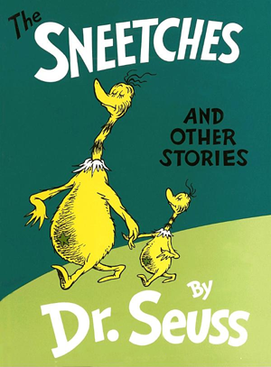
To take an well-known example, consider the sneetch (Seussius sneetchis).
Quite at random, a few male sneetches have stars on their bellies. The stars have no function; they're just a random mutation. Nonetheless, some female sneetches think the stars are sexy--again, not for any particular reason, but just because sneetches make value judgments about stuff. Generation after generation . . .
For a slightly more subtle point, imagine that what the sneetch-ettes inherit is not just "a star is better than no star," but "more stars are better". In this case, the even-rarer two-star sneetches have an advantage over their one-star brethren. Once the one-star trait becomes common, the female preference for more stars preferentially benefits the two-star sneetches. And similarly, once two stars are common, the sneetch-ettes start flocking to the three-star sneetches . . . and so on, and so on . . . In this way, even a trait that does begin as a positive adaptation can turn negative, by being exaggerated into uselessness.
Returning to Richard Prum, his point is that a purely aesthetic preference is perfectly capable of driving evolution, survival value be damned. This is (according to him) something of a heresy within the evolutionary-biology world. Apparently there are those--Stephen Jay Gould called them "hyperadaptationists"--who insist that no trait can be inherited unless it contributes to genetic fitness, i.e. competitive advantage. This view explains the peacock's tail as a signal, advertising the genetic health of the bearer. An extreme version holds that the very uselessness of the tail is part of the signal--look at me, it's saying, I'm so genetically overendowed that I can carry this useless ornament around and still prosper.
Prum takes vigorous issue with these views. I think he's right to do so. The evidence for them seems weak, and their internal logic is less than compelling. Under the extreme view, for instance, shouldn't organisms with extreme deformities attract more mates? If surviving with a long useless tail signals fitness, then surely surviving with a long useless tail and intestinal parasites and only one wing signals more fitness. Ask for it by name!
Another of Prum's targets is the idea that animals simply can't form arbitrary, aesthetic preferences. Evidently there are a good many scientists who believe this; these scientists have never owned cats. (Consider, for example, the laser pointer. One of ours ignores it, one evinces occasional interest, and one will chase it endlessly. Nor is it just a matter of different neurological wiring, because all three were equally excited when they first encountered the Red Dot.) The idea that humans are just so very special in this regard is nothing more than a warmed-over search for the soul. Humans' ability to form aesthetic preferences came from somewhere; simple scientific parsimony suggests that it came from our animal ancestors.
At the same time, I wonder a little bit whether the prevailing wisdom is quite as prevalent as Prum makes out. Certainly his theory is one that I--a complete outsider--had heard before, including the fact that a trait need not be adaptive if it's sufficiently preferred. It's clear, however, that Prum is heavily emotionally invested in his theory. It may be that he's a bit hyper-focused on the opposition. It's almost certain that he's overstating his case.
One issue is that Prum mingles factual truth and normative truth. He points out, correctly, that--in the common case where females chose the mates--mate choice is consistent with female sexual agency, choice, and empowerment (which I'll call FSACE, for short). It's also true that we, societally, consider FSACE ethically desirable--indeed, mandatory. Those two things, however, are not connected. FSACE is not ethically mandatory because it's consistent with mate choice, and mate choice isn't necessarily true because it's consistent with FSACE. Put another way, FSACE is an ethical must even if someone proves that Prum's ideas are false.
In this regard, Prum also doesn't see that the evidence he cites against competing theories can also be used against his own. For example: in many societies women's sexual pleasure has always been marginalized, denigrated, or just ignored. This is evidence against the idea that female sexual pleasure is adaptive, true enough. But it's also evidence against the idea that female sexual pleasure is a consequence of women selecting sexually-compatible mates.
Another overreach comes when Prum tries to explain some behavioral differences between humans and our closest evolutionary relatives. Among apes, females generally can't select mates; the dominant male controls mating. So why do human relationships (cross-culturally, even in small tribal groups) tend towards pair-bonding?
Prum's proposal is that female mate choice explains this. Women, he suggests, prefer males who allow them to exercise their preferences. That is, proto-women preferred to hook up with proto-men who were inclined towards pair-bonding, rather than dominance/polygyny, which in turn spread the pair-bonding genes through the population--not because they provide any particular survival advantage, but because they offer more mating opportunities.
Well, sure, that might be true. There's no evidence of it. Furthermore, it suffers from a bit of a chicken-and-egg problem: women promote free mate choice by exercising their free mate choice to select males who will permit them free mate choice, which raises the question of where the free mate choice came from in the first place.
There are plenty of other equally-credible explanations. Here's one alternative, in dialogue form:
#1 MALE: I hereby invoke my maleness to take away your Female Sexual Agency, Choice, and Empowerment!
FEMALES: Let's kill him.
#2 MALE: Yeah!
#3 MALE: I'm in.
#1 MALE: Wait, what? Argh, gurgle.
FEMALES: Good riddance.
FORMER #2 MALE: Aha! Now I am #1 Male, and I--
FEMALES and FORMER #3 MALE: Ahem.
FORMER #2 MALE: . . . that is . . . ah . . . things will be a bit different . . . mistakes were made.
Richard Prum doesn't present any more evidence for his idea than I have for mine. If anything, I think mine is more plausible, because it explains one thing that's unique to humans (our sexual arrangements) with another thing that's unique to humans (our ability to communicate, plan, and cooperate).
On the other hand, Prum's description of his own work with birds is tremendous. He goes into deep detail (which could have gotten dull, but doesn't) about, for example, bower birds' elaborate constructions and manakins' elaborate dances. Here I think his evidence is very strong and his arguments sound. It's no coincidence that the bird-oriented chapters are a lot lighter on the "it is possible"s and the "it could well be"s and the "might have"s.
That's not to say that I discount Prum's ideas entirely when it comes to humans. I do mistrust the single-cause fallacy, particularly when it comes to something as multifarious as human behavior--but that applies to Prum's opponents as well as to Prum himself. If you're at all interested in this sort of thing, do read The Evolution of Beauty. It'll keep you thinking for quite some time.
There are a number of good books on evolution, adaptation, and related topics. High among them, though also speculative, is Richard Wrangham's Catching Fire. Daniel Lieberman's The Story of the Human Body is extremely convincing, if not quite as daring. A good deal older, but still very much worth reading, is Melvin Konner's The Tangled Wing.
Richard O. Prum
Natural history
[WARNING: long]
The Evolution of Beauty is a very good book. It's well-written. It has an interesting idea at its core and a leavening of entertaining personal content. It may even change the way you look at the world. It's also overstated, and in parts quite probably wrong--but intriguingly so.
Very briefly summarized, the theory that Prum is championing--originating in Charles Darwin's second great book, The Descent of Man--is that species can evolve features that don't help them survive at all, if those features help them attract mates. The peacock's tail is an example: it doesn't help the peacock fly, fight, or feed, but it surely attracts the chicks (rim shot). Prum's own field of study provides numerous fascinating examples of birds that have evolved some astonishing ornaments and behaviors, none of which seem to be "adaptive" in the survival-of-the-fittest sense. These features persist not because they have any use, but because mates prefer them--and mates prefer them not for any adaptive reason, but just ... because.
To take an well-known example, consider the sneetch (Seussius sneetchis).
 |
| Image hosted at Wikimedia |
- Male star-bellied sneetches attract more mates than plain-bellied sneetches, because some sneetch-ettes just prefer them.
- These couples have more children than plain-bellied sneetches.
- The children inherit stars.
- The females inherit a preference for stars.
For a slightly more subtle point, imagine that what the sneetch-ettes inherit is not just "a star is better than no star," but "more stars are better". In this case, the even-rarer two-star sneetches have an advantage over their one-star brethren. Once the one-star trait becomes common, the female preference for more stars preferentially benefits the two-star sneetches. And similarly, once two stars are common, the sneetch-ettes start flocking to the three-star sneetches . . . and so on, and so on . . . In this way, even a trait that does begin as a positive adaptation can turn negative, by being exaggerated into uselessness.
Returning to Richard Prum, his point is that a purely aesthetic preference is perfectly capable of driving evolution, survival value be damned. This is (according to him) something of a heresy within the evolutionary-biology world. Apparently there are those--Stephen Jay Gould called them "hyperadaptationists"--who insist that no trait can be inherited unless it contributes to genetic fitness, i.e. competitive advantage. This view explains the peacock's tail as a signal, advertising the genetic health of the bearer. An extreme version holds that the very uselessness of the tail is part of the signal--look at me, it's saying, I'm so genetically overendowed that I can carry this useless ornament around and still prosper.
Prum takes vigorous issue with these views. I think he's right to do so. The evidence for them seems weak, and their internal logic is less than compelling. Under the extreme view, for instance, shouldn't organisms with extreme deformities attract more mates? If surviving with a long useless tail signals fitness, then surely surviving with a long useless tail and intestinal parasites and only one wing signals more fitness. Ask for it by name!
Another of Prum's targets is the idea that animals simply can't form arbitrary, aesthetic preferences. Evidently there are a good many scientists who believe this; these scientists have never owned cats. (Consider, for example, the laser pointer. One of ours ignores it, one evinces occasional interest, and one will chase it endlessly. Nor is it just a matter of different neurological wiring, because all three were equally excited when they first encountered the Red Dot.) The idea that humans are just so very special in this regard is nothing more than a warmed-over search for the soul. Humans' ability to form aesthetic preferences came from somewhere; simple scientific parsimony suggests that it came from our animal ancestors.
At the same time, I wonder a little bit whether the prevailing wisdom is quite as prevalent as Prum makes out. Certainly his theory is one that I--a complete outsider--had heard before, including the fact that a trait need not be adaptive if it's sufficiently preferred. It's clear, however, that Prum is heavily emotionally invested in his theory. It may be that he's a bit hyper-focused on the opposition. It's almost certain that he's overstating his case.
One issue is that Prum mingles factual truth and normative truth. He points out, correctly, that--in the common case where females chose the mates--mate choice is consistent with female sexual agency, choice, and empowerment (which I'll call FSACE, for short). It's also true that we, societally, consider FSACE ethically desirable--indeed, mandatory. Those two things, however, are not connected. FSACE is not ethically mandatory because it's consistent with mate choice, and mate choice isn't necessarily true because it's consistent with FSACE. Put another way, FSACE is an ethical must even if someone proves that Prum's ideas are false.
In this regard, Prum also doesn't see that the evidence he cites against competing theories can also be used against his own. For example: in many societies women's sexual pleasure has always been marginalized, denigrated, or just ignored. This is evidence against the idea that female sexual pleasure is adaptive, true enough. But it's also evidence against the idea that female sexual pleasure is a consequence of women selecting sexually-compatible mates.
Another overreach comes when Prum tries to explain some behavioral differences between humans and our closest evolutionary relatives. Among apes, females generally can't select mates; the dominant male controls mating. So why do human relationships (cross-culturally, even in small tribal groups) tend towards pair-bonding?
Prum's proposal is that female mate choice explains this. Women, he suggests, prefer males who allow them to exercise their preferences. That is, proto-women preferred to hook up with proto-men who were inclined towards pair-bonding, rather than dominance/polygyny, which in turn spread the pair-bonding genes through the population--not because they provide any particular survival advantage, but because they offer more mating opportunities.
Well, sure, that might be true. There's no evidence of it. Furthermore, it suffers from a bit of a chicken-and-egg problem: women promote free mate choice by exercising their free mate choice to select males who will permit them free mate choice, which raises the question of where the free mate choice came from in the first place.
There are plenty of other equally-credible explanations. Here's one alternative, in dialogue form:
#1 MALE: I hereby invoke my maleness to take away your Female Sexual Agency, Choice, and Empowerment!
FEMALES: Let's kill him.
#2 MALE: Yeah!
#3 MALE: I'm in.
#1 MALE: Wait, what? Argh, gurgle.
FEMALES: Good riddance.
FORMER #2 MALE: Aha! Now I am #1 Male, and I--
FEMALES and FORMER #3 MALE: Ahem.
FORMER #2 MALE: . . . that is . . . ah . . . things will be a bit different . . . mistakes were made.
Richard Prum doesn't present any more evidence for his idea than I have for mine. If anything, I think mine is more plausible, because it explains one thing that's unique to humans (our sexual arrangements) with another thing that's unique to humans (our ability to communicate, plan, and cooperate).
On the other hand, Prum's description of his own work with birds is tremendous. He goes into deep detail (which could have gotten dull, but doesn't) about, for example, bower birds' elaborate constructions and manakins' elaborate dances. Here I think his evidence is very strong and his arguments sound. It's no coincidence that the bird-oriented chapters are a lot lighter on the "it is possible"s and the "it could well be"s and the "might have"s.
That's not to say that I discount Prum's ideas entirely when it comes to humans. I do mistrust the single-cause fallacy, particularly when it comes to something as multifarious as human behavior--but that applies to Prum's opponents as well as to Prum himself. If you're at all interested in this sort of thing, do read The Evolution of Beauty. It'll keep you thinking for quite some time.
There are a number of good books on evolution, adaptation, and related topics. High among them, though also speculative, is Richard Wrangham's Catching Fire. Daniel Lieberman's The Story of the Human Body is extremely convincing, if not quite as daring. A good deal older, but still very much worth reading, is Melvin Konner's The Tangled Wing.
Wednesday, June 13, 2018
Book Review: Graphene
Graphene: The Superstrong, Superthin, and Superversatile Material That Will Revolutionize the World
Les Johnson, Joseph E. Meany
Science, engineering
Graphene is crazy stuff. It's incredibly simple--a repeating plane of carbon atoms arranged in a hexagonal latice. It's one atom thick. It's phenomenally strong: if plastic cling-wrap were made of graphene, you could support a car on it. It's a near-supercoductor. It's basically weightless. Plus I'm a sucker for the single-word-title biography-of-a-substance book. What could possibly go wrong?
Answer: the writing. Johnson and Meany have good intentions, but their writing skills show more enthusiasm than discipline. Graphene is written in a golly-gee-Mister-Wizard tone that set my teeth on edge from the first chapter. It also contains random anecdotes stuck in unhelpful places, repeated bits, a digressive and disorganized structure, and not nearly enough critical thinking. There's only a limited amount of graphene hagiography that I can stomach before I start feeling contrarian, and Graphene exceeds it early on. The worst part is a section imagining our glowing graphene-enhanced future which reads like somebody watched "Zinc Oxide and You" without realizing that it was funny.
The authors do manage to slip in many fascinating facts. There are also some remarkable graphs showing, for example, the growth in graphene-related patents. None of this, however, adds up to anything more than wishful thinking. Our Friend Graphene is the scientific miracle of the next decade? So is fusion, and it has been for fifty years. So were high-temperature superconductors. So were fuel-cell cars, a bit more than a decade ago. Who knows? Graphene is too long on passion and too short on analysis to let me make any kind of reasoned judgment on its eponymous material. And that's a missed opportunity.
Les Johnson, Joseph E. Meany
Science, engineering
Graphene is crazy stuff. It's incredibly simple--a repeating plane of carbon atoms arranged in a hexagonal latice. It's one atom thick. It's phenomenally strong: if plastic cling-wrap were made of graphene, you could support a car on it. It's a near-supercoductor. It's basically weightless. Plus I'm a sucker for the single-word-title biography-of-a-substance book. What could possibly go wrong?
Answer: the writing. Johnson and Meany have good intentions, but their writing skills show more enthusiasm than discipline. Graphene is written in a golly-gee-Mister-Wizard tone that set my teeth on edge from the first chapter. It also contains random anecdotes stuck in unhelpful places, repeated bits, a digressive and disorganized structure, and not nearly enough critical thinking. There's only a limited amount of graphene hagiography that I can stomach before I start feeling contrarian, and Graphene exceeds it early on. The worst part is a section imagining our glowing graphene-enhanced future which reads like somebody watched "Zinc Oxide and You" without realizing that it was funny.
The authors do manage to slip in many fascinating facts. There are also some remarkable graphs showing, for example, the growth in graphene-related patents. None of this, however, adds up to anything more than wishful thinking. Our Friend Graphene is the scientific miracle of the next decade? So is fusion, and it has been for fifty years. So were high-temperature superconductors. So were fuel-cell cars, a bit more than a decade ago. Who knows? Graphene is too long on passion and too short on analysis to let me make any kind of reasoned judgment on its eponymous material. And that's a missed opportunity.
Tuesday, May 29, 2018
Book Review: The Knowledge
The Knowledge: How to Rebuild Civilization in the Aftermath of a Cataclysm
Lewis Dartnell
Science, engineering
In the absence of an actual cataclysm, it's not clear what function this book serves. It's mildly interesting, if you're interested in this sort of thing.
Lewis Dartnell
Science, engineering
In the absence of an actual cataclysm, it's not clear what function this book serves. It's mildly interesting, if you're interested in this sort of thing.
Thursday, May 24, 2018
Book Review: The Perfectionists
The Perfectionists: How Precision Engineers Created the Modern World
Simon Winchester
Science, engineering, history
This is one of Simon Winchester's better books, all the more so because he takes a really original perspective on Modernity and How It Got That Way. On the one hand, The Perfectionists is chock-full of intriguing facts about everything from jet engines to camera lenses. On the other hand, it's also a paean to a bunch of extraordinary characters. And on the other other hand, it's well-tied together by its theme.
Precision is one of those things, like rust, that's so incredibly important that nobody thinks about it. That is: it's so important that we've had to get very, very sophisticated at it--so sophisticated that it's largely invisible. A couple hundred years ago, James Watt found that he needed a then-unheard-of level of precision to make his steam engines work . . . whereupon divers other actors discovered that such precision let them do, or almost do, amazing things . . . which led to a need for more precision . . . which led, ultimately, to things like Moore's Law . . . which led to people in third-world countries throwing away two-year-old cell phones with enough processing power to launch a space-shuttle because they're too old and slow.
Thought-provoking, no? And the writing is good, too: lively, vivid, and readable. Winchester is not at his best when he tries to be profound--there's a chapter on Japan, as an alleged conundrum, that's basically one big mistake--but for telling details he's one of the best.
Winchester got to visit one of the most precise things in the solar system, the Laser Interferometer Gravitational-Wave Observatory, which shows up in a lot more detail in Ripples in Spacetime. For other good books about important stuff that nobody thinks about, see Rose George's The Big Necessity and Mark Levinson's The Box.
Simon Winchester
Science, engineering, history
This is one of Simon Winchester's better books, all the more so because he takes a really original perspective on Modernity and How It Got That Way. On the one hand, The Perfectionists is chock-full of intriguing facts about everything from jet engines to camera lenses. On the other hand, it's also a paean to a bunch of extraordinary characters. And on the other other hand, it's well-tied together by its theme.
Precision is one of those things, like rust, that's so incredibly important that nobody thinks about it. That is: it's so important that we've had to get very, very sophisticated at it--so sophisticated that it's largely invisible. A couple hundred years ago, James Watt found that he needed a then-unheard-of level of precision to make his steam engines work . . . whereupon divers other actors discovered that such precision let them do, or almost do, amazing things . . . which led to a need for more precision . . . which led, ultimately, to things like Moore's Law . . . which led to people in third-world countries throwing away two-year-old cell phones with enough processing power to launch a space-shuttle because they're too old and slow.
Thought-provoking, no? And the writing is good, too: lively, vivid, and readable. Winchester is not at his best when he tries to be profound--there's a chapter on Japan, as an alleged conundrum, that's basically one big mistake--but for telling details he's one of the best.
Winchester got to visit one of the most precise things in the solar system, the Laser Interferometer Gravitational-Wave Observatory, which shows up in a lot more detail in Ripples in Spacetime. For other good books about important stuff that nobody thinks about, see Rose George's The Big Necessity and Mark Levinson's The Box.
Friday, April 27, 2018
Book Review: The Great Quake
The Great Quake: How the Biggest Earthquake in North America Changed Our Understanding of the Planet
Henry Fountain
Geology, biography
The 1906 San Francisco quake gets all the press, but the 1964 Alaska quake was bigger. How much bigger? Oh, about 90x as powerful, in terms of total energy released. The human cost was limited only by the limited population in the area. As it was, the entire city of Valdez was flattened, abandoned, and rebuilt from the ground up--four miles inland, on bedrock.
Not only that, the Alaska quake came at a crucial point in the development of geoscience. The theory of (what's now called) plate tectonics had been floating around since the 1920s; in the 1960s it was beginning to gain currency. Evidence from the Alaska earthquake provided crucial support.
Those are the two threads that Henry Fountain builds The Great Quake around. It's a nice piece of work. Fountain very sensibly chooses one primary viewpoint character for each thread--geologist George Plafker and schoolteacher Kris Madsen--with other characters weaving their ways into and out of the story. The result is one part human tragedy, one part scientific detective story.
Both parts are good, too (which doesn't always happen with this sort of book). The picture of the sheer unstoppable devastation caused by the quake is particularly vivid. Streets ripple and crack. Slabs of concrete shear off the sides of buildings. A ship, 441.5 feet long, rocks in the waves so that its brass propellor appears above the houses. Tsunamis reach, in some cases, hundreds of feet above the water line. On the scientific side, too, Fountain has chosen a very appealing main character to follow: a working-class Brooklyn kid, who fell in love with geology almost by accident (and who's still alive, at the time of this typing).
The Great Quake is a good science book for non-scientists. It's also a good sociology book for non-sociologists, and a good piece of human-interest reportage to boot. It's well worth your time.
The inevitable John McPhee has to be mentioned here, once again, both for his books about geology (collectively known as Annals of the Former World) and for his book about Alaska, Coming Into the Country. Simon Winchester's A Crack in the Edge of the World is a good account of the San Francisco also-ran.
Henry Fountain
Geology, biography
The 1906 San Francisco quake gets all the press, but the 1964 Alaska quake was bigger. How much bigger? Oh, about 90x as powerful, in terms of total energy released. The human cost was limited only by the limited population in the area. As it was, the entire city of Valdez was flattened, abandoned, and rebuilt from the ground up--four miles inland, on bedrock.
Not only that, the Alaska quake came at a crucial point in the development of geoscience. The theory of (what's now called) plate tectonics had been floating around since the 1920s; in the 1960s it was beginning to gain currency. Evidence from the Alaska earthquake provided crucial support.
Those are the two threads that Henry Fountain builds The Great Quake around. It's a nice piece of work. Fountain very sensibly chooses one primary viewpoint character for each thread--geologist George Plafker and schoolteacher Kris Madsen--with other characters weaving their ways into and out of the story. The result is one part human tragedy, one part scientific detective story.
Both parts are good, too (which doesn't always happen with this sort of book). The picture of the sheer unstoppable devastation caused by the quake is particularly vivid. Streets ripple and crack. Slabs of concrete shear off the sides of buildings. A ship, 441.5 feet long, rocks in the waves so that its brass propellor appears above the houses. Tsunamis reach, in some cases, hundreds of feet above the water line. On the scientific side, too, Fountain has chosen a very appealing main character to follow: a working-class Brooklyn kid, who fell in love with geology almost by accident (and who's still alive, at the time of this typing).
The Great Quake is a good science book for non-scientists. It's also a good sociology book for non-sociologists, and a good piece of human-interest reportage to boot. It's well worth your time.
The inevitable John McPhee has to be mentioned here, once again, both for his books about geology (collectively known as Annals of the Former World) and for his book about Alaska, Coming Into the Country. Simon Winchester's A Crack in the Edge of the World is a good account of the San Francisco also-ran.
Sunday, April 1, 2018
Book Review: The Tale of the Dueling Neurosurgeons
The Tale of the Dueling Neurosurgeons: The History of the Human Brain as Revealed by True Stories of Trauma, Madness, and Recovery
Sam Kean
Biology, psychology
Sam Kean's books are much of a muchness. His gifts as a writer include a witty, colloquial style; good organization; and a tremendous gift for using entertaining anecdotes to illuminate and explain the larger story. That describes The Tale of the Dueling Neurosurgeons in a nutshell.
The book is cleverly structured. Instead of sticking to a strict chronological sequence, Kean makes each chapter deals with a specific part of the brain. At the same time, he manages to build up his information in a coherent, simpler-to-more-complex sequence--you won't see any of those vexatious "(as we shall explain further in Chapter 37)" interpolations that mar lesser works. The result is both entertaining and genuinely informative.
It doesn't hurt, of course, that there's a genuine if creepy fascination to Weird Brain Facts. To his credit, Kean mostly avoids the temptation to turn the book into a literary freak show; he treats the subjects of his stories with measured compassion. He also does well with character portraits of scientists, materially aided by a wealth of juicy material. Some of it, be it noted, is not for the faint of stomach.
Ultimately, though, it all comes down to Weird Brain Facts. They're weirder than you can possibly imagine. Not the least of The Tale of the Dueling Neurosurgeons's achievements is that it will make you seriously question what you imagine that you know about your "self."
The grand seigneur of this subject is Oliver Sacks, whose best-known work is The Man Who Mistook His Wife for a Hat (I'm also partial to Musicophilia).
Sam Kean
Biology, psychology
Sam Kean's books are much of a muchness. His gifts as a writer include a witty, colloquial style; good organization; and a tremendous gift for using entertaining anecdotes to illuminate and explain the larger story. That describes The Tale of the Dueling Neurosurgeons in a nutshell.
The book is cleverly structured. Instead of sticking to a strict chronological sequence, Kean makes each chapter deals with a specific part of the brain. At the same time, he manages to build up his information in a coherent, simpler-to-more-complex sequence--you won't see any of those vexatious "(as we shall explain further in Chapter 37)" interpolations that mar lesser works. The result is both entertaining and genuinely informative.
It doesn't hurt, of course, that there's a genuine if creepy fascination to Weird Brain Facts. To his credit, Kean mostly avoids the temptation to turn the book into a literary freak show; he treats the subjects of his stories with measured compassion. He also does well with character portraits of scientists, materially aided by a wealth of juicy material. Some of it, be it noted, is not for the faint of stomach.
Ultimately, though, it all comes down to Weird Brain Facts. They're weirder than you can possibly imagine. Not the least of The Tale of the Dueling Neurosurgeons's achievements is that it will make you seriously question what you imagine that you know about your "self."
The grand seigneur of this subject is Oliver Sacks, whose best-known work is The Man Who Mistook His Wife for a Hat (I'm also partial to Musicophilia).
Friday, March 30, 2018
Book Review: Void
Void: The Strange Physics of Nothing
James Owen Weatherall
Physics, philosophy
To some extent, Void is another book that falls between two stools. To someone completely new to the subject, it might seem formidably abstruse. To someone who has even an educated layman's grasp of physics and astronomy, there's a lot of repetition. There are no equations, no illustrations, no graphs--even where they might prove helpful.
I ended up enjoying the book anyway--mainly for the speculation, rather than the physics. We think of black holes as being things, to take one example--the remnants of dead stars--and yet, mathematically at least, you could have a universe that contains nothing but a single black hole and always has. Is such a universe "empty"? Is space-time itself a thing? Since the vacuum itself has energy, is it even sensible to talk about nothing?
So Void is mental calisthenics, coupled with an aggressively non-quantitative overview of such topics as special and general relativity, quantum electrodynamics, and string theory. It also contains some nice short character portraits of many important scientists, which is always a plus. I wouldn't recommend it to everyone, but if you're interested in physics and you like big unanswered questions you should give it a shot.
Weatherall, in his notes, says that he was in part inspired by James Holt's Why Does the World Exist?, which I liked very much.
James Owen Weatherall
Physics, philosophy
To some extent, Void is another book that falls between two stools. To someone completely new to the subject, it might seem formidably abstruse. To someone who has even an educated layman's grasp of physics and astronomy, there's a lot of repetition. There are no equations, no illustrations, no graphs--even where they might prove helpful.
I ended up enjoying the book anyway--mainly for the speculation, rather than the physics. We think of black holes as being things, to take one example--the remnants of dead stars--and yet, mathematically at least, you could have a universe that contains nothing but a single black hole and always has. Is such a universe "empty"? Is space-time itself a thing? Since the vacuum itself has energy, is it even sensible to talk about nothing?
So Void is mental calisthenics, coupled with an aggressively non-quantitative overview of such topics as special and general relativity, quantum electrodynamics, and string theory. It also contains some nice short character portraits of many important scientists, which is always a plus. I wouldn't recommend it to everyone, but if you're interested in physics and you like big unanswered questions you should give it a shot.
Weatherall, in his notes, says that he was in part inspired by James Holt's Why Does the World Exist?, which I liked very much.
Saturday, March 3, 2018
Book Review: The Wizard and the Prophet
The Wizard and the Prophet: Two Remarkable Scientists and Their Dueling Visions to Shape Tomorrow's World
Charles C. Mann
Science, biography, ecology, philosophy, politics
[DISCLAIMER: Charles C. Mann graduated from my alma mater and lives in my home town. I don't think we've ever met, but it would be surprising if we didn't have connections in common.]
It's quite likely that The Wizard and the Prophet will be my favorite book of 2018.
Here's the core of the matter: in thirty years, the world will have ten billion people. Should we:
Most importantly, Mann is scrupulously fair towards both Wizards and Prophets. He presents each sides's arguments fairly and in their best lights, and then presents the other side's critique with equal insight. That lifts the book up from "enjoyable" to "important". These are big ideas, and they are consequential. How we think about them will have a profound effect on life on earth--within our lifetimes.
It subtracts nothing from Mann's wonderful book to point out that the dichotomy he points out is an artificial one. "The fox knows many things, but the hedgehog knows one big thing": Prophets and Wizards are hedgehogs, but the answer probably lies with the foxes. It's true that we should waste less, decentralize our electrical grid, be skeptical of claims that innovation will inevitably save us. It's also true that innovation has produced miracles, that more people are living better now than ever before, that the doomsayers have hitherto been wrong. We should recognize both truths.
Related books worth reading are Gretchen Bakke's The Grid, Rose George's The Big Necessity, and Edward Glaeser's The Triumph of the City. Mann's own 1491 and 1493, though unrelated, are also good.
Charles C. Mann
Science, biography, ecology, philosophy, politics
[DISCLAIMER: Charles C. Mann graduated from my alma mater and lives in my home town. I don't think we've ever met, but it would be surprising if we didn't have connections in common.]
It's quite likely that The Wizard and the Prophet will be my favorite book of 2018.
Here's the core of the matter: in thirty years, the world will have ten billion people. Should we:
- Make wise use of our existing resources, conserving and cutting back as necessary, in order to minimize the damage we cause to ourselves and our planet? That's the "Prophet" response, exemplified in Mann's book by the early ecologist William Vogt.
- Innovate, adapt, embracing creativity and dynamic capitalism, in order to expand the carrying capacity of the world and lift more people out of poverty? That's the "Wizard" response, as espoused by Norman Borlaug--a man who won a Nobel Peace Prize as the father of the so-called "Green Revolution".
Most importantly, Mann is scrupulously fair towards both Wizards and Prophets. He presents each sides's arguments fairly and in their best lights, and then presents the other side's critique with equal insight. That lifts the book up from "enjoyable" to "important". These are big ideas, and they are consequential. How we think about them will have a profound effect on life on earth--within our lifetimes.
It subtracts nothing from Mann's wonderful book to point out that the dichotomy he points out is an artificial one. "The fox knows many things, but the hedgehog knows one big thing": Prophets and Wizards are hedgehogs, but the answer probably lies with the foxes. It's true that we should waste less, decentralize our electrical grid, be skeptical of claims that innovation will inevitably save us. It's also true that innovation has produced miracles, that more people are living better now than ever before, that the doomsayers have hitherto been wrong. We should recognize both truths.
Related books worth reading are Gretchen Bakke's The Grid, Rose George's The Big Necessity, and Edward Glaeser's The Triumph of the City. Mann's own 1491 and 1493, though unrelated, are also good.
Monday, January 8, 2018
Book Review: Feathers
Feathers: The Evolution of a Natural Miracle
Thor Hanson
Nature
Like The Triumph of Seeds, Feathers is a beautifully-written book about a fascinating, easy-to-overlook subject. Feathers are absurdly, wonderfully complex. Just the description of how they grow--the cells behave like fans in a sports stadium doing the Wave--is mind-boggling. Hanson peels back multiple layers of featherology: evolution, physics, natural history, looks, physics. Woven in and out of this are a nice series of personal touches and anecdotes, anchoring the book in time and place. If you have any interest at all in looking more deeply into nature, this is a book to latch onto.
Like The Triumph of Seeds, Feathers is a beautifully-written book about a fascinating, easy-to-overlook subject. Feathers are absurdly, wonderfully complex. Just the description of how they grow--the cells behave like fans in a sports stadium doing the Wave--is mind-boggling. Hanson peels back multiple layers of featherology: evolution, physics, natural history, looks, physics. Woven in and out of this are a nice series of personal touches and anecdotes, anchoring the book in time and place. If you have any interest at all in looking more deeply into nature, this is a book to latch onto.
Sunday, December 10, 2017
Book Review: Ripples in Spacetime
Ripples in Spacetime: Einstein, Gravitational Waves, and the Future of Astronomy
Govert Schilling
Astrophysics
I liked a little over half of this book--the second half. The first half is wasted on me, and probably on most other readers, because it wastes a lot of time explaining basic science. Folks, if you write a book entitled Ripples in Spacetime, you can probably assume that your audience doesn't need a lot of background on what a neutron star is. Furthermore, while plain English and helpful analogies are great, slipping over the line from "colloquial" into "cutesy" is not.
Once we finally get to the actual subject matter of the book, things even out. There's some good info on laser interferometry, a description of the various projects underway, an intelligent discussion of how you detect a tiny gravitational signal, and an argument for why it matters. I don't think the argument entirely makes its case--and I'm a former astronomy student!--but it's still interesting.
So, on balance, okay. Schilling needs to trust his readers more, and have a stronger hold on what it is he's actually trying to express. It's possible that Ripples in Spacetime would work better as a series of articles than as a book. I ended up learning some things, though, and that's the main objective.
Govert Schilling
Astrophysics
I liked a little over half of this book--the second half. The first half is wasted on me, and probably on most other readers, because it wastes a lot of time explaining basic science. Folks, if you write a book entitled Ripples in Spacetime, you can probably assume that your audience doesn't need a lot of background on what a neutron star is. Furthermore, while plain English and helpful analogies are great, slipping over the line from "colloquial" into "cutesy" is not.
Once we finally get to the actual subject matter of the book, things even out. There's some good info on laser interferometry, a description of the various projects underway, an intelligent discussion of how you detect a tiny gravitational signal, and an argument for why it matters. I don't think the argument entirely makes its case--and I'm a former astronomy student!--but it's still interesting.
So, on balance, okay. Schilling needs to trust his readers more, and have a stronger hold on what it is he's actually trying to express. It's possible that Ripples in Spacetime would work better as a series of articles than as a book. I ended up learning some things, though, and that's the main objective.
Sunday, November 19, 2017
Book Review: Caesar's Last Breath
Caesar's Last Breath: Decoding the Secrets of the Air Around Us
Sam Kean
Science
This is one of those "a thousand and one fascinating facts about [fill in noun here]" books. I like books of this sort, I like Sam Kean's writing, and I liked this. It's not a thorough scientific study; it won't give you a sound theoretical basis for anything. Instead, Caesar's Last Breath romps lightly but intelligently over the ideal gas law, nitrogen fertilizer, weather, ballooning, fallout, volcanoes--anything at all that fits into this generously-sized topic. This includes fart jokes. The overall style is strongly reminiscent of James Burke's classic TV series Connections, in which pulling on a thread leads on to unexpected places and extraordinary vignettes. What's not to like?
Much more constricted in scope--but also much more intellectually ambitious--is Steven Johnson's thought-provoking meditation on connectedness, The Invention of Air; the latter overlaps some with Madison Smartt Bell's Lavoisier in the Year One. For more fart jokes, as well for writing that will appeal to anyone who likes Sam Kean's style, read Mary Roach's Gulp.
Sam Kean
Science
This is one of those "a thousand and one fascinating facts about [fill in noun here]" books. I like books of this sort, I like Sam Kean's writing, and I liked this. It's not a thorough scientific study; it won't give you a sound theoretical basis for anything. Instead, Caesar's Last Breath romps lightly but intelligently over the ideal gas law, nitrogen fertilizer, weather, ballooning, fallout, volcanoes--anything at all that fits into this generously-sized topic. This includes fart jokes. The overall style is strongly reminiscent of James Burke's classic TV series Connections, in which pulling on a thread leads on to unexpected places and extraordinary vignettes. What's not to like?
Much more constricted in scope--but also much more intellectually ambitious--is Steven Johnson's thought-provoking meditation on connectedness, The Invention of Air; the latter overlaps some with Madison Smartt Bell's Lavoisier in the Year One. For more fart jokes, as well for writing that will appeal to anyone who likes Sam Kean's style, read Mary Roach's Gulp.
Tuesday, October 24, 2017
Book Review: Time Travel
Time Travel: A History
James Gleick
Literature, science
As far as anyone can tell, there isn't any history of actual time travel. This book is, accordingly, a history of the idea of time travel. It's fairly light on physics, discursive, playfully written, and enjoyably meandering. What it lacks in mass, it makes up in range. There can't be all that many books out there, for example, that quote T. S. Eliot and Commander Spock within a few pages of one another. (Admittedly the comparison is a bit unfair; Eliot's cultural influence is comparatively minor.) There are some mind-bending asides, some witty aphorisms, some unexpected cultural crossovers. All in all, a fun read.
Much of Time Travel is about the fictions of time travel. In the process, the fictions themselves are described in some detail, which would rather spoil them for anyone who hadn't read them already. Read Asimov's The End of Eternity, Heinlein's "By His Bootstraps" and "--All You Zombies--", before you read Time Travel.
James Gleick
Literature, science
As far as anyone can tell, there isn't any history of actual time travel. This book is, accordingly, a history of the idea of time travel. It's fairly light on physics, discursive, playfully written, and enjoyably meandering. What it lacks in mass, it makes up in range. There can't be all that many books out there, for example, that quote T. S. Eliot and Commander Spock within a few pages of one another. (Admittedly the comparison is a bit unfair; Eliot's cultural influence is comparatively minor.) There are some mind-bending asides, some witty aphorisms, some unexpected cultural crossovers. All in all, a fun read.
Much of Time Travel is about the fictions of time travel. In the process, the fictions themselves are described in some detail, which would rather spoil them for anyone who hadn't read them already. Read Asimov's The End of Eternity, Heinlein's "By His Bootstraps" and "--All You Zombies--", before you read Time Travel.
Saturday, October 21, 2017
Book Review: Atomic Adventures
Atomic Adventures: Secret Islands, Forgotten N-Rays, and Isotopic Murder--a Journey into the Wild World of Nuclear Science
James Mahaffey
Science
This could more accurately be titled Atomic Anecdotes. It's like a Ripley's Believe-It-Or-Not compendium of nuclear physics. The stories are a semi-random mix of
James Mahaffey
Science
This could more accurately be titled Atomic Anecdotes. It's like a Ripley's Believe-It-Or-Not compendium of nuclear physics. The stories are a semi-random mix of
- Outright scientific quackery (Ronald Richter)
- Scientists who were honestly deluded (the titular N-rays, cold fusion)
- Stuff that was scientifically fine but not practical engineering (atomic-powered aircraft)
- Stuff that was scientifically and practically fine, but killed by politics (nuclear-thermal rockets)
- Tales of the true but obscure (the Japanese atomic bomb program)
To put it another way, Chapter 1 is 36 pages long and contains 39 footnotes, all of which are anecdotes or sidelights that Mahaffey couldn't squeeze into the text but couldn't bear to leave out.
Also, the writing assumes a quite substantial understanding of physics--not at the degree level, perhaps, but certainly above the interested-amateur grade.
Personally, I enjoyed the book. It's funny, and the individual components are all well-written. More importantly, I have a bottomless appetite for this kind of useless information, and I also have the requisite scientific knowledge. The story of how the author got caught up in the cold-fusion debacle is particularly good--amusing, personal, and lively. I'd be cautious about picking this up if you don't fit my profile, though.
Sunday, October 1, 2017
Book Review: Scale
Scale: The Universal Laws of Life and Death in Organisms, Cities, and Companies
Geoffrey West
Science
With a subtitle like that, you expect that "modest" is not going to be what you get. And you don't.
In most of these reviews, I try to avoid too much recapping of what the book's contents actually are. That's what the back-cover blurb is for. For Scale, however, my reaction only makes sense in the context of Geoffrey West's argument. So, briefly:
Geoffrey West
Science
With a subtitle like that, you expect that "modest" is not going to be what you get. And you don't.
In most of these reviews, I try to avoid too much recapping of what the book's contents actually are. That's what the back-cover blurb is for. For Scale, however, my reaction only makes sense in the context of Geoffrey West's argument. So, briefly:
- It's long been known that larger animals have slower metabolic rates--lower heartbeats, longer lives, and so forth.
- Empirically, the relationship between animal size and metabolic rate is a three-quarters power law.
- Many other biological features also show three-quarter-power scaling, or one-quarter-power scaling, or occasionally one-half-power scaling.
- Geoffrey West has come up with a theoretical explanation for this surprising profusion of multiples of 4.
- This theory allows him to make testable, quantitative predictions for various biological features, which agree closely with observations.
- Cities have some animal-like features, but they also have some differences. For example, the number of patents per capita more than doubles when a city doubles in size.
- With some alterations, West's theory can be used to make somewhat looser predictions about cities.
- Companies also can be compared to organisms.
- With some further alterations, Wests theory can be used to make somewhat looser yet predictions about companies.
My reaction is: intriguing, but unproven. For one thing, West isn't necessarily the first to have made the connections he makes, although he may well be the first to do so in a formal, testable fashion. For another, his ideas seem quite strongly supported in the biological realm, but increasingly speculative outside it. For a third, some of the non-biological examples smell a bit like fishing. By that I mean that any two quantities that both grow exponentially--say, the adoption of telephones after 1880 and the salaries of baseball free agents after 1980--will have some power-law relationship, and some of these relationships will fit with whatever theory you propose.
That doesn't mean I didn't like the book; I did. It reminds me of Edward O. Wilson's Consilience. (Wilson is a better writer, but West makes his case more convincingly.) There's also a close connection to Edward Glaeser's very good book Triumph of the City, and a more distant one to the outstanding The Ghost Map by Stephen Johnson.
The connection here, if it wasn't obvious, is that these are all big-picture-thinking books: books that try to perform synthesis on a heroic scale, making sense of many disparate facts under one intellectual umbrella. Scale isn't the best such book I've ever read--I wouldn't recommend it to a reader who doesn't have some tolerance for scientific writing, for example--but it's pretty good. In particular, it's a paean to the value of interdisciplinary thinking, and that's a subject dear to my heart.
Subscribe to:
Posts (Atom)