The Miracle of Dunkirk: The True Story of Operation Dynamo
Walter Lord
History
Walter Lord was one of the greatest narrative historians of the 20th century. The Miracle of Dunkirk isn't up there with his best work (such as A Night to Remember, Day of Infamy, and especially Incredible Victory), but it's still pretty good. It has the trademark Lord style: beautifully readable, extensively researched, and absolutely packed with vivid first-person detail. It doesn't quite cohere into a single overarching narrative--there are so many viewpoints that the book takes on a fractured, impressionistic quality. In an odd way, though, that's appropriate to the subject matter. In a battle nobody had planned for, a national emergency that seemingly arose from nowhere in the course of a few days, there could be no coordinating genius and no overall architecture of salvation . . . only a series of improvisations, enough of which somehow worked.
This would be a good book to read if you saw last year's rather peculiar movie Dunkirk and wanted to actually, you know, learn something.
If music is your thing, do not miss James Keelaghan's song "Fires of Calais".
Sunday, May 20, 2018

Sunday, May 13, 2018
Book Review: Salem Witch Judge
Salem Witch Judge: The Life and Repentance of Samuel Sewall
Eve LaPlante
Biography, history
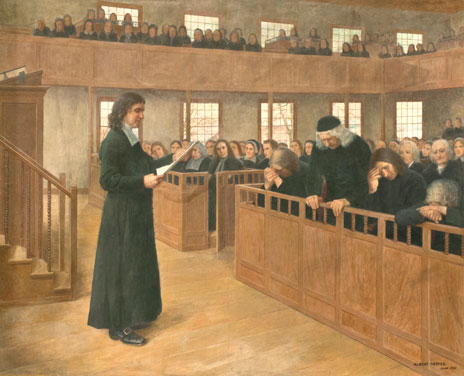
Samuel Sewall was the only one of the Salem judges to publicly repent. An image of the event is now in the Massachusetts State House:
It's a significant turning point: an insider, a member of the governing class, acknowledging not just his own personal failure, but the failure of the institutions of authority. So much for the divine right of anybody in particular. To think of it another way: Samuel Sewall was born in 1652, when people who knew William Shakespeare and Queen Elizabeth were still alive. When he came to New England as a boy, a few of the original Pilgrims were still around. When he died in 1730, Samuel Adams was eight and Benjamin Franklin already 24 years old. His life bridged two different worlds: the world of witches and devils and kings who could cure scrofula with their magic touch, and the world of Jefferson and the Enlightenment and all men being created equal.
LaPlante's biography, it must be said, doesn't really delve into those larger meanings. It's a nice, readable write-up based on Sewall's own extensive diaries, rather like the better class of Wikipedia article done up to book length. It's at its strongest when it recreates the extraordinary physical and mental worlds of late-17th-century New England. It's at its weakest when LaPlante resorts to wholesale quotations from other authors (a venial sin that's hardly unique to her). I was especially intrigued by the period hymns sprinkled through the pages, but unfortunately I don't read enough music to really get the feel of the pieces.
LaPlante also argues that Sewall's repentance moved him towards a kind of pre-Enlightenment position vis-a-vis women, slaves, and Indians. Based on the writings of his that she includes, that's a little generous. However, Sewall--though his understanding of the world is stunningly alien--seems to have been a pretty decent fellow, overall, so I'll give him and LaPlante the benefit of the doubt.
Eve LaPlante
Biography, history
Samuel Sewall was the only one of the Salem judges to publicly repent. An image of the event is now in the Massachusetts State House:
 |
| Image hosted at malegislature.gov |
LaPlante's biography, it must be said, doesn't really delve into those larger meanings. It's a nice, readable write-up based on Sewall's own extensive diaries, rather like the better class of Wikipedia article done up to book length. It's at its strongest when it recreates the extraordinary physical and mental worlds of late-17th-century New England. It's at its weakest when LaPlante resorts to wholesale quotations from other authors (a venial sin that's hardly unique to her). I was especially intrigued by the period hymns sprinkled through the pages, but unfortunately I don't read enough music to really get the feel of the pieces.
LaPlante also argues that Sewall's repentance moved him towards a kind of pre-Enlightenment position vis-a-vis women, slaves, and Indians. Based on the writings of his that she includes, that's a little generous. However, Sewall--though his understanding of the world is stunningly alien--seems to have been a pretty decent fellow, overall, so I'll give him and LaPlante the benefit of the doubt.
Friday, May 11, 2018
Book Review: Head On
Head On
John Scalzi
Science fiction
This is the sequel to Lock In. If you liked that, you should read this. If you haven't read Lock In but like John Scalzi, go ahead and read it. (There's actually a spoiler for Lock In buried in this one.)
Does that sound kinda . . . tepid? I enjoyed reading this book--I bought it in hardcover the day it came out, and buzzed through it in an afternoon--but it's not a major work even within the Scalzi oeuvre. The chief problems are:
Here's an insightful take from my much-missed pal "B.S." For what it's worth, I didn't read it until after I'd composed the above.
John Scalzi
Science fiction
This is the sequel to Lock In. If you liked that, you should read this. If you haven't read Lock In but like John Scalzi, go ahead and read it. (There's actually a spoiler for Lock In buried in this one.)
Does that sound kinda . . . tepid? I enjoyed reading this book--I bought it in hardcover the day it came out, and buzzed through it in an afternoon--but it's not a major work even within the Scalzi oeuvre. The chief problems are:
- It's overly complex for no particular reason. (At a certain point in the exposition, I felt little Xes forming in my eyes.)
- More importantly, it doesn't really take advantage of the world that Scalzi sets up. The initial idea is great--a sport that appeals to Americans because it's even more violent than football. The plot that develops, however, could be set in any professional sports league. With no more than cosmetic changes, you could turn it into a novel about present-day soccer, or basketball, or water polo, or whatever.
- The last quarter of the novel reads like a rush job. It's almost pure dialog, to the exclusion of plot or character development. It's good dialog, but John Scalzi's dialog resembles itself to a remarkable degree, and it gets repetitive.
- A major plot point is pretty obvious from early on. It's not as major as similar case in Lock In, where . . . SPOILER FOR LOCK IN COMING AT YOU . . . the whole plot is built around the gimmick of YES HERE IS THE SPOILER "the solution would be obvious if only X were technically possible, only we know that X isn't technically possible, only it turns out that it is." But there's a certain amount of waiting around for the other shoe to drop.
Here's an insightful take from my much-missed pal "B.S." For what it's worth, I didn't read it until after I'd composed the above.
Tuesday, May 1, 2018
Book Review: Dark State
Dark State
Charles Stross
Science fiction
This is the sequel to Empire Games. If you liked that, you'll like this. I did, and I did.
Mind you, the quarrel that I had with Empire Games is in full force here. (Mild spoiler ahead.) We have two governments who have nothing in particular to fight over, and who have no reason whatsoever not to acknowledge each other, dancing around creating artificial peril--instead of, oh, say, sending a few high-level bureaucrats to have a summit or something. If either side sent the other a note saying "Hi. We don't want a nuclear war. We hope you don't, either", this book would be about a quarter of its length. The excellent pacing is there to hide that fact.
Friday, April 27, 2018
Book Review: The Great Quake
The Great Quake: How the Biggest Earthquake in North America Changed Our Understanding of the Planet
Henry Fountain
Geology, biography
The 1906 San Francisco quake gets all the press, but the 1964 Alaska quake was bigger. How much bigger? Oh, about 90x as powerful, in terms of total energy released. The human cost was limited only by the limited population in the area. As it was, the entire city of Valdez was flattened, abandoned, and rebuilt from the ground up--four miles inland, on bedrock.
Not only that, the Alaska quake came at a crucial point in the development of geoscience. The theory of (what's now called) plate tectonics had been floating around since the 1920s; in the 1960s it was beginning to gain currency. Evidence from the Alaska earthquake provided crucial support.
Those are the two threads that Henry Fountain builds The Great Quake around. It's a nice piece of work. Fountain very sensibly chooses one primary viewpoint character for each thread--geologist George Plafker and schoolteacher Kris Madsen--with other characters weaving their ways into and out of the story. The result is one part human tragedy, one part scientific detective story.
Both parts are good, too (which doesn't always happen with this sort of book). The picture of the sheer unstoppable devastation caused by the quake is particularly vivid. Streets ripple and crack. Slabs of concrete shear off the sides of buildings. A ship, 441.5 feet long, rocks in the waves so that its brass propellor appears above the houses. Tsunamis reach, in some cases, hundreds of feet above the water line. On the scientific side, too, Fountain has chosen a very appealing main character to follow: a working-class Brooklyn kid, who fell in love with geology almost by accident (and who's still alive, at the time of this typing).
The Great Quake is a good science book for non-scientists. It's also a good sociology book for non-sociologists, and a good piece of human-interest reportage to boot. It's well worth your time.
The inevitable John McPhee has to be mentioned here, once again, both for his books about geology (collectively known as Annals of the Former World) and for his book about Alaska, Coming Into the Country. Simon Winchester's A Crack in the Edge of the World is a good account of the San Francisco also-ran.
Sunday, April 22, 2018
Short Story Teaser: "Code H"
From time to time I've offered up samples of my creative output, as we author chappies are wont to do. Here's another. Leave me a note if you'd like me to send you the whole thing. (This is still something of a draft, not necessarily the final version.)
"God damn it," said Mahoney, slamming down her coffee cup. Drips slopped over onto her desk. "Hitler's dead again."
"What's that, three this kilochron?" asked Ibekwe across the low cubicle wall.
"Four." Mahoney wiped up coffee with the back of her tie. She hated the tie. There were good things about not having to walk a temporal beat. Wearing the clothes wasn't one of them.
Ling's head popped up from Robbery, halfway across the squad room. "When is it this time?" he called.
"July '31. Why, what do you care?"
"Office pool."
"Great," said Mahoney, standing. "If you win, how about you fill out the fucking DHP-370s?"
Lieutenant Xox, a.k.a. the Loot, rolled its eyes. It had three of them. Mahoney thought this gave it an unfair advantage. Insofar as a creature that looked like a seven-foot-tall cerulean-scaled lizard could look jaundiced, it looked jaundiced.
"Another code H?" it said. "Sonofabitch. What the hell is it with this precinct, anyway?"
"It's the goddamn writers," said Mahoney. "You got sci-fi writers when you come from?"
"Not any more," said Xox, giving her a toothy grin. It had an unfair advantage in that department as well.
"Well, that shit's practically a cottage industry around here. Means every asshole who gets ahold of a chronomobile, the first thing they think is 'Hey, I'm gonna go kill Hitler.'"
Xox shrugged. "Well, it keeps us in business, I guess. When was it, by the way?"
"July 1931. Don't tell me you're in the pool too."
"Sure, but I had January '28. Anyway, that's not why I called you in. You're gonna have a ride-along on this one."
Mahoney swore fluently in twenty-third century Sparabic. It was a good language for swearing. The Loot waited, looking occasionally out the window, which was in the 1970s. For some reason Xox really liked the 1970s.
Mahoney realized she was repeating herself. She stopped.
"Sorry, Sparks," said Xox, not sounding sorry. "This came all the way from the Castle. It's the new curriculum. They want to get the cadets out walking the timestreams, show 'em how it's done. Hell, you should be all for that."
"I am, just not with me."
"I'll tell the commissioner next time we have tea. I'm sure she'll be real sympathetic. 'Til then, you get to experience the joy and camaraderie of mentoring." It turned two of its eyes towards her midsection. "Maybe you can trade grooming tips. Buddha's balls, Mahoney, it looks like you washed your tie in coffee. And get your DHP-370s in on time, for once."
Code H
"What's that, three this kilochron?" asked Ibekwe across the low cubicle wall.
"Four." Mahoney wiped up coffee with the back of her tie. She hated the tie. There were good things about not having to walk a temporal beat. Wearing the clothes wasn't one of them.
Ling's head popped up from Robbery, halfway across the squad room. "When is it this time?" he called.
"July '31. Why, what do you care?"
"Office pool."
"Great," said Mahoney, standing. "If you win, how about you fill out the fucking DHP-370s?"
#
Lieutenant Xox, a.k.a. the Loot, rolled its eyes. It had three of them. Mahoney thought this gave it an unfair advantage. Insofar as a creature that looked like a seven-foot-tall cerulean-scaled lizard could look jaundiced, it looked jaundiced.
"Another code H?" it said. "Sonofabitch. What the hell is it with this precinct, anyway?"
"It's the goddamn writers," said Mahoney. "You got sci-fi writers when you come from?"
"Not any more," said Xox, giving her a toothy grin. It had an unfair advantage in that department as well.
"Well, that shit's practically a cottage industry around here. Means every asshole who gets ahold of a chronomobile, the first thing they think is 'Hey, I'm gonna go kill Hitler.'"
Xox shrugged. "Well, it keeps us in business, I guess. When was it, by the way?"
"July 1931. Don't tell me you're in the pool too."
"Sure, but I had January '28. Anyway, that's not why I called you in. You're gonna have a ride-along on this one."
Mahoney swore fluently in twenty-third century Sparabic. It was a good language for swearing. The Loot waited, looking occasionally out the window, which was in the 1970s. For some reason Xox really liked the 1970s.
Mahoney realized she was repeating herself. She stopped.
"Sorry, Sparks," said Xox, not sounding sorry. "This came all the way from the Castle. It's the new curriculum. They want to get the cadets out walking the timestreams, show 'em how it's done. Hell, you should be all for that."
"I am, just not with me."
"I'll tell the commissioner next time we have tea. I'm sure she'll be real sympathetic. 'Til then, you get to experience the joy and camaraderie of mentoring." It turned two of its eyes towards her midsection. "Maybe you can trade grooming tips. Buddha's balls, Mahoney, it looks like you washed your tie in coffee. And get your DHP-370s in on time, for once."
Saturday, April 21, 2018
Book Review: Fatal Discord
Fatal Discord: Erasmus, Luther, and the Fight for the Western Mind
Michael Massing
Philosophy, religion, history
As with Crucible of Faith, I read this book, not because religion is among my core interests, but because I'm largely ignorant of the subject matter. In this, if for somewhat different reasons, I'm a match for the author. "I had never read the New Testament," he says in an afterword, "could not distinguish Peter from Paul, knew little about the birth of Christianity."
The result is a pretty good matchup, and a pretty good book. Massing's explicit mission is to rescue Erasmus from Martin Luther's vast penumbra. Erasmus of Rotterdam is a name that invokes vague familiarity in the well-read (I certainly couldn't have told you any details about him); Lutheran jokes, by contrast, were a staple of A Prairie Home Companion. Yet the battle between their worldviews is as lively as ever.
Luther is the one who got famous as the champion of individual judgment. "I cannot and will not recant anything, since it is neither safe nor right to go against conscience," he's recorded as saying--in the face of a very real possibility that he would be burned at the stake for saying it. Courageous, yes; and yet, in truth, Luther ended up by furiously denying that other people might use their consciences. He feuded savagely with everyone, other reformers most especially included. It wasn't really "scripture and only scripture" that he stood for: it was "scripture according to the understanding of Martin Luther, and nobody else."
By contrast, Erasmus--though not always a model of sweetness and light in his writing--was closer to the "can't we all get along" camp. For this, he was roundly vilified by everyone, Luther included. He seems to have been prickly and egocentric, and sometimes vituperative--it was a vituperative age, literarily speaking--but, unlike Luther, he didn't set himself up as the sole arbiter of a singular truth, and he generally called for his foes to be convinced rather than disemboweled. (Massing quotes a letter in which Erasmus frankly admits that he's a coward who has no wish to be a martyr, no stomach for fighting to the death; it made me like him rather more than otherwise!)
In his last chapters, Massing follows the Luther/Erasmus split into the modern world. Luther's insistence on a single truth and a single interpretation of it is obviously relevant to modern American politics, for example; so his his insistence on the right of the individual, not the authorities, to seek it.. The Erasmian tradition shows up among those who argue for compromise and arbitration as an alternative to war, as well as for those who emphasize inner rather than outer piety.
This is a pretty interesting thread. All the same, it would be more accurate to describe Luther and Erasmus as torchbearers for these ideas, rather than originators. The dueling perspectives themselves are, I think, universal. To take one modern analogy that Massing doesn't make, his account of the schisms and savageries within the post-Luther reform movement remind me of nothing so much as the current upheaval in the Islamic world. Violent peasant armies spring up, seemingly overnight, and sweep over large swathes of territory. Sects which are in theory united against a common enemy spent more and more of their time quarreling bitterly with each other. Firebrand preachers give rise to to even more firebrand-ish preachers, many of whom split from their progenitors. Trivial points of doctrine start wars. Ultra-puritans rail against music, against images, against modernism. The voices of moderation go unheard, even persecuted. 16th-century Germany, or the 21st-century Arab world? It could be either.
Thought-provoking, no? So, as I said, Fatal Discord is pretty good--intellectually stimulating, readable enough, and thorough. It even gets mildly exciting in spots. As it goes on, the book does lose steam somewhat. Luther dominates--he's just more colorful--and at times Fatal Discord forgets its intellectual core and descends into a straightforward biography/history. At 800 pages, it's probably too long and too detailed, and certainly not for the faint of heart. If it doesn't entirely succeed in its primary goal of rehabilitating Erasmus, it at least gives us an insight into why he was so important at the time.
For a much more modern and very readable philosophers' smackdown tale, try the excellent Wittgenstein's Poker.
Subscribe to:
Posts (Atom)