Heart: A History
Sandeep Jauhar
Medicine, biography
Yes, it's the fourth book in my heart-books trilogy. Heart is one of those works where the author intersperses his personal biography with medical and/or historical facts. It works pretty well here, although the integration between the two faces of the text is sometimes a bit slipshod. The personal stories are interesting, though, and the history of heart medicine and surgery--organized, interestingly, by theme; each chapter deals with one aspect of the heart's functioning--is clear and concise. Not an all-time classic, but worth a read if you're interested.
I see that it's been a while since I've recommended Siddhartha Mukherjee's The Emperor of All Maladies as an inspired book of medical history. Consider it re-recommended.
Showing posts with label Biography. Show all posts
Showing posts with label Biography. Show all posts
Friday, February 22, 2019

Friday, December 7, 2018
Book Review: Leadership in Turbulent Times
Leadership in Turbulent Times
Doris Kearns Goodwin
Biography
Doris Kearns Goodwin is an outstanding writer. Team of Rivals is a classic for a reason. Wait Till Next Year is a wonderful memoir. The Bully Pulpit is an insightful and sometimes moving triple portrait of Theodore Roosevelt, William Howard Taft, and the progressive press.
Leadership in Turbulent Times is a business book.
It's not bad. As a reading experience, in fact, it's pretty good. It serves as an interesting four-way parallel biography of four presidents--Lincoln, Theodore Roosevelt, Franklin Roosevelt, and Lyndon Johnson. It proposes an interesting thesis, which is that these represent four different types of leadership (transformational, crisis, turnaround, visionary). But the business book is a fundamentally limited endeavor, and Goodwin doesn't transcend those limitations.
The weakest part of Leadership in Turbulent Times, in fact, is its most business-book-y part--the third of its four sections. The first two sections are narrative and descriptive, describing her protagonists' childhood and formative political experiences. She goes one president at a time, in chronological order. That works fine. It lets her compare and contrast each man at analogous points in their lives.
But in the third section Goodwin veers down into the swamp of distilling the biographies into maxims, and the four-way structure doesn't cut it. She should have organized section by leadership practice, and then show how the four presidents applied them--differently, similarly, or both. Instead, every president is treated in sequence. There are a lot of problems with this, but here are the killers:
Doris Kearns Goodwin
Biography
Doris Kearns Goodwin is an outstanding writer. Team of Rivals is a classic for a reason. Wait Till Next Year is a wonderful memoir. The Bully Pulpit is an insightful and sometimes moving triple portrait of Theodore Roosevelt, William Howard Taft, and the progressive press.
Leadership in Turbulent Times is a business book.
It's not bad. As a reading experience, in fact, it's pretty good. It serves as an interesting four-way parallel biography of four presidents--Lincoln, Theodore Roosevelt, Franklin Roosevelt, and Lyndon Johnson. It proposes an interesting thesis, which is that these represent four different types of leadership (transformational, crisis, turnaround, visionary). But the business book is a fundamentally limited endeavor, and Goodwin doesn't transcend those limitations.
The weakest part of Leadership in Turbulent Times, in fact, is its most business-book-y part--the third of its four sections. The first two sections are narrative and descriptive, describing her protagonists' childhood and formative political experiences. She goes one president at a time, in chronological order. That works fine. It lets her compare and contrast each man at analogous points in their lives.
But in the third section Goodwin veers down into the swamp of distilling the biographies into maxims, and the four-way structure doesn't cut it. She should have organized section by leadership practice, and then show how the four presidents applied them--differently, similarly, or both. Instead, every president is treated in sequence. There are a lot of problems with this, but here are the killers:
- It's shallow. By drawing on each leader's life individually, Goodwin's text is reduced to a series of platitudes. Of course it's good to "Lead with your strengths," to "Bring all stakeholders aboard," and so forth. Did anyone doubt it?
- It's not coherent. Any litany of this sort is bound to be littered with contradictions, of the "don't look before you leap" vs. "he who hesitates is lost" variety.
- It's forgettable. By the time you get to "Know when to hold back, know when to move forward" (Lyndon Johnson), you've probably forgotten about "Acknowledge when failed policies demand a change in direction" (Lincoln).
- It doesn't support Goodwin's own taxonomy. If you want to establish that transformational leadership is actually distinct from crisis leadership, for example, you need to establish that the "transformational" rubric "Tell the truth" doesn't apply, or at least applies differently, in the "crisis" case. Using silos doesn't do that.
Saturday, November 17, 2018
Book Review: First Man
First Man: The Life of Neil A. Armstrong
James R. Hansen
Biography
[Yes, I saw the movie. Naturally, that meant I had to read the book.]
Suppose you were a baseball fan. Suppose further that you had a favorite player--Babe Ruth, say. You might find yourself reading, and enjoying, a biography of the Babe that was mainly about his playing days. The statistics--the great games--the sixty-homer season--the awards--the "called shot" home run . . . great stuff.
Substitute "space" for baseball, and "Neil Armstrong" for Ruth, and you've got First Man. Aircraft flown--missions accomplished--piloting deeds--feats of analysis under pressure--touch-and-go-emergencies . . . great stuff. To quantify it (a thing which Armstrong would have approved of), First Man is 389 pages long. Armstrong becomes a pilot on page 46; he retires on page 330. In between is a sports bio for nerds.
Within that limitation, First Man is pretty good. It gives a very complete picture of Armstrong's famously reserved and analytical personality. There are some illuminating anecdotes from the people around Armstrong, though nothing to his discredit. It's exciting in the exciting bits. It's (just) sufficiently technical in the technical bits. It's a little bit hero-worshiping. To nobody's surprise, Apollo XI occupies the biggest single chunk.
The portrait of Armstrong that emerges is an interesting and detailed one, too. He seems to have been a man who avoided strong emotions and was uncomfortable in the limelight. He believed that problems have solutions. (As an engineer, I think I recognize a kindred spirit.) If this doesn't make for the most colorful personal story ever told, it's at least an insightful one.
James R. Hansen
Biography
[Yes, I saw the movie. Naturally, that meant I had to read the book.]
Suppose you were a baseball fan. Suppose further that you had a favorite player--Babe Ruth, say. You might find yourself reading, and enjoying, a biography of the Babe that was mainly about his playing days. The statistics--the great games--the sixty-homer season--the awards--the "called shot" home run . . . great stuff.
Substitute "space" for baseball, and "Neil Armstrong" for Ruth, and you've got First Man. Aircraft flown--missions accomplished--piloting deeds--feats of analysis under pressure--touch-and-go-emergencies . . . great stuff. To quantify it (a thing which Armstrong would have approved of), First Man is 389 pages long. Armstrong becomes a pilot on page 46; he retires on page 330. In between is a sports bio for nerds.
Within that limitation, First Man is pretty good. It gives a very complete picture of Armstrong's famously reserved and analytical personality. There are some illuminating anecdotes from the people around Armstrong, though nothing to his discredit. It's exciting in the exciting bits. It's (just) sufficiently technical in the technical bits. It's a little bit hero-worshiping. To nobody's surprise, Apollo XI occupies the biggest single chunk.
The portrait of Armstrong that emerges is an interesting and detailed one, too. He seems to have been a man who avoided strong emotions and was uncomfortable in the limelight. He believed that problems have solutions. (As an engineer, I think I recognize a kindred spirit.) If this doesn't make for the most colorful personal story ever told, it's at least an insightful one.
Tuesday, November 13, 2018
Book Review: The Poison Squad
The Poison Squad: One Chemist's Single-Minded Crusade for Food Safety at the Turn of the Twentieth Century
Deborah Blum
Biography, science, politics
In 2010, Deborah Blum published an excellent book entitled The Poisoner's Handbook. The Poison Squad is in many ways a sequel, or para-quel. Unfortunately, the comparison doesn't work in the current book's favor. In The Poison Squad, Blum slips over the line from writer to cheerleader.
The book is centered strongly on Dr. Harvey Wiley, "Father of the FDA". That in itself is a good choice; Wiley was a remarkable character, and provides a unifying thread. However, Blum makes a dreadful choice in her presentation of facts: a reader of The Poison Squad could be pardoned for concluding that everything that Dr. Wiley said, did, or proposed was absolutely righteous, because it was Dr. Wiley saying, doing, or proposing it.
This is nonsense. However well-intentioned Wiley was, and however nefarious his adversaries--and some were pretty nefarious!--he was not a prophet. The eponymous Poison Squad studies were far better than the previous standard, which consisted of nothing; but they would be laughed out of court today, due to tiny sample sizes and a lack of rigor. To use the existence of those studies to support their conclusions is absurd--but Blum does it, over and over. In no case does she even refer even glancingly to the actual, you know, currently-accepted facts. No: Dr. Wiley was always right, and his foes were always wrong (and not just wrong, but EEEVIL).
Blum likes horror stories. She flings around the fact that formaldehyde was used as a food additive like a mad card sharp pulling aces out of her sleeves, apparently because the phrase "formaldehyde in food!!!!" is a scary phrase. She doesn't mention that formaldehyde occurs naturally in some foods, much less give us meaningful facts by which we could compare quantities or make reasoned judgments. She kicks up Wiley-quotin' storm on the terror that is sodium benzoate, but does she include anything like Science Magazine's commentary on the stuff? I'll give you one guess. (Hint: Science uses the terms "idiotic", "stupid", and "Your reasoning is faulty and your science is wrong".)
At several points Blum's text reads like the "arguments" of today's anti-vaccine zealots. That is not a compliment.
Blum really shows her colors in a rather bad afterword. Here she tries to connect Saint Harvey Wiley to global warming, the Trump Administration, the heartbreak of psoriasis, etc. (Okay, I made that last one up.) This is not only off-putting; it shouldn't be necessary. If Blum had written her book better, she could have--should have--trusted her readers to make the connections for themselves. Instead, the addendum just looks like more frothing and propaganda.
A pretty good book covering some related topics (among many others) is Doris Kearns Goodwin's The Bully Pulpit.
Deborah Blum
Biography, science, politics
In 2010, Deborah Blum published an excellent book entitled The Poisoner's Handbook. The Poison Squad is in many ways a sequel, or para-quel. Unfortunately, the comparison doesn't work in the current book's favor. In The Poison Squad, Blum slips over the line from writer to cheerleader.
The book is centered strongly on Dr. Harvey Wiley, "Father of the FDA". That in itself is a good choice; Wiley was a remarkable character, and provides a unifying thread. However, Blum makes a dreadful choice in her presentation of facts: a reader of The Poison Squad could be pardoned for concluding that everything that Dr. Wiley said, did, or proposed was absolutely righteous, because it was Dr. Wiley saying, doing, or proposing it.
This is nonsense. However well-intentioned Wiley was, and however nefarious his adversaries--and some were pretty nefarious!--he was not a prophet. The eponymous Poison Squad studies were far better than the previous standard, which consisted of nothing; but they would be laughed out of court today, due to tiny sample sizes and a lack of rigor. To use the existence of those studies to support their conclusions is absurd--but Blum does it, over and over. In no case does she even refer even glancingly to the actual, you know, currently-accepted facts. No: Dr. Wiley was always right, and his foes were always wrong (and not just wrong, but EEEVIL).
Blum likes horror stories. She flings around the fact that formaldehyde was used as a food additive like a mad card sharp pulling aces out of her sleeves, apparently because the phrase "formaldehyde in food!!!!" is a scary phrase. She doesn't mention that formaldehyde occurs naturally in some foods, much less give us meaningful facts by which we could compare quantities or make reasoned judgments. She kicks up Wiley-quotin' storm on the terror that is sodium benzoate, but does she include anything like Science Magazine's commentary on the stuff? I'll give you one guess. (Hint: Science uses the terms "idiotic", "stupid", and "Your reasoning is faulty and your science is wrong".)
At several points Blum's text reads like the "arguments" of today's anti-vaccine zealots. That is not a compliment.
Blum really shows her colors in a rather bad afterword. Here she tries to connect Saint Harvey Wiley to global warming, the Trump Administration, the heartbreak of psoriasis, etc. (Okay, I made that last one up.) This is not only off-putting; it shouldn't be necessary. If Blum had written her book better, she could have--should have--trusted her readers to make the connections for themselves. Instead, the addendum just looks like more frothing and propaganda.
A pretty good book covering some related topics (among many others) is Doris Kearns Goodwin's The Bully Pulpit.
Tuesday, October 30, 2018
Book Review: The Flatiron
The Flatiron: The New York Landmark and the Incomparable City That Arose With It
Alice Sparberg Alexiou
Architecture, Biography
There is a surprisingly substantial sub-subgenre comprising biographies of buildings. The Flatiron Building is perhaps a little less known nowadays, but it was interesting and important in its own time. The notable thing about The Flatiron--the book, that is--is that spends relatively few pages on the engineering and construction of the edifice. It does some work on telling the building's story throughout its subsequent life, which is nice, and which many other books in this sub-subgenre neglect.
More than anything else, however, The Flatiron revolves around a person. Specifically, it's the story of one Harry S. Black, the would-be "Skyscraper King" of New York, whose ambition and vision--or, if you prefer, ego and monomania--drove the construction in the first place. This improves the book if you're one of those readers who prefers stories about people; Black was certainly colorful enough to carry it.
On the other hand, it also makes the book more conventional. It'd make a good episode of a TV show: there are decidedly soap-operatic threads. Gilded-Age tycoon melodramas, however, are a dime a dozen. The building's story is more unique than its progenitor's. I didn't dislike The Flatiron, but I didn't think it quite lived up to its potential.
Some notable books in the biography-of-a-building category include Skyscraper: The Making of a Building, by Karl Sabbagh, and Great Fortune: The Epic of Rockefeller Center, by Daniel Okrent. Moving from buildings to edifices in general, David McCullough's The Great Bridge is a classic for a reason.
Alice Sparberg Alexiou
Architecture, Biography
There is a surprisingly substantial sub-subgenre comprising biographies of buildings. The Flatiron Building is perhaps a little less known nowadays, but it was interesting and important in its own time. The notable thing about The Flatiron--the book, that is--is that spends relatively few pages on the engineering and construction of the edifice. It does some work on telling the building's story throughout its subsequent life, which is nice, and which many other books in this sub-subgenre neglect.
More than anything else, however, The Flatiron revolves around a person. Specifically, it's the story of one Harry S. Black, the would-be "Skyscraper King" of New York, whose ambition and vision--or, if you prefer, ego and monomania--drove the construction in the first place. This improves the book if you're one of those readers who prefers stories about people; Black was certainly colorful enough to carry it.
On the other hand, it also makes the book more conventional. It'd make a good episode of a TV show: there are decidedly soap-operatic threads. Gilded-Age tycoon melodramas, however, are a dime a dozen. The building's story is more unique than its progenitor's. I didn't dislike The Flatiron, but I didn't think it quite lived up to its potential.
Some notable books in the biography-of-a-building category include Skyscraper: The Making of a Building, by Karl Sabbagh, and Great Fortune: The Epic of Rockefeller Center, by Daniel Okrent. Moving from buildings to edifices in general, David McCullough's The Great Bridge is a classic for a reason.
Friday, September 7, 2018
Book Review: Ticker
Ticker: The Quest to Create an Artificial Heart
Mimi Swartz
Biography, engineering
Having read a book on heart surgery recently, and another on heart symbolism, it seemed only natural to continue with heart engineering.
The subtitle is a bit of bait-and-switch. Ticker doesn't recount "the" quest to create an artificial heart. It recounts "a" quest, specifically the quest of one Dr. Oscar “Bud” Frazier of the Texas Heart Institute. Everyone else who's worked on artificial hearts is involved only in so far as they intersect Frazier's orbit.
The technique is reminiscent of Tracy Kidder, as exemplified in his classic The Soul of a New Machine. Mimi Swartz is no Tracy Kidder. To be fair, most people aren't. Swartz is a pretty good journalist and she writes pretty good "New Journalism" style prose. Ticker reads like a long article in one of the better class of magazines--Atlantic or New Yorker, perhaps--that's overflowed its banks. It suffers from a bad case of hagriography. It benefits from a narrow focus. It's strong in character portraits, particularly in a devastatingly acerbic view of pioneering heart surgeon Michael DeBakey. It's weak in technology.
Most unsatisfying, however, is that Ticker lacks an ending. I understand that Swartz wanted to get the book out, but the story she tells is an unfinished one. Reality is not neat. Great authors find a way to write as if it were; competent authors merely reflect the fact. Ticker is competent.
Mimi Swartz
Biography, engineering
Having read a book on heart surgery recently, and another on heart symbolism, it seemed only natural to continue with heart engineering.
The subtitle is a bit of bait-and-switch. Ticker doesn't recount "the" quest to create an artificial heart. It recounts "a" quest, specifically the quest of one Dr. Oscar “Bud” Frazier of the Texas Heart Institute. Everyone else who's worked on artificial hearts is involved only in so far as they intersect Frazier's orbit.
The technique is reminiscent of Tracy Kidder, as exemplified in his classic The Soul of a New Machine. Mimi Swartz is no Tracy Kidder. To be fair, most people aren't. Swartz is a pretty good journalist and she writes pretty good "New Journalism" style prose. Ticker reads like a long article in one of the better class of magazines--Atlantic or New Yorker, perhaps--that's overflowed its banks. It suffers from a bad case of hagriography. It benefits from a narrow focus. It's strong in character portraits, particularly in a devastatingly acerbic view of pioneering heart surgeon Michael DeBakey. It's weak in technology.
Most unsatisfying, however, is that Ticker lacks an ending. I understand that Swartz wanted to get the book out, but the story she tells is an unfinished one. Reality is not neat. Great authors find a way to write as if it were; competent authors merely reflect the fact. Ticker is competent.
Monday, July 30, 2018
Book Review: City of Devils
City of Devils: The Two Men Who Ruled the Underworld of Old Shanghai
Paul French
Biography, history, "true" crime
Let's start a representative quote. It's opening night at Farren's, the glittering jewel in the crown of Shanghai's hectic eve-of-war demimonde of nightclubs and gambling venues:
That's City of Devils for you. Lively, beautifully visual, fast-paced, written in the best choppy hard-boiled style, visceral, an incredible sense of place, full to the bursting of cinematic scenes and sharply-delineated characters . . . and it's bollocks. Not all bollocks. Probably a good half of it might be true. Good luck figuring out which half, though.
It's a ripping yarn, mind you. It's written like a combination of Raymond Chandler and Sebastian (The Perfect Storm) Junger. If you made a movie about it, which could easily happen, it'd be a kind of art-deco Blade Runner. Definitely read City of Devils if you like this sort of thing. Just keep in mind that some unknown fraction of it is bollocks.
Paul French
Biography, history, "true" crime
Let's start a representative quote. It's opening night at Farren's, the glittering jewel in the crown of Shanghai's hectic eve-of-war demimonde of nightclubs and gambling venues:
Here's the honorary Cuban consul, a man with his hand permanently out for cumshaw; the slimeball Portuguese commercial attaché, talking up Macao's neutrality with his arm round the honorary Brazilian consul--the Portuguese mobs paid both men three times as much as their government salaries in squeeze every month. Here also is the nest-feathering brigade of officials from swamps like Venezuela, Mexico, Chile, all with passports for sale and letters of transit falling like confetti, no worth more than gold. A Portuguese visa had been a few hundred dollars' cumshaw to a corrupt official a year before; now the price is treble, quadruple. Still they mingle--Portuguese bossman Fat Tony Perpetuo, Macassared hair slicked back with some simmering señorita on his arm, trades gossip with fellow countryman José Boletho, while the consults in white linen suits hover near and smile through nicotine-stained teeth.Here's the thing: "letters of transit" do not exist. They're a plot device made up for the movie Casablanca. Paul French either doesn't know or doesn't care; he refers to them at least twice more.
That's City of Devils for you. Lively, beautifully visual, fast-paced, written in the best choppy hard-boiled style, visceral, an incredible sense of place, full to the bursting of cinematic scenes and sharply-delineated characters . . . and it's bollocks. Not all bollocks. Probably a good half of it might be true. Good luck figuring out which half, though.
It's a ripping yarn, mind you. It's written like a combination of Raymond Chandler and Sebastian (The Perfect Storm) Junger. If you made a movie about it, which could easily happen, it'd be a kind of art-deco Blade Runner. Definitely read City of Devils if you like this sort of thing. Just keep in mind that some unknown fraction of it is bollocks.
Saturday, July 28, 2018
Book Review: The Meaning of Treason
The Meaning of Treason
Rebecca West
History, biography, literature
The Meaning of Treason is about the life and post-war trial of William Joyce, the British traitor (known as Lord Haw-Haw) who broadcast for the Nazis. I read it in my college years; I don't recall much of my reaction. Then Anthony Horowitz dropped a couple of references to it in The Word is Murder, and naturally I had to reread it.
It's an exceedingly odd book. It could have been written by nobody on earth but a member of the British upper classes from before 1960. Imagine a collaboration between Tom Wolfe (the one who wrote The Right Stuff and The Bonfire of the Vanities) and Lord Peter Wimsey, and you'll have some idea of the style: fluently literate, vivid, intimate, closely observed, and sometimes inane to the point of bafflement. Rebecca West (that's Dame Cicely Isabel Fairfield DBE, to you) belonged to that persuasion of writers who suppose that, once you have looked upon a man's face and clothing, and perhaps heard him speak, you are entitled to pronounce with high confidence any judgement you would care to make about his character, psychology, literary tastes, dietary foibles, or what have you. If you in addition know his ancestry, the thing becomes an absolute certainty.
So, for example, we are informed with perfect seriousness that a certain man "had a great head, bulging at the back like the head of a foetus, in a conformation often found in men of exceptional talent." Of a minor witness, West explains that
What makes this book particularly interesting, then, is not exactly its content. West's biographical eloquence is more poetical than informative, for example, and her discussion of the legal issues at question is sophomoric; by her analysis, a person who obtains a British passport by fraud or forgery would be nonetheless entitled to claim its protection. No: The Meaning of Treason is fascinating as a historical document. Rebecca West was of, in, and writing for a social class that basically ceased to exist a few years later. Notice the chummy insularity: "a black-and-lime scarf of the heavy and subtly-coloured sort that used to be sold at the expensive shops at the Croisette at Cannes." Naturally! Observe the unthinking assumption that all humanity can be sorted into fixed categories, predictable in nature, and differing in quality as they approach or fall short of the British Gentry: "He was a not very fortunate example of the small, nippy, jig-dancing type of Irish peasant." Not just an Irish peasant, you understand, but a very particular subspecies of the breed--as if there were some kind of Irish Peasant Fancy, devoted to breeding and showing Irish Peasants, wherein one might amass a modest collection of "Best In Show" ribbons to impress one's friends.
It's off-putting to a modern reader, but it's fascinating as well. The intelligent, sensitive, ex-post-facto writing of the early 21st century can never inhabit the world of William Joyce, of Rebecca West, of the immediate post-war London in which wildflowers grew in the bombed-out buildings around St. Paul's Cathedral, where everyone and everything was tired and a little grubby and still trying to adjust to what had happened. Everything seemed like it was in short supply. Everyone was trying to make sense of it all: what had happened in the War, whose fault it had been, what it might have meant to be pro-Fascist beforehand, what the new world might look like. Considered as reporting, The Meaning of Treason is persiflage. Considered as an entry into that world, it's peerless.
Rebecca West
History, biography, literature
The Meaning of Treason is about the life and post-war trial of William Joyce, the British traitor (known as Lord Haw-Haw) who broadcast for the Nazis. I read it in my college years; I don't recall much of my reaction. Then Anthony Horowitz dropped a couple of references to it in The Word is Murder, and naturally I had to reread it.
It's an exceedingly odd book. It could have been written by nobody on earth but a member of the British upper classes from before 1960. Imagine a collaboration between Tom Wolfe (the one who wrote The Right Stuff and The Bonfire of the Vanities) and Lord Peter Wimsey, and you'll have some idea of the style: fluently literate, vivid, intimate, closely observed, and sometimes inane to the point of bafflement. Rebecca West (that's Dame Cicely Isabel Fairfield DBE, to you) belonged to that persuasion of writers who suppose that, once you have looked upon a man's face and clothing, and perhaps heard him speak, you are entitled to pronounce with high confidence any judgement you would care to make about his character, psychology, literary tastes, dietary foibles, or what have you. If you in addition know his ancestry, the thing becomes an absolute certainty.
So, for example, we are informed with perfect seriousness that a certain man "had a great head, bulging at the back like the head of a foetus, in a conformation often found in men of exceptional talent." Of a minor witness, West explains that
People of this type need to construct around themselves dramas in which they play the leading part, and doubtless she had made her life in a riverside suburb into a very moving and uplifting drama, using her personal relationships as a fiery but solemn argument for love and decencyAs for William Joyce in person, "All though his life he had been anxious, with the special anxiety of the small man, not to make a fool of himself". Good to know!
What makes this book particularly interesting, then, is not exactly its content. West's biographical eloquence is more poetical than informative, for example, and her discussion of the legal issues at question is sophomoric; by her analysis, a person who obtains a British passport by fraud or forgery would be nonetheless entitled to claim its protection. No: The Meaning of Treason is fascinating as a historical document. Rebecca West was of, in, and writing for a social class that basically ceased to exist a few years later. Notice the chummy insularity: "a black-and-lime scarf of the heavy and subtly-coloured sort that used to be sold at the expensive shops at the Croisette at Cannes." Naturally! Observe the unthinking assumption that all humanity can be sorted into fixed categories, predictable in nature, and differing in quality as they approach or fall short of the British Gentry: "He was a not very fortunate example of the small, nippy, jig-dancing type of Irish peasant." Not just an Irish peasant, you understand, but a very particular subspecies of the breed--as if there were some kind of Irish Peasant Fancy, devoted to breeding and showing Irish Peasants, wherein one might amass a modest collection of "Best In Show" ribbons to impress one's friends.
It's off-putting to a modern reader, but it's fascinating as well. The intelligent, sensitive, ex-post-facto writing of the early 21st century can never inhabit the world of William Joyce, of Rebecca West, of the immediate post-war London in which wildflowers grew in the bombed-out buildings around St. Paul's Cathedral, where everyone and everything was tired and a little grubby and still trying to adjust to what had happened. Everything seemed like it was in short supply. Everyone was trying to make sense of it all: what had happened in the War, whose fault it had been, what it might have meant to be pro-Fascist beforehand, what the new world might look like. Considered as reporting, The Meaning of Treason is persiflage. Considered as an entry into that world, it's peerless.
Tuesday, June 19, 2018
Book Review: Berlin 1936
Berlin 1936: Sixteen Days in August
Oliver Hilmes
History, biography, sports
Berlin 1936 is a rather unusual book. I can imagine it might not be to everyone's taste. I liked it a lot, though.
"The Nazi Olympics" are famous as the occasion of Jesse Owens's on-field heroics, which are (and were) widely understood as having giving Hitler the metaphorical finger. The rest of the scene is treated as background--or reported in the newspaper-like tones used for any sporting event. Berlin 1936 flips all of this around. The book is a series of vignettes, told in the present tense and taken from a broad swath of lives both famous and obscure. Some of the actors appear once and vanish. Others weave into and out of the story: the American author Thomas Wolfe, Joseph Goebbels, the club owner Leon Henri Dajou. Owens is there, but he's one among many.
The theme of the book is not athletics, but contrast. Hilmes does a rather fine job in showing Berlin as the visitors saw it, as the Nazis wanted it to be seen--and then showing the ugly, underlying truth. The spectacle--not only of the games, but of Berlin itself--was deliberate: bait for the gaze of the world. Dangled in front of the visitors and the newsreel cameras, it pulled their eyes away from such nasty facts as Hitler's recent treaty violations, the race laws, and the burgeoning concentration camps. It worked, too.*
I can't say that Berlin 1936 is a book for everyone. It's novelistic (and should appeal to lovers of historical fiction). The present-tense prose makes the book more immediate--there's a sense of not knowing how it all comes out--but it's obviously a stylistic device. Substantively, while the book is well-researched and end-noted, it makes no pretense of completeness; it's no substitute, for example, for a straight, rigorous history book. There are no hard numbers and not much in the way of historical context. Ordinary Berliners are present, but they're at the margins, and they fade away entirely as the book continues.
. . . which, I think, is part of Hilmes's point. In Hitler's Germany, ordinary individual German didn't count for much. They were just grist for the mill--obscured by Olympic razzle-dazzle--and ultimately mere fodder for armies. In much same way, the virulently anti-Semitic newspaper Der Stürmer was kept off the streets for sixteen days, the rhetoric was muted, the press coverage was orchestrated in fine detail, the swing bands were given plenty of leeway, the nightlife was permitted to roar. Hilmes does a nice job in showing the frothy surface, while periodically puncturing it. To complain that this book reads like a guide to Berlin glitz (as one or two reviewers have done) completely misses the point.
*Comparisons with the current World Cup in Moscow are left as an exercise for the reader.
Oliver Hilmes
History, biography, sports
Berlin 1936 is a rather unusual book. I can imagine it might not be to everyone's taste. I liked it a lot, though.
"The Nazi Olympics" are famous as the occasion of Jesse Owens's on-field heroics, which are (and were) widely understood as having giving Hitler the metaphorical finger. The rest of the scene is treated as background--or reported in the newspaper-like tones used for any sporting event. Berlin 1936 flips all of this around. The book is a series of vignettes, told in the present tense and taken from a broad swath of lives both famous and obscure. Some of the actors appear once and vanish. Others weave into and out of the story: the American author Thomas Wolfe, Joseph Goebbels, the club owner Leon Henri Dajou. Owens is there, but he's one among many.
The theme of the book is not athletics, but contrast. Hilmes does a rather fine job in showing Berlin as the visitors saw it, as the Nazis wanted it to be seen--and then showing the ugly, underlying truth. The spectacle--not only of the games, but of Berlin itself--was deliberate: bait for the gaze of the world. Dangled in front of the visitors and the newsreel cameras, it pulled their eyes away from such nasty facts as Hitler's recent treaty violations, the race laws, and the burgeoning concentration camps. It worked, too.*
I can't say that Berlin 1936 is a book for everyone. It's novelistic (and should appeal to lovers of historical fiction). The present-tense prose makes the book more immediate--there's a sense of not knowing how it all comes out--but it's obviously a stylistic device. Substantively, while the book is well-researched and end-noted, it makes no pretense of completeness; it's no substitute, for example, for a straight, rigorous history book. There are no hard numbers and not much in the way of historical context. Ordinary Berliners are present, but they're at the margins, and they fade away entirely as the book continues.
. . . which, I think, is part of Hilmes's point. In Hitler's Germany, ordinary individual German didn't count for much. They were just grist for the mill--obscured by Olympic razzle-dazzle--and ultimately mere fodder for armies. In much same way, the virulently anti-Semitic newspaper Der Stürmer was kept off the streets for sixteen days, the rhetoric was muted, the press coverage was orchestrated in fine detail, the swing bands were given plenty of leeway, the nightlife was permitted to roar. Hilmes does a nice job in showing the frothy surface, while periodically puncturing it. To complain that this book reads like a guide to Berlin glitz (as one or two reviewers have done) completely misses the point.
*Comparisons with the current World Cup in Moscow are left as an exercise for the reader.
Monday, June 4, 2018
Book Review: The Year of Lear
The Year of Lear: Shakespeare in 1606
James Shapiro
Literature, biography, history
A more recent book by the author of this excellent 1599: A Year in the Life of William Shakespeare, and similarly thought-provoking. Shapiro combines conventional literary criticism with a deep knowledge of what was happening around Shakespeare when he was writing. The result is really illuminating: however "timeless" the Shakespeare plays may seem, in reality he was writing for a contemporary audience who would see reflections of contemporary events.
Some of the information seems obvious--in retrospect. In 1606, James I--newly-installed on the throne of England, but already king of Scotland--was trying to effect a union between his two kingdoms. Lear deals with the disastrous division of a kingdom; Macbeth deals with an ambitious Scottish king. It's inconceivable that people at the time wouldn't have noticed the parallels.
Other pieces are new, at least to me. I hadn't registered, for example, that Shakespeare's Stratford-upon-Avon and its surrounds were heavily involved in the aftermath of the Guy Fawkes plot. As to how that may have worked its way onto the stage . . . read the book! We can never know what Shakespeare was thinking. But we can know what was on his mind, which is perhaps the next best thing.
James Shapiro
Literature, biography, history
A more recent book by the author of this excellent 1599: A Year in the Life of William Shakespeare, and similarly thought-provoking. Shapiro combines conventional literary criticism with a deep knowledge of what was happening around Shakespeare when he was writing. The result is really illuminating: however "timeless" the Shakespeare plays may seem, in reality he was writing for a contemporary audience who would see reflections of contemporary events.
Some of the information seems obvious--in retrospect. In 1606, James I--newly-installed on the throne of England, but already king of Scotland--was trying to effect a union between his two kingdoms. Lear deals with the disastrous division of a kingdom; Macbeth deals with an ambitious Scottish king. It's inconceivable that people at the time wouldn't have noticed the parallels.
Other pieces are new, at least to me. I hadn't registered, for example, that Shakespeare's Stratford-upon-Avon and its surrounds were heavily involved in the aftermath of the Guy Fawkes plot. As to how that may have worked its way onto the stage . . . read the book! We can never know what Shakespeare was thinking. But we can know what was on his mind, which is perhaps the next best thing.
Sunday, May 13, 2018
Book Review: Salem Witch Judge
Salem Witch Judge: The Life and Repentance of Samuel Sewall
Eve LaPlante
Biography, history
Samuel Sewall was the only one of the Salem judges to publicly repent. An image of the event is now in the Massachusetts State House:
It's a significant turning point: an insider, a member of the governing class, acknowledging not just his own personal failure, but the failure of the institutions of authority. So much for the divine right of anybody in particular. To think of it another way: Samuel Sewall was born in 1652, when people who knew William Shakespeare and Queen Elizabeth were still alive. When he came to New England as a boy, a few of the original Pilgrims were still around. When he died in 1730, Samuel Adams was eight and Benjamin Franklin already 24 years old. His life bridged two different worlds: the world of witches and devils and kings who could cure scrofula with their magic touch, and the world of Jefferson and the Enlightenment and all men being created equal.
LaPlante's biography, it must be said, doesn't really delve into those larger meanings. It's a nice, readable write-up based on Sewall's own extensive diaries, rather like the better class of Wikipedia article done up to book length. It's at its strongest when it recreates the extraordinary physical and mental worlds of late-17th-century New England. It's at its weakest when LaPlante resorts to wholesale quotations from other authors (a venial sin that's hardly unique to her). I was especially intrigued by the period hymns sprinkled through the pages, but unfortunately I don't read enough music to really get the feel of the pieces.
LaPlante also argues that Sewall's repentance moved him towards a kind of pre-Enlightenment position vis-a-vis women, slaves, and Indians. Based on the writings of his that she includes, that's a little generous. However, Sewall--though his understanding of the world is stunningly alien--seems to have been a pretty decent fellow, overall, so I'll give him and LaPlante the benefit of the doubt.
Eve LaPlante
Biography, history
Samuel Sewall was the only one of the Salem judges to publicly repent. An image of the event is now in the Massachusetts State House:
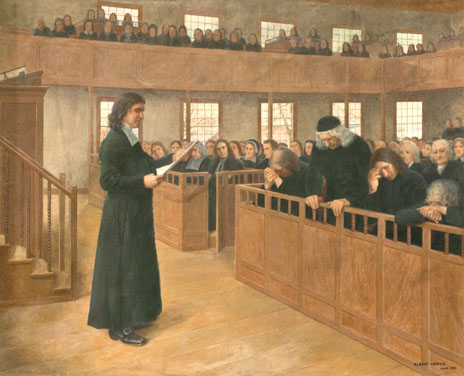 |
| Image hosted at malegislature.gov |
LaPlante's biography, it must be said, doesn't really delve into those larger meanings. It's a nice, readable write-up based on Sewall's own extensive diaries, rather like the better class of Wikipedia article done up to book length. It's at its strongest when it recreates the extraordinary physical and mental worlds of late-17th-century New England. It's at its weakest when LaPlante resorts to wholesale quotations from other authors (a venial sin that's hardly unique to her). I was especially intrigued by the period hymns sprinkled through the pages, but unfortunately I don't read enough music to really get the feel of the pieces.
LaPlante also argues that Sewall's repentance moved him towards a kind of pre-Enlightenment position vis-a-vis women, slaves, and Indians. Based on the writings of his that she includes, that's a little generous. However, Sewall--though his understanding of the world is stunningly alien--seems to have been a pretty decent fellow, overall, so I'll give him and LaPlante the benefit of the doubt.
Friday, April 27, 2018
Book Review: The Great Quake
The Great Quake: How the Biggest Earthquake in North America Changed Our Understanding of the Planet
Henry Fountain
Geology, biography
The 1906 San Francisco quake gets all the press, but the 1964 Alaska quake was bigger. How much bigger? Oh, about 90x as powerful, in terms of total energy released. The human cost was limited only by the limited population in the area. As it was, the entire city of Valdez was flattened, abandoned, and rebuilt from the ground up--four miles inland, on bedrock.
Not only that, the Alaska quake came at a crucial point in the development of geoscience. The theory of (what's now called) plate tectonics had been floating around since the 1920s; in the 1960s it was beginning to gain currency. Evidence from the Alaska earthquake provided crucial support.
Those are the two threads that Henry Fountain builds The Great Quake around. It's a nice piece of work. Fountain very sensibly chooses one primary viewpoint character for each thread--geologist George Plafker and schoolteacher Kris Madsen--with other characters weaving their ways into and out of the story. The result is one part human tragedy, one part scientific detective story.
Both parts are good, too (which doesn't always happen with this sort of book). The picture of the sheer unstoppable devastation caused by the quake is particularly vivid. Streets ripple and crack. Slabs of concrete shear off the sides of buildings. A ship, 441.5 feet long, rocks in the waves so that its brass propellor appears above the houses. Tsunamis reach, in some cases, hundreds of feet above the water line. On the scientific side, too, Fountain has chosen a very appealing main character to follow: a working-class Brooklyn kid, who fell in love with geology almost by accident (and who's still alive, at the time of this typing).
The Great Quake is a good science book for non-scientists. It's also a good sociology book for non-sociologists, and a good piece of human-interest reportage to boot. It's well worth your time.
The inevitable John McPhee has to be mentioned here, once again, both for his books about geology (collectively known as Annals of the Former World) and for his book about Alaska, Coming Into the Country. Simon Winchester's A Crack in the Edge of the World is a good account of the San Francisco also-ran.
Henry Fountain
Geology, biography
The 1906 San Francisco quake gets all the press, but the 1964 Alaska quake was bigger. How much bigger? Oh, about 90x as powerful, in terms of total energy released. The human cost was limited only by the limited population in the area. As it was, the entire city of Valdez was flattened, abandoned, and rebuilt from the ground up--four miles inland, on bedrock.
Not only that, the Alaska quake came at a crucial point in the development of geoscience. The theory of (what's now called) plate tectonics had been floating around since the 1920s; in the 1960s it was beginning to gain currency. Evidence from the Alaska earthquake provided crucial support.
Those are the two threads that Henry Fountain builds The Great Quake around. It's a nice piece of work. Fountain very sensibly chooses one primary viewpoint character for each thread--geologist George Plafker and schoolteacher Kris Madsen--with other characters weaving their ways into and out of the story. The result is one part human tragedy, one part scientific detective story.
Both parts are good, too (which doesn't always happen with this sort of book). The picture of the sheer unstoppable devastation caused by the quake is particularly vivid. Streets ripple and crack. Slabs of concrete shear off the sides of buildings. A ship, 441.5 feet long, rocks in the waves so that its brass propellor appears above the houses. Tsunamis reach, in some cases, hundreds of feet above the water line. On the scientific side, too, Fountain has chosen a very appealing main character to follow: a working-class Brooklyn kid, who fell in love with geology almost by accident (and who's still alive, at the time of this typing).
The Great Quake is a good science book for non-scientists. It's also a good sociology book for non-sociologists, and a good piece of human-interest reportage to boot. It's well worth your time.
The inevitable John McPhee has to be mentioned here, once again, both for his books about geology (collectively known as Annals of the Former World) and for his book about Alaska, Coming Into the Country. Simon Winchester's A Crack in the Edge of the World is a good account of the San Francisco also-ran.
Friday, April 13, 2018
Book Review: Silk Parachute
Silk Parachute
John McPhee
Essays
John McPhee may well be America's greatest living non-fiction writer. This isn't his greatest work, but it's pretty good. These are mostly short pieces, mostly autobiographical, several dealing with sports. The best of them is "Season on the Chalk," which glides seamlessly, McPhee-fashion, across the geology of southeastern England, its extensions and permutations, French winemaking, the extinction of the dinosaurs, and other such fascinating whatnot. It's like a non-fiction version of Garrison Keillor's "News from Lake Wobegon". If you've never read McPhee, this isn't the best place to start, but it's not the worst either.
John McPhee
Essays
John McPhee may well be America's greatest living non-fiction writer. This isn't his greatest work, but it's pretty good. These are mostly short pieces, mostly autobiographical, several dealing with sports. The best of them is "Season on the Chalk," which glides seamlessly, McPhee-fashion, across the geology of southeastern England, its extensions and permutations, French winemaking, the extinction of the dinosaurs, and other such fascinating whatnot. It's like a non-fiction version of Garrison Keillor's "News from Lake Wobegon". If you've never read McPhee, this isn't the best place to start, but it's not the worst either.
Monday, March 5, 2018
Book Review: The Bohemians
The Bohemians: Mark Twain and the San Francisco Writers Who Reinvented American Literature
Ben Tarnoff
Literature, biography
The Bohemians isn't a bad book, but it's not original or insightful enough to be a great book. It's another IYTTSMSIYPETB. The big problem is that it wouldn't exist without Mark Twain, and Mark Twain does not lack for previous literary coverage. Without Twain, the three remaining Bohemians would consist of Bret Harte--briefly famous, now obscure--and a couple of (from a literary viewpoint) nonentities. It was Mark Twain who reinvented American literature; the others were "and supporting cast".
Okay, maybe that's a little harsh towards Harte. At the outset he was far better-known than Twain. He was the first to crack the eastern literary establishment, and he was a friend and mentor to Twain when the latter first fetched up in San Francisco. He didn't launch Twain's career by himself, but he played a part. So, too, did the city of 1860s San Francisco itself--its roaring debauches, its raw frontier cosmopolitanism, its outrageous Western characters, its sprung-from-nowhere ambiance, its boosterism. The city is a character in The Bohemians, one that Tarnoff limns particularly well.
If Tarnoff had stuck to the relationship among Harte, Twain, and San Francisco, this would be a more focused and more interesting read. No doubt his other two protagonists--Ina Coolbrith and Charles Stoddard--have a moral right something more than obscurity, but obscurity is what they have, and The Bohemians gives us no reason to think it should be otherwise.
Justin Martin's Rebel Souls is about the first American Bohemians--the New York set centered around Walt Whitman. There, too, there's the problem that one member of the cast completely obscures the others. I thought it was more enlightening than Tarnoff's book, though, in part because the New York Bohemians made a somewhat lasting impact as a group.
Ben Tarnoff
Literature, biography
The Bohemians isn't a bad book, but it's not original or insightful enough to be a great book. It's another IYTTSMSIYPETB. The big problem is that it wouldn't exist without Mark Twain, and Mark Twain does not lack for previous literary coverage. Without Twain, the three remaining Bohemians would consist of Bret Harte--briefly famous, now obscure--and a couple of (from a literary viewpoint) nonentities. It was Mark Twain who reinvented American literature; the others were "and supporting cast".
Okay, maybe that's a little harsh towards Harte. At the outset he was far better-known than Twain. He was the first to crack the eastern literary establishment, and he was a friend and mentor to Twain when the latter first fetched up in San Francisco. He didn't launch Twain's career by himself, but he played a part. So, too, did the city of 1860s San Francisco itself--its roaring debauches, its raw frontier cosmopolitanism, its outrageous Western characters, its sprung-from-nowhere ambiance, its boosterism. The city is a character in The Bohemians, one that Tarnoff limns particularly well.
If Tarnoff had stuck to the relationship among Harte, Twain, and San Francisco, this would be a more focused and more interesting read. No doubt his other two protagonists--Ina Coolbrith and Charles Stoddard--have a moral right something more than obscurity, but obscurity is what they have, and The Bohemians gives us no reason to think it should be otherwise.
Justin Martin's Rebel Souls is about the first American Bohemians--the New York set centered around Walt Whitman. There, too, there's the problem that one member of the cast completely obscures the others. I thought it was more enlightening than Tarnoff's book, though, in part because the New York Bohemians made a somewhat lasting impact as a group.
Saturday, March 3, 2018
Book Review: The Wizard and the Prophet
The Wizard and the Prophet: Two Remarkable Scientists and Their Dueling Visions to Shape Tomorrow's World
Charles C. Mann
Science, biography, ecology, philosophy, politics
[DISCLAIMER: Charles C. Mann graduated from my alma mater and lives in my home town. I don't think we've ever met, but it would be surprising if we didn't have connections in common.]
It's quite likely that The Wizard and the Prophet will be my favorite book of 2018.
Here's the core of the matter: in thirty years, the world will have ten billion people. Should we:
Most importantly, Mann is scrupulously fair towards both Wizards and Prophets. He presents each sides's arguments fairly and in their best lights, and then presents the other side's critique with equal insight. That lifts the book up from "enjoyable" to "important". These are big ideas, and they are consequential. How we think about them will have a profound effect on life on earth--within our lifetimes.
It subtracts nothing from Mann's wonderful book to point out that the dichotomy he points out is an artificial one. "The fox knows many things, but the hedgehog knows one big thing": Prophets and Wizards are hedgehogs, but the answer probably lies with the foxes. It's true that we should waste less, decentralize our electrical grid, be skeptical of claims that innovation will inevitably save us. It's also true that innovation has produced miracles, that more people are living better now than ever before, that the doomsayers have hitherto been wrong. We should recognize both truths.
Related books worth reading are Gretchen Bakke's The Grid, Rose George's The Big Necessity, and Edward Glaeser's The Triumph of the City. Mann's own 1491 and 1493, though unrelated, are also good.
Charles C. Mann
Science, biography, ecology, philosophy, politics
[DISCLAIMER: Charles C. Mann graduated from my alma mater and lives in my home town. I don't think we've ever met, but it would be surprising if we didn't have connections in common.]
It's quite likely that The Wizard and the Prophet will be my favorite book of 2018.
Here's the core of the matter: in thirty years, the world will have ten billion people. Should we:
- Make wise use of our existing resources, conserving and cutting back as necessary, in order to minimize the damage we cause to ourselves and our planet? That's the "Prophet" response, exemplified in Mann's book by the early ecologist William Vogt.
- Innovate, adapt, embracing creativity and dynamic capitalism, in order to expand the carrying capacity of the world and lift more people out of poverty? That's the "Wizard" response, as espoused by Norman Borlaug--a man who won a Nobel Peace Prize as the father of the so-called "Green Revolution".
Most importantly, Mann is scrupulously fair towards both Wizards and Prophets. He presents each sides's arguments fairly and in their best lights, and then presents the other side's critique with equal insight. That lifts the book up from "enjoyable" to "important". These are big ideas, and they are consequential. How we think about them will have a profound effect on life on earth--within our lifetimes.
It subtracts nothing from Mann's wonderful book to point out that the dichotomy he points out is an artificial one. "The fox knows many things, but the hedgehog knows one big thing": Prophets and Wizards are hedgehogs, but the answer probably lies with the foxes. It's true that we should waste less, decentralize our electrical grid, be skeptical of claims that innovation will inevitably save us. It's also true that innovation has produced miracles, that more people are living better now than ever before, that the doomsayers have hitherto been wrong. We should recognize both truths.
Related books worth reading are Gretchen Bakke's The Grid, Rose George's The Big Necessity, and Edward Glaeser's The Triumph of the City. Mann's own 1491 and 1493, though unrelated, are also good.
Tuesday, January 2, 2018
Book Review: Code Girls
Code Girls: The Untold Story of the American Women Codebreakers Who Helped Win World War II
Liza Mundy
History, biography
You might think that Code Girls would be, basically, Hidden Figures with white women and cryptography. And you would be, basically, correct. If that sounds like the kind of book you'd like, you'll like Code Girls.
Of the two books, Code Girls is better-written. It by no means avoids Hidden Figures's gee-whiz-weren't-these-women-swell approach, but it dials it back considerably. Mundy touches on the lives of many women, but she wisely anchors Code Girls around just one (Dot Braden)--although it's still often hard to remember who was who. She's at her best with vivid biographical details and lively character portraits.
Less happily, Mundy does a poor job of describing what code-breaking actually entailed. She desperately needed at least a few simple examples of the techniques she's describing (there are no examples at all). I could follow along because I'm fairly well versed in basic cryptography and cryptographic history; if you're not, you may find some paragraphs frustratingly vague. In terms of technical detail, Mundy stops at the level of saying "It's amazing what you can do with math," or words to that effect.
It matters. Without these details, Code Girls is reduced to a series of People Magazine-style profiles. Mundy wants to establish, not just that women worked in cryptography, but that their contributions were more than drudge work--that, in fact, they made real intellectual leaps. Without describing the codes, she's reduced to hauling out a few vague anecdotes and telling us they were, like, really important. As with Hidden Figures, I'm ready to admire these women--but I'd like to admire them for what they achieved. Mundy's book is a good quick read, but no more than that.
Two good books about cryptography are David Kahn's classic The Codebreakers and Simon Singh's The Code Book. For an unforgettable portrait of cryptographers at work--and the consequences--see Walter Lord's Incredible Victory.
Liza Mundy
History, biography
You might think that Code Girls would be, basically, Hidden Figures with white women and cryptography. And you would be, basically, correct. If that sounds like the kind of book you'd like, you'll like Code Girls.
Of the two books, Code Girls is better-written. It by no means avoids Hidden Figures's gee-whiz-weren't-these-women-swell approach, but it dials it back considerably. Mundy touches on the lives of many women, but she wisely anchors Code Girls around just one (Dot Braden)--although it's still often hard to remember who was who. She's at her best with vivid biographical details and lively character portraits.
Less happily, Mundy does a poor job of describing what code-breaking actually entailed. She desperately needed at least a few simple examples of the techniques she's describing (there are no examples at all). I could follow along because I'm fairly well versed in basic cryptography and cryptographic history; if you're not, you may find some paragraphs frustratingly vague. In terms of technical detail, Mundy stops at the level of saying "It's amazing what you can do with math," or words to that effect.
It matters. Without these details, Code Girls is reduced to a series of People Magazine-style profiles. Mundy wants to establish, not just that women worked in cryptography, but that their contributions were more than drudge work--that, in fact, they made real intellectual leaps. Without describing the codes, she's reduced to hauling out a few vague anecdotes and telling us they were, like, really important. As with Hidden Figures, I'm ready to admire these women--but I'd like to admire them for what they achieved. Mundy's book is a good quick read, but no more than that.
Two good books about cryptography are David Kahn's classic The Codebreakers and Simon Singh's The Code Book. For an unforgettable portrait of cryptographers at work--and the consequences--see Walter Lord's Incredible Victory.
Sunday, November 26, 2017
Book Review: Grant
Grant
Ron Chernow
Biography
Ulysses Grant owned one slave in his lifetime: William Jones, a gift from Grant's obnoxious father-in-law. This was in 1858, and Grant was down and out. He'd resigned from the army under a cloud. He'd failed in business, was failing at running the farm he'd named "Hardscrabble," eking out a living by selling firewood on street corners, reluctantly taking handouts from his wealthier relatives. The gift of a slave was a substantial windfall. Grant could have sold Jones for a good $1,500 (and in 1858 money, $15 a month was a living wage).
So Grant freed William Jones.
I've plucked that anecdote from Grant's rich soil not just because it's admirable--although it is--but because it seems to me that it illustrates one of U.S. Grant's fundamental character traits: he lacked duplicity. One can only guess at his reasoning, but plausibly it went something like this:
Chief among these virtues is the astoundingly complete and consistent portrait of Grant as an individual. Ron Chernow deftly picks out the major-key themes that defined Ulysses Grant--his modesty, his quiet humor, his odd combination of clear thinking and naïveté, his battle with alcoholism--and threads them through the narrative. Sometimes it gets repetitive; about the eight time that we're given a dissection of when and why Grant fell off the wagon, for example, we could reasonably take the explanation as a given. But as a character study, it's absolutely convincing.
A character study is what it is, too--not an examination of historical trends or an academic exercise in thesis-proving. Rather, Grant is most certainly an example of the great-man school of history. Some people may well deplore it on those grounds. It's not an unfair point--noble white males have been decidedly oversold in the past--but, as a matter of plain observable fact, sometimes the person on the ground really does make a difference. Grant certainly did; you need only to contrast his behavior with that of other Union generals to see as much.
The occupational hazard that comes with the great-man school of history is a tendency to be a little too kind to your subject. Chernow doesn't fully resist; I think he makes Grant out to be a bit more steely-eyed in the defense of southern freedpeople than he really was, for example. On the other hand, the former "definitive" biography (by William McFeely) was quite certainly far too harsh. Much as with Chernow's other works--you may possibly have heard of this one?--the portrait that emerges is that of a flawed, great, and ultimately sympathetic man.
I don't usually recommend anything but books in this space, but all the hype about Ken Burns's documentary The Civil War is 100% true. For written Civil War history, try James McPherson's Battle Cry of Freedom or Bruce Catton's Centennial History of the Civil War.
Ron Chernow
Biography
Ulysses Grant owned one slave in his lifetime: William Jones, a gift from Grant's obnoxious father-in-law. This was in 1858, and Grant was down and out. He'd resigned from the army under a cloud. He'd failed in business, was failing at running the farm he'd named "Hardscrabble," eking out a living by selling firewood on street corners, reluctantly taking handouts from his wealthier relatives. The gift of a slave was a substantial windfall. Grant could have sold Jones for a good $1,500 (and in 1858 money, $15 a month was a living wage).
So Grant freed William Jones.
I've plucked that anecdote from Grant's rich soil not just because it's admirable--although it is--but because it seems to me that it illustrates one of U.S. Grant's fundamental character traits: he lacked duplicity. One can only guess at his reasoning, but plausibly it went something like this:
- I own a slave.
- I don't like slavery [Ron Chernow documents this thoroughly].
- Therefore I should free my slave.
That same clear-eyed assessment of the facts served Grant well as a general. While others were havering about what the enemy might do, or quoting learned authorities about Napoleon, Grant simply observed that he had an army and a duty to use it. He was not a stupid man or an unsubtle tactician, in spite of what later (mostly Southern) writers said, but he didn't delude himself either. War means fighting.
Before and after the Civil War, though, this trait served Grant badly. He consistently lost money by trusting dishonest men. The corruption of his presidency never touched him personally, but he had immense difficulty in understanding that his associates were conniving, scheming, self-seeking manipulators. Over and over, in Ron Chernow's telling, Grant assumed that other men were like him: straightforward, candid, and consistent. It ruined him, eventually, and it did his posthumous reputation no good either.
You'll gather that I liked this book. It's 959 pages long, and I finished it in a couple of days. Like its hero, it has its flaws; but, again like its hero, its flaws are in many ways merely the defects of its virtues.
A character study is what it is, too--not an examination of historical trends or an academic exercise in thesis-proving. Rather, Grant is most certainly an example of the great-man school of history. Some people may well deplore it on those grounds. It's not an unfair point--noble white males have been decidedly oversold in the past--but, as a matter of plain observable fact, sometimes the person on the ground really does make a difference. Grant certainly did; you need only to contrast his behavior with that of other Union generals to see as much.
The occupational hazard that comes with the great-man school of history is a tendency to be a little too kind to your subject. Chernow doesn't fully resist; I think he makes Grant out to be a bit more steely-eyed in the defense of southern freedpeople than he really was, for example. On the other hand, the former "definitive" biography (by William McFeely) was quite certainly far too harsh. Much as with Chernow's other works--you may possibly have heard of this one?--the portrait that emerges is that of a flawed, great, and ultimately sympathetic man.
I don't usually recommend anything but books in this space, but all the hype about Ken Burns's documentary The Civil War is 100% true. For written Civil War history, try James McPherson's Battle Cry of Freedom or Bruce Catton's Centennial History of the Civil War.
Monday, November 20, 2017
Book Review: Churchill and Orwell
Churchill and Orwell: The Fight for Freedom
Thomas E. Ricks
Biography
Churchill and Orwell is an audacious attempt at an interleaved dual intellectual biography, showing the parallels and cross-connections not just of its two subjects' lives, but of their thoughts. It doesn't entirely succeed, but it's a worthwhile attempt.
Churchill and Orwell never met, though they had acquaintances in common. (Given the chummy closeness of the British politico-literate classes, it would have been surprising if they didn't.) Ricks, therefore, tries to highlight two things: the ways in which their personal story arcs reflected each other, and the ways in which their thinking--specifically, both men's hatred of cant and unyielding defense of freedom--ran in parallel. When he sticks to this program, he's doing something really interesting.
He just doesn't stick to it strenuously enough. Both threads of Churchill and Orwell spend a bit too much time in basic biographical detail, the kind you could get anywhere. It's all interesting, but it's not all deep. Ricks quite rightly magnifies the episodes that he considers most formative--particularly Orwell's experience in the Spanish Civil War and (inevitably) Churchill's triumphal return from political exile from the late 1930s to 1941. But he doesn't entirely solve the problem of making that stuff his exclusive, concentrated focus.
Still, I'd rather read an ambitious book that doesn't quite pull it off than an unambitious success. At its worst, Churchill and Orwell is entirely readable. At its best, it's thought-provoking. If you any interest in the 20th century's intellectual response to the problem of totalitarianism, this is a good book for you. Sadly, the matter is still relevant.
Thomas E. Ricks
Biography
Churchill and Orwell is an audacious attempt at an interleaved dual intellectual biography, showing the parallels and cross-connections not just of its two subjects' lives, but of their thoughts. It doesn't entirely succeed, but it's a worthwhile attempt.
Churchill and Orwell never met, though they had acquaintances in common. (Given the chummy closeness of the British politico-literate classes, it would have been surprising if they didn't.) Ricks, therefore, tries to highlight two things: the ways in which their personal story arcs reflected each other, and the ways in which their thinking--specifically, both men's hatred of cant and unyielding defense of freedom--ran in parallel. When he sticks to this program, he's doing something really interesting.
He just doesn't stick to it strenuously enough. Both threads of Churchill and Orwell spend a bit too much time in basic biographical detail, the kind you could get anywhere. It's all interesting, but it's not all deep. Ricks quite rightly magnifies the episodes that he considers most formative--particularly Orwell's experience in the Spanish Civil War and (inevitably) Churchill's triumphal return from political exile from the late 1930s to 1941. But he doesn't entirely solve the problem of making that stuff his exclusive, concentrated focus.
Still, I'd rather read an ambitious book that doesn't quite pull it off than an unambitious success. At its worst, Churchill and Orwell is entirely readable. At its best, it's thought-provoking. If you any interest in the 20th century's intellectual response to the problem of totalitarianism, this is a good book for you. Sadly, the matter is still relevant.
Monday, September 25, 2017
Book Review: A Mind at Play
A Mind a Play: How Claude Shannon Invented the Information Age
Jimmy Soni, Rob Goodman
Biography, computers
Claude Shannon was the Isaac Newton of information theory--and that's not an exaggeration; he reified and measured the concept of "information" much as Newton made sense of force and acceleration. Unlike Newton, he seems to have been a genuinely playful and sweet-natured man. After revolutionizing communication, he rode unicycles, taught himself to juggle, and built whimsical machines--like the box with the switch on top; when the switch was turned on, a mechanical arm emerged, turned off the switch, and retracted.
A Mind at Play is not a super-dense book, either as biology or as mathematics. Its core is a very nice summary, very light on mathematics, of just what it was that Shannon did. I think the authors missed a couple of tricks for the more knowledgeable reader--the deep connections between information entropy and physical entropy go unacknowledged--but the book is well-written and provides a good, sympathetic character portrait.
Among the good books that overlap with A Mind at Play are:
Jimmy Soni, Rob Goodman
Biography, computers
Claude Shannon was the Isaac Newton of information theory--and that's not an exaggeration; he reified and measured the concept of "information" much as Newton made sense of force and acceleration. Unlike Newton, he seems to have been a genuinely playful and sweet-natured man. After revolutionizing communication, he rode unicycles, taught himself to juggle, and built whimsical machines--like the box with the switch on top; when the switch was turned on, a mechanical arm emerged, turned off the switch, and retracted.
A Mind at Play is not a super-dense book, either as biology or as mathematics. Its core is a very nice summary, very light on mathematics, of just what it was that Shannon did. I think the authors missed a couple of tricks for the more knowledgeable reader--the deep connections between information entropy and physical entropy go unacknowledged--but the book is well-written and provides a good, sympathetic character portrait.
Among the good books that overlap with A Mind at Play are:
- The Innovators, Walter Isaacson
- The Idea Factory, Jon Gertner
- The Information, James Gleick (much more technically rich)
Friday, July 28, 2017
Book Review: Victoria
Victoria: A Life
A. N. Wilson
Biography
[That's Queen Victoria, in case you were wondering. Not, say, Victoria's Secret. Crossovers are left to the imagination of the reader.]
The reviewers loved this book. I liked it quite a bit. I didn't quite love it.
The good parts are easy to identify. Victoria is very well written: easy to read, sometimes witty, quick-moving, and thorough. It has a large cast of characters and generally manages to keep them straight, which is really hard and thoroughly admirable. It's sometimes insightful and always entertaining.
Thematically, one of Victoria's strengths is how thoroughly it brings out the connection between Victoria and the royal breeding population of Europe--and, especially, Germany. She herself was three-quarters German, her husband was German, her daughter married the son of King-subsequently-Kaiser Wilhelm I, she had native-level fluency in the language, German was often spoken around her household . . . honestly, a mid-19th-century observer who heard that the 20th century would feature two major European wars could have been pardoned for predicting that they'd involve England and Germany as allies. This is not new--readers of Robert Massie, for example, will know the particulars--but it's well presented.
A second major thematic strand involves what we might term the domestication of the crown--Britain's transformation, over the course of the 19th century, into a modern democratic/constitutional monarchy. Wilson's analysis here is mildly toasted with academic Marxism, in the sense that he sees everything through the lens of class:
Conversely, Wilson doesn't give Victoria quite enough credit for something that really was attributable to her personally: she made the monarchy Respectable (capital R intended). Nowadays people tend to think of royalty as a thoroughly bourgeois institution, and act shocked when Prince X or Princess Y does something even mildly scandalous. Royalty, it is now thought, should confine itself to its traditional duties of smiling, waving, supporting worthy causes, wearing funny hats, opening shopping centers, etc. Anyone who knows anything about European history should recognize how absolutely wildly novel this idea is! Victoria's predecessor, William IV, cohabited with an actress for twenty years and ten illegitimate children, and that wasn't even especially scandalous. Wilson touches on this facet of QV's reign, but he leaves it only half-explored.
Wilson also has some authorial, um, idiosyncracies. He has a tendency, particularly in the earlier chapters, to wander away from his topic into some side issue, and thence into another side issue, before (sometimes) zooming abruptly back to his main point. There I was, for instance, reading peacefully about Lord Palmerston; then, suddenly, I found myself deep in the background of the painter Franz Xavier Winterhalter.
Finally, Wilson is writing for insiders. He refers to issues, interpretations, characters in abbreviated form, assuming that his readers already know what he's talking about. On the micro level, he doesn't think it worth his while to translate quotes from French into English, and he loves his offhand literary-historical references. On the macro level, he has a tendency to explain how he's affirming or reviewing some conventional historical view, which is only interesting if you actually knew already what that view was.
So I had a few reservations. At the same time, I want to emphasize that this was a spiffing effort, well done that man, top hole, and all in all a jolly good read. That makes up for any number of sins.
A. N. Wilson
Biography
[That's Queen Victoria, in case you were wondering. Not, say, Victoria's Secret. Crossovers are left to the imagination of the reader.]
The reviewers loved this book. I liked it quite a bit. I didn't quite love it.
The good parts are easy to identify. Victoria is very well written: easy to read, sometimes witty, quick-moving, and thorough. It has a large cast of characters and generally manages to keep them straight, which is really hard and thoroughly admirable. It's sometimes insightful and always entertaining.
Thematically, one of Victoria's strengths is how thoroughly it brings out the connection between Victoria and the royal breeding population of Europe--and, especially, Germany. She herself was three-quarters German, her husband was German, her daughter married the son of King-subsequently-Kaiser Wilhelm I, she had native-level fluency in the language, German was often spoken around her household . . . honestly, a mid-19th-century observer who heard that the 20th century would feature two major European wars could have been pardoned for predicting that they'd involve England and Germany as allies. This is not new--readers of Robert Massie, for example, will know the particulars--but it's well presented.
A second major thematic strand involves what we might term the domestication of the crown--Britain's transformation, over the course of the 19th century, into a modern democratic/constitutional monarchy. Wilson's analysis here is mildly toasted with academic Marxism, in the sense that he sees everything through the lens of class:
. . . Melbourne and all the Whigs would have fought to the death to defend themselves against radicals, plebeians, trades unions--anything which diminished their power in any way. Their only reason for siding with the liberals was self-preservation.Fair enough; but I don't think that Wilson's case is as strong here. He wants to argue that Victoria was indispensable to the process. By his own precepts, the changes in power and in wealth that occurred between 1837 and 1901 made change inevitable. Victoria's role, while certainly not passive, doesn't seem to me to have been crucial in shaping it.
Conversely, Wilson doesn't give Victoria quite enough credit for something that really was attributable to her personally: she made the monarchy Respectable (capital R intended). Nowadays people tend to think of royalty as a thoroughly bourgeois institution, and act shocked when Prince X or Princess Y does something even mildly scandalous. Royalty, it is now thought, should confine itself to its traditional duties of smiling, waving, supporting worthy causes, wearing funny hats, opening shopping centers, etc. Anyone who knows anything about European history should recognize how absolutely wildly novel this idea is! Victoria's predecessor, William IV, cohabited with an actress for twenty years and ten illegitimate children, and that wasn't even especially scandalous. Wilson touches on this facet of QV's reign, but he leaves it only half-explored.
Wilson also has some authorial, um, idiosyncracies. He has a tendency, particularly in the earlier chapters, to wander away from his topic into some side issue, and thence into another side issue, before (sometimes) zooming abruptly back to his main point. There I was, for instance, reading peacefully about Lord Palmerston; then, suddenly, I found myself deep in the background of the painter Franz Xavier Winterhalter.
Finally, Wilson is writing for insiders. He refers to issues, interpretations, characters in abbreviated form, assuming that his readers already know what he's talking about. On the micro level, he doesn't think it worth his while to translate quotes from French into English, and he loves his offhand literary-historical references. On the macro level, he has a tendency to explain how he's affirming or reviewing some conventional historical view, which is only interesting if you actually knew already what that view was.
So I had a few reservations. At the same time, I want to emphasize that this was a spiffing effort, well done that man, top hole, and all in all a jolly good read. That makes up for any number of sins.
Subscribe to:
Posts (Atom)