Thursday, April 19, 2018
Postscript
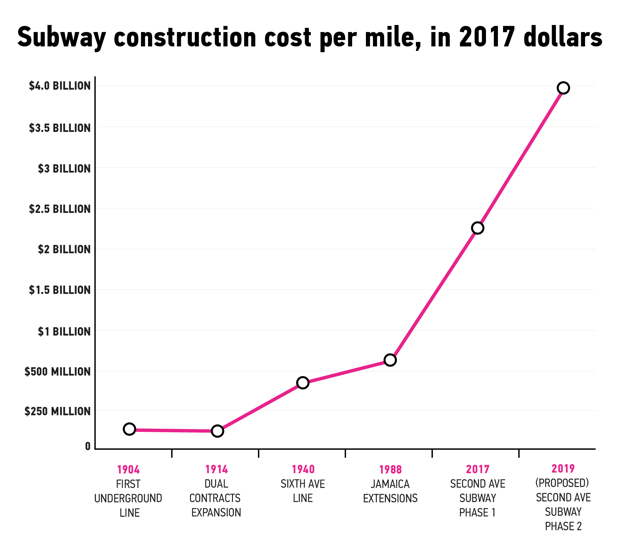
As an addendum to my recent cri de coeur, I offer this chart:
Note that this chart is inflation-adjusted. I took it from this article, which is well worth reading.

Friday, April 13, 2018
Book Review: Silk Parachute
Silk Parachute
John McPhee
Essays
John McPhee may well be America's greatest living non-fiction writer. This isn't his greatest work, but it's pretty good. These are mostly short pieces, mostly autobiographical, several dealing with sports. The best of them is "Season on the Chalk," which glides seamlessly, McPhee-fashion, across the geology of southeastern England, its extensions and permutations, French winemaking, the extinction of the dinosaurs, and other such fascinating whatnot. It's like a non-fiction version of Garrison Keillor's "News from Lake Wobegon". If you've never read McPhee, this isn't the best place to start, but it's not the worst either.
Monday, April 9, 2018
Book Review: Tiny Stations
Tiny Stations: An Uncommon Odyssey Through Britain's Railway Request Stops
Dixe Wills
Trains, travel
It's even more like the usual than usual. To appreciate Tiny Stations, you'll need:
I should add, furthermore, that a relaxed attitude towards strict factual accuracy might be of assistance here. Wills swallows some blatantly urban-legend (or actually rural-legend, but it's the same thing really) anecdotes without a blink, and his personal commitment to truth in the face of a good story is open to question--he questions it himself.
If you're one of the dozen or so Americans whose response to the above is "Well, I've got to read that!", please drop me a line, if your ward attendants are willing. We'll have a lot in common.
Dixe Wills
Trains, travel
It's even more like the usual than usual. To appreciate Tiny Stations, you'll need:
- A high tolerance for a peculiarly English form of arch humor. Possibly Dixe Willis was savaged by Bill Bryson's Notes From a Small Island at an impressionable age, but he raises smiles where Bryson achieves guffaws.
- At least a passing familiarity with the British landscape. Tiny Stations is entirely undefiled by color photographs, and the few black-and-white images are small and a bit grainy. In a book that's more or less defined as "what I saw when I got off at Little-Snoodlington-in-the-Quagmire", good visuals are a must.
- A deep affection, not merely for trains--any fool could have that--not merely for train travel, but for the idea of train travel. Taking train trips can be jolly good fun. Reading about other people's train trips is not an endeavor that should be undertaken without plenty of time and a high tolerance for discursiveness.
I should add, furthermore, that a relaxed attitude towards strict factual accuracy might be of assistance here. Wills swallows some blatantly urban-legend (or actually rural-legend, but it's the same thing really) anecdotes without a blink, and his personal commitment to truth in the face of a good story is open to question--he questions it himself.
If you're one of the dozen or so Americans whose response to the above is "Well, I've got to read that!", please drop me a line, if your ward attendants are willing. We'll have a lot in common.
Sunday, April 1, 2018
Book Review: The Tale of the Dueling Neurosurgeons
The Tale of the Dueling Neurosurgeons: The History of the Human Brain as Revealed by True Stories of Trauma, Madness, and Recovery
Sam Kean
Biology, psychology
Sam Kean's books are much of a muchness. His gifts as a writer include a witty, colloquial style; good organization; and a tremendous gift for using entertaining anecdotes to illuminate and explain the larger story. That describes The Tale of the Dueling Neurosurgeons in a nutshell.
The book is cleverly structured. Instead of sticking to a strict chronological sequence, Kean makes each chapter deals with a specific part of the brain. At the same time, he manages to build up his information in a coherent, simpler-to-more-complex sequence--you won't see any of those vexatious "(as we shall explain further in Chapter 37)" interpolations that mar lesser works. The result is both entertaining and genuinely informative.
It doesn't hurt, of course, that there's a genuine if creepy fascination to Weird Brain Facts. To his credit, Kean mostly avoids the temptation to turn the book into a literary freak show; he treats the subjects of his stories with measured compassion. He also does well with character portraits of scientists, materially aided by a wealth of juicy material. Some of it, be it noted, is not for the faint of stomach.
Ultimately, though, it all comes down to Weird Brain Facts. They're weirder than you can possibly imagine. Not the least of The Tale of the Dueling Neurosurgeons's achievements is that it will make you seriously question what you imagine that you know about your "self."
The grand seigneur of this subject is Oliver Sacks, whose best-known work is The Man Who Mistook His Wife for a Hat (I'm also partial to Musicophilia).
Friday, March 30, 2018
Book Review: Void
Void: The Strange Physics of Nothing
James Owen Weatherall
Physics, philosophy
To some extent, Void is another book that falls between two stools. To someone completely new to the subject, it might seem formidably abstruse. To someone who has even an educated layman's grasp of physics and astronomy, there's a lot of repetition. There are no equations, no illustrations, no graphs--even where they might prove helpful.
I ended up enjoying the book anyway--mainly for the speculation, rather than the physics. We think of black holes as being things, to take one example--the remnants of dead stars--and yet, mathematically at least, you could have a universe that contains nothing but a single black hole and always has. Is such a universe "empty"? Is space-time itself a thing? Since the vacuum itself has energy, is it even sensible to talk about nothing?
So Void is mental calisthenics, coupled with an aggressively non-quantitative overview of such topics as special and general relativity, quantum electrodynamics, and string theory. It also contains some nice short character portraits of many important scientists, which is always a plus. I wouldn't recommend it to everyone, but if you're interested in physics and you like big unanswered questions you should give it a shot.
Weatherall, in his notes, says that he was in part inspired by James Holt's Why Does the World Exist?, which I liked very much.
Saturday, March 24, 2018
Book Review: Floodpath
Floodpath: The Deadliest Man-Made Disaster of 20th-Century America and the Making of Modern Los Angeles
Jon Wilkman
History, engineering
This is a perfectly decent book about the failure of the St. Francis Dam in 1928. The writing is decent. There's a lot of detailed research. The description of the flood is evocative. Wilkman does some modest analysis, reaches a few tentative conclusions, and ties the events of 1928 lightly into a larger context. There's nothing that falls short of the title, and nothing that goes beyond it. In short, if you think the subject matter sounds interesting ...
For a closely related book, see Water to the Angels, although Floodpath is more measured in its assessments. The grandfather of all dam-failure disaster books is, of course, David McCullough's The Johnstown Flood. For a book full of local interest, Elizabeth Sharpe's In the Shadow of the Dam describes the Mill River flood of 1874 in Northampton, MA.
Friday, March 23, 2018
Essay: What Trump Voters Got Right
I am not a Donald Trump enthusiast. I do, however, think it's useful to assess Trumpism in an analytical, detached fashion (blame this guy), as opposed to the hyper-partisan mode of . . . well . . . everyone else. Trumpism is not an inexplicable force of nature. Further, while there are bad people among Trump voters, they are not universally bad, nor does it follow that they are all wrong about everything.
I think Trump voters are reacting--at least some of them, some of the time--to a genuine problem. I don't think they've chosen a good solution, but that doesn't mean that the problem isn't there. Specifically:
I think Trump voters are reacting--at least some of them, some of the time--to a genuine problem. I don't think they've chosen a good solution, but that doesn't mean that the problem isn't there. Specifically:
- The system is in need of radical (in the sense of Latin radix, "root") reform.
- The system is designed to make radical reform impossible.
- The project been legally mandated since 1990.
- The MBTA already owns the right-of-way, which runs alongside the commuter rail tracks.
- It's supported by virtually everybody.
- It doesn't require any tunnels or complex engineering.
- It's even genuinely useful.
The line is 4.7 miles long. In the 9,944 days since December 31, 1990, the amount of track that has been laid along that 4.7 miles is zero feet, zero inches. If I could snap my fingers and have the line completed overnight, the average rate of construction would have been just about thirty inches per day.
Of course, the line won't be completed overnight. After the MBTA fired its original contractor, it took them 23 months just to name a replacement. Naturally, no work whatsoever happened in the interim.
Consider that from 1863 to 1869 this country built a railroad from Omaha to Sacramento using black powder, mules, and human muscles. Obviously things were a lot different there and then, and there was both enormous waste and grave injustice involved . . . but still. In six years, the Pacific Railroad laid 1,868 miles of track. In the six years since the so-called "ground-breaking" of the Green Line extension, we've paid a lot of money for virtually nothing.
Multiply that by all the things that the federal and state governments do, and you get the kind of institutional sclerosis that lets the nationalist populist authoritarians take over.
By the way, I think my prognostications here were pretty accurate. Just saying.
Subscribe to:
Posts (Atom)